Category Archives: fine arts

an introduction to Prague

Prague from Hrad?anská (2)I think few people really enjoy visits to beautiful old places, and they’re not helped by most guide books and tours, which just attach dates, artists’ names, and styles to the objects on view. Guides also tell anecdotes about events that happened to occur where one is standing. The result is history as one thing after another, which is fundamentally tedious. Much more compelling is some kind of explanation that presents works as intentional efforts to solve problems within their cultural contexts.

I am unqualified to explain Prague in those terms. I don’t speak the language, haven’t read most of the acknowledged classics of the literature, and have only spent a total of 14 days there. But this is a blog, so qualifications are waived. Here is my brief introduction to the city, based on four of its historical figures and their contexts.

1. Emperor Charles IV (1316-1378)

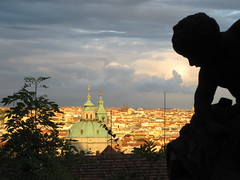
To imagine the Prague of 1350, think of the high middle ages: of ladies in tall conical hats, troubadours, sophisticated theologians. Also remember plague victims and open sewers; but it’s a mistake to think of those times as ignorant and backward (as in Steve Martin’s “Theodoric of York” skit). Progress was never linear or uniform; life was probably better in Central Europe in 1350 than in 1640, during the wars of religion. Certainly, the culture was highly sophisticated and developed. Looking out over the city, one can pick out the medieval parts (mixed with some modern imitations) by looking for angular spires, pointed arches, and steep triangular roofs. IMG_0193
Prague became the capital of the whole of central Europe whenever the local monarch was elected Holy Roman Emperor, which happened on several occasions over the centuries. (Its status as an occasional capital helps to explain its magnificence.) When Charles IV was elected, he became the highest figure in the vast hierarchical system called feudalism. Each piece of land was assigned simultaneously to serfs, a local lord, a major lord, often a king, and the emperor; and each of these had different rights and duties. The whole system was circumscribed by law; and the feudal law reflected general principles that could also be discerned in ecclesiastical law, municipal law, and even the rules of chivalry and courtly love. The same way of thinking was also evident in theology, which Charles IV studied at the great university of Paris as a youth. Medieval Europeans loved hierarchies and patterns generated by distinctions and rules; but within each cell of a pattern, they welcomed improvisation and elaboration. A clear illustration is a Gothic church, with its regular pointed arches and windows, each heavily and uniquely decorated. All of this took work: one intentionally brought diversity into order and then embellished the results.

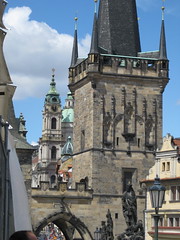
Charles IV personally made Prague a city of greater sophistication, elaboration, and order by founding the university that bears his name and commissioning major works of architecture. To explore his city, one could climb the medieval Jind?išská gate tower and look for other Gothic tours and spires, walk through Old Town Square with the Týn Church and famous clock, visit the university and bridge both named for Charles as their founder, and ascend to the Royal Castle, within which is St. Vitus Cathedral–substantially built under Charles’ patronage by a great Gothic master, Peter Parler.

The Cathedral is good place to think about the Czech people and what has defined them, in Charles’ day and thereafter. One answer emphasizes the Slavic side. Czechs were originally a group of Slavs not sharply differentiated from other Slavs. (It is the human condition to belong to groups not sharply distinct from others.) Today their language is defined by dictionaries and grammars and is different from Slovak or Polish. In the middle ages, Bohemia was already a province, along with the other Czech province of Moravia. It had a quasi-mythical founding figure, “good” king Wenceslas (Vaclav; pronounced “vatzlav”) who was expected to return, like Arthur, to serve his people. Thus Czechs were of the tribe of Vaclav. That was also Charles’ given name, before he ascended to the imperial throne, when he became Karel/Karl/Carolus. But the population he ruled included many who spoke German or Yiddish. That remained the case in Bohemia until 1948. Thus another answer is: Czechs were a multi-ethnic people in a melting pot. Charles himself spoke German and Czech along with Latin, French, and Italian (and all five languages have had deep impact in Prague).

2. Emperor Rudolf II (1552-1612)

Rudolf held the same offices as Charles, plus others. He was a Hapsburg, thus of German extraction, although he too spoke several languages. The political system he oversaw was still feudal; serfs on huge estates paid for the massive and numerous Renaissance and baroque palaces that crown Hrad?any hill. But this was the beginning of the age of absolutism. Although Rudolf was not an absolute monarch like Louis XIV somewhat later on, he had more power and a more effective bureaucracy than Charles IV had possessed at the high point of feudalism.

We are now in the Renaissance, whose definition is the recovery of Greco-Roman culture. At the peak of the Italian Renaissance, the result is simplicity, clarity, and still perfection. A Madonna by Raphael is an idealized woman in a peaceful and transparent three-dimensional space, often framed by classical architecture. But the recovery of ancient civilization also dredged up all kinds of odd and esoteric ideas and practices: magic, religious cults, speculative philosophies, and strange and deliberately distorted works of art. Renaissance Europeans were always interested in the eccentric side of the ancient world, but this interest rose in Rudolf’s time and especially in his own circle. He made his court the world’s center for occult and cabalistic studies, collected a huge museum of strange objects, and patronized the style of art we call Mannerism. This style deliberately eschewed clarity and perfection and made an issue out of the artist’s personal style (“maniera”)–the odder the better. Mannerist architects played with the classical rules, using traditional elements of Ionic or Corinthian orders but deliberately turning them backwards or upside-down.
IMG_0270Magic and the occult were not yet distinguished from science. Rudolf brought both Kepler and Brahe to Prague and made it the greatest scientific center of the age. We could see his era as a struggle (not perhaps fully conscious) between the transparent and the secretive, and between classical norms and personal eccentricities.

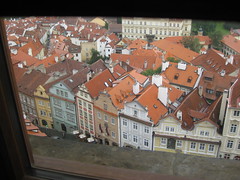
It would be hard to conduct a walking tour of Rudolf’s Prague, since he locked himself in his castle to avoid assassins; and not much other Renaissance architecture survives. Better to look out of the Castle windows at the subjects’ houses below. There is also some important Mannerist art in the Sternberg Palace.

Rudolf provides a good opportunity to think about religion. In Charles IV’s day, all of Europe north of the Alps was Catholic, with the exception of the Jewish ghettos, of which Prague’s was particularly important. But the Protestant Reformation came especially early and strongly to Bohemia, thanks to the influence of the pre-Protestant religious reformer Jan Huss. During Rudolf’s reign, as religious wars raged in France and the Low Countries, tensions simmered in Prague. Everyone had to take a side and could easily be burned at the stake for taking the wrong one–unless one were the Emperor. Rudolf seemed neutral or perhaps committed to his own strange and unorthodox beliefs. After he died, religious conflict dominated Central Europe and may have killed 20 percent of the whole population. The Thirty Years War ended with Bohemia under Austrian rule and mandatory Catholicism.

III. Wolfgang Amadeus Mozart (in Prague 1786-9)

Mozart was not a Czech; he was a German-speaking subject of the Austrian Empire. But he did some of his most important work in Prague and especially liked the city. He is a representative figure from an era in which Prague was a provincial Austrian capital and German was the only official language.

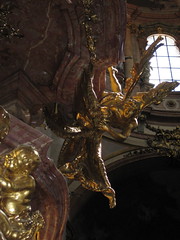
Mozart found a Baroque city. There had been an enormous investment in religious art and architecture as the authorities tried to institutionalize Catholicism after 1648. They naturally commissioned Baroque works, that being the style of the era. Baroque artists were learned in the classical orders, but they changed them to make them dynamic and dramatic. Every surface (pilaster, column, lintel, frieze, and cornice) might be bent and decorated. Buildings were situated for theatrical effect, emerging surprisingly from crowded streets or looming dramatically above. Paintings and statues were likewise situated within and around buildings for dramatic impact.
IMG_0185

Baroque is an art of ornament. The real structure of an object is concealed with embellishments. Windows are hidden to allow the light to play mysteriously on painted surfaces. In its final phase, rococo, the ornament becomes the art. Gilt frames break loose from paintings and flow all over walls in abstract, plantlike forms.

Rococo seemed to reflect the artifice and inauthenticity of a culture dominated by feudalism and Catholicism, when the most sophisticated people (such as Mozart) were republicans and free-thinkers. So rococo contended against at least two major alternatives: neoclassicism and romanticism. Mozart dramatically reduced the ornamentation typical in Baroque music; instead, he combined several musical themes in related keys to build ordered and transparent musical structures. Don Giovanni, the transcendent example of his classical style, was first performed at the Neoclassical Estates Theater in Prague.

This was a city, then of Baroque theatrical propaganda versus Enlightenment and Neoclassicism; of absolutist feudalism and revolutionary thinking; of artifice and critique.

IV. Franz Kafka (1883-1924)

Kafka was an unobservant Jew, a Czechoslovak citizen with a Czech name who spoke German, and a potential victim of the German State if he hadn’t died prematurely. He was alienated, skeptical, detached. These are hallmarks of modernism, of which Prague was a major center. It was the only place in the world where Cubist buildings were constructed (see Josef Go?ár’s Cubist House of the Black Madonna with Gothic spires in the distance); and it was the seedbed of literary theory. IMG_0278
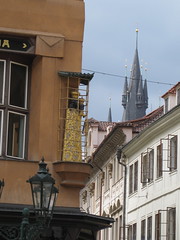
One could contrast Kafka to the highly talented and abidingly popular Czech artist Alfons Mucha (1860-1939). Mucha was a Czech nationalist and a Slavophile (although not at all antisemitic). He thought that the Czech people had an essential character that could be celebrated in art. The way to celebrate it was to illustrate dramatic episodes of Czech history in a realistic yet idealized style. His illustrations decorate, for example, the Municipal House, a shrine to Czech culture and language that was deliberately built at the head of Na Prikope street–am Graben to Kafka–which was the center of Prague’s German-speaking cafe and theatrical life. In contrast to Mucha, Kafka didn’t fit in, didn’t believe in the essential character of any nation, couldn’t complete any public project, and didn’t think that he could or should tell straightforward stories. I emphasize the negative, but of course he invented some of the greatest stories of our age.

A day devoted to Kafka might begin with the old Jewish synagogues, because he was interested in his heritage and the Prague-Jewish traditions of Cabala. It is then possible to see some of his old cafes, plus many important Cubist and other modernist buildings. There is even the world’s only Cubist lamppost on Wenceslas Square.

Reading the City


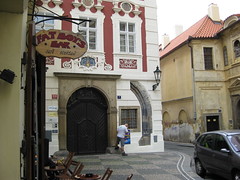
A final photo posted below shows a Gothic arch from the Middle Ages still embedded in a house that was given a Baroque facade in the eighteenth century, behind a modern commercial sign in the new international language of English, and a guy on a cell phone. This is Prague, endlessly fun to interpret if one begins to learn its codes.
IMG_0276

the ethics of liking a fictional character

(Waltham, Mass.) I have mentioned before that Middlemarch is my favorite book. Specifically, I am fond of Dorothea Brooke, its heroine. I like her; I want her to succeed and be happy. Allowing for the fact that she is a fictional character, I care about her.

Such feelings represent moral choices. Caring about someone is less important when that person happens to be fictional, but novels are at least good tests of judgment. Thus I am interested in whether I am right to care about the elder Miss Brooke. It seems to me that George Eliot was also especially fond of her heroine, and one could ask whether that was an ethical stance. Or, to put the question differently, was Eliot right to pull together a set of traits into one fictional person and describe that person in such a way as to make us like her?

The traits that seem especially problematic are Dorothea’s beauty, her high birth, and her youth. She is a young woman from the very highest social stratum in the hierarchical community of Middlemarch, surpassed by no one in rank. She is consistently described as beautiful, not only by other characters, but also by the narrator. In fact, these are the very first lines of Chapter One:

Miss Brooke had that kind of beauty which seems to be thrown into relief by poor dress. Her hand and wrist were so finely formed that she could wear sleeves not less bare of style than those in which the Blessed Virgin appeared to Italian painters; and her profile as well as her stature and bearing seemed to gain the more dignity from her plain garments, which by the side of provincial fashion gave her the impressiveness of a fine quotation from the Bible,–or from one of our elder poets,–in a paragraph of to-day’s newspaper. She was usually spoken of as being remarkably clever, but with the addition that her sister Celia had more common-sense.

This introduction contains no physical detail, in contrast to the portrayals of other characters in the same novel, such as Rosamond and Ladislaw. The simple fact of Dorothea’s beauty is not complicated by the mention of any particular form of beauty that a reader might happen not to like.

We have a tendency, I think, to want beautiful and high-born but lonely young ladies to live happily ever after. When we were young, we heard a lot of stories about princesses. We expect a princess to become happy by uniting with a young and attractive man; and whether that will happen to Dorothea is a suspenseful question in Middlemarch.

If we are prone to admire and like Dorothea because she is beautiful, Eliot complicates matters in three ways. First, she produces a second beautiful young woman in need of a husband, but this one is bad and thoroughly unlikable. (At least, it is very challenging to see things from Rosamond’s perspective, as perhaps we should try to do.) Second, in Mary Garth, Eliot creates a deeply appealing young female character who, we are told, is simply plain. Third, Eliot makes Dorothea not only beautiful, but also “clever” and good.

Evidently, beauty does not guarantee goodness, nor vice-versa; yet several people in Middlemarch think that Dorothea’s appearance and quality of voice manifest or reflect her inner character. This seems to be a kind of pathetic fallacy: people attribute virtues to her face, body, and voice as poets sometimes do to flowers or stars. But of course the characters who admire Dorothea’s appearance as a manifestation of her soul may be right, within the world that Eliot has created in Middlemarch. Or perhaps character and appearance really are linked. Rosamond, for instance, could not be the same kind of person if she were less pretty.

I presume that it is right to like someone for being good, but it is not right to like someone because she is beautiful. One could raise questions about this general principle. Is someone’s goodness really within his or her control? Perhaps we should pity (and care about) people like Rosamond who are not very virtuous. On the other hand, if we can admire beauty in nature and art, why not in human beings? And what about cleverness, which is not a moral quality but is certainly admired?

One interpretation of the novel is that Dorothea does not have a moral right to her inheritance or to her social status. These are arbitrary matters of good fortune, and she is wise to be critical of them. She does, however, according to the novel, deserve a happy marriage to a handsome man because she is both good and beautiful (and also passionate). The end of the novel feels happy to the extent that she gets the marriage she deserves. Does this make any sense as a moral doctrine? Is it an acceptable moral doctrine within a fictional world, but inapplicable to the real world?

Beautiful people tend to find other beautiful people, just as the rich tend to marry the rich and (nowadays) the clever marry the clever. Lucky people have assets in the market for partners. But is this something we should want to see? What if the plain but nice Mary Garth ended up with a broodingly handsome romantic outsider, and Dorothea married a nice young man from the neighborhood? Would that ending be wrong because beauty deserves beauty, or would it only be an aesthetic mistake (or a market failure)?

my favorite book

I first read Middlemarch when I was 17. It was assigned in the Telluride Association Summer Program at Cornell, and I think I loved it because it was the first time that I had read any book in a seminar, with real college professors and many hours spent on a single text. It was my first experience with close reading and with the application of challenging theory to literature. Gradually, as the years passed, I forgot most of the content of the novel–even the plot. I used to joke that it had retired undefeated as my favorite novel. But then, about a month ago, I opened it casually to remind myself of something near the beginning, and I found myself unable to put it down. I finished the very same copy that I had read almost a quarter century ago.

What is Middlemarch? It is a great feminist text, an indictment of the structure of relations between men and women that is not an indictment of the men as individuals. Patriarchy stunts the lives of male and female characters alike; and women often actively promote it. (Mrs. Garth, for example, is consciously raising her son Ben to be superior to her daughter Letty, and she is able to do that because she has such strong ideas and such control of her household that her husband could not object.) The “imperfect social state” of patriarchy prevents Dorothea from achieving public greatness and reduces her to “liv[ing] faithfully a hidden life.”

It is a superbly constructed story. Henry James denied that Middlemarch was “an organized, moulded, balanced composition, gratifying the reader with a sense of design and construction.” It was, he wrote, “a treasure-house of details, but … an indifferent whole.” That was nonsense, and I suspect he was jealous. Five or six plots are carried throughout, intertwining and building pressure on the characters until the denouement reveals Dorothea’s true heroism. Although the novel is not overburdened with coincidences or artifice, one could spend months finding careful symmetries and parallels. Take, for example, the brief visit of Dorothea to Rosamond’s house that opens Book V. This is the first time that two major story lines intersect. The women are foils, different in class, character, and appearance. Their first encounter, in the presence of a man who becomes an object of jealousy, causes all three to see themselves differently, in ways that reverberate until the end. This episode is just one example of how skillfully the whole work is constructed.

It is a grown-up’s novel. “Marriage,” says the narrator, “has been the bourne of so many narratives.” A bourne is a brook, and many romantic stories are streams flowing toward the inevitable wedding, when the ingenues, having overcome obstacles to their love, are united in a timeless happily-ever-after. In Middlemarch, however, two of the three essential weddings come near the beginning, and then the plot really begins. The novel is not cynical about marriage, nor critical of it. But it refuses to dwell only on the moment of falling in love or becoming united. Lives go on, and going on is hard.

It is a novel that is remarkably clear-sighted about economics. “I will learn what everything costs,” Dorothea exclaims at a crucial moment. Debts and inheritances figure strongly in the plot. There is an important auction. People confuse “use value” with “exchange value” (what things are really worth versus what they capture in a market). Because of the social structure of a market, it is not easy to be moral. “Spending money so as not to injure one’s neighbours” is a challenge.

It is a novel about a large network. I wish I had marked each significant character on a piece of paper and drawn a line between them whenever they had some “connection” (which is an important word in the text). The result would be a complex web with at least 50 nodes and hundreds of connections, which often link the gentry to the riffraff in just a few steps. News and gossip travel with fateful effects along this network. In many cases, the parties who are linked directly do not understand one another. In fact ….

It is a novel about misunderstanding other people; and the misunderstandings arise for a huge variety of moral, psychological, and social reasons. People misread others out of vanity, fear, naivete, and even because of admirable faith. Middlemarch would be one kind of novel if the omniscient narrator patronized these characters for their all-to-human failure to know one another. But the third-person omniscient narrative voice is occasionally broken by a first-person acknowledgment of uncertainty. The narrator will remark that he (or she?) doesn’t know what a particular character was thinking. This must be a deliberate reminder that understanding other human beings is never possible.

The narrator also occasionally expresses an explicit judgment or even interrupts the narration irritably. These outbursts are comic surprises because the rest of the narration is so objective. For instance, I love this beginning of chapter XXIX: “One morning, some weeks after her arrival at Lowick, Dorothea–but why always Dorothea? Was her point of view the only possible one with regard to this marriage? I protest against all our interest, all our effort at understanding being given to the young skins that look blooming in spite of trouble; for these too will get faded, and will know the older and more eating griefs which we are helping to neglect.”

Perhaps the most prevalent reason for misunderstanding in Middlemarch is egoism, which comes in many forms, some contemptible and some fully excusable. Egoism is relevant to the idea of a network, because any node can be taken as the center and all the other nodes can be seen as arrayed around it in various degrees of separation. There is a famous and very rich passage in Middlemarch about our propensity to see ourselves as the central node:

An eminent philosopher among my friends, who can dignify even your ugly furniture by lifting it into the serene light of science, has shown me this pregnant little fact. Your pier-glass [mirror] or extensive surface of polished steel made to be rubbed by a housemaid, will be minutely and multitudinously scratched in all directions; but place now against it a lighted candle as a centre of illumination, and lo! the scratches will seem to arrange themselves in a fine series of concentric circles round that little sun. It is demonstrable that the scratches are going everywhere impartially and it is only your candle which produces the flattering illusion of a concentric arrangement, its light falling with an exclusive optical selection. These things are a parable. The scratches are events, and the candle is the egoism of any person now absent …

The narrator supplies a heartbreaking reason that we must place ourselves at the center of the network, act egoistically, and fail to understand one another fully. “If we had a keen vision and feeling of all ordinary human life, it would be like hearing the grass grow and the squirrel’s heart beat, and we should die of that roar that lies on the other side of silence. As it is, the quickest of us walk about well wadded with stupidity.” Our “stupidity” is essential for our survival; none of us could bear to comprehend the suffering of everyone else.

Finally, Middlemarch is, I suppose, a comedy. It has jokes, a lightness of tone, and a satisfying conclusion that I would not call tragic. Most of the loose ends are tied up. And yet there is a powerful sense of the weight of norms and the inertia of history. We are left with a deep question: whether Dorothea’s life has turned out to be a good one.

[Spoiler warning: I can’t address this question without giving away the conclusion.]

Continue reading

an open Embassy

The Swedish Embassy in Washington is a gift to our city. It’s a Nordic modernist building right on the Potomac, with a public esplanade that helps form a continuous riverfront walkway. The building itself is made largely of glass and has no evident security at its doors. It symbolizes transparency and accessibility. One day, my 8-year-old, some family friends, and I visited for a free circus show on the lawn. Inside was a highly educational and interactive kids’ science exhibition, free of charge and open for wandering in and out. Downstairs was a very serious exhibition about child trafficking, with advice on how you can get involved in addressing the problem. I love the combination of entertainment, instruction, and social activism.

I realize that the United States cannot play the same role as Sweden plays in today’s world. If we built a glass-walled embassy in the middle of a foreign city and invited people to stroll through, it would probably be blown to bits. Still, we have tilted awfully far in the opposite direction, our embassies and cultural facilities surrounded by blast walls and Marines. The Swedish gift to DC is at least a reminder of what we have lost.

PS I wanted to illustrate this contrast by showing the US Embassy in Stockholm, because I suspected it might be a rather forbidding structure like those in London and Moscow. But it was built at a time of greater confidence and openness, in 1954. The Minnesota-based architect was Ralph Rapson. It’s not my favorite kind of building–rather isolated from the city’s fabric, designed to be reached by car, and set in a suburban lot. But those were the ideals of the time–not least in Scandinavia–and it was meant to look open and cheerful.

John the Baptist, raw and cooked

It occurs to me that a structuralist anthropologist could make hay out of Matthew 3:4 (“And the same John had his raiment of camel’s hair, and a leathern girdle about his loins; and his meat was locusts and wild honey.”)

As I understand it–barely–the distinction between raw and cooked is one of the central oppositions that creates the structure of any culture, according to the pioneering anthropologist Claude Levi-Strauss. He notes that human beings are capable of eating a very wide range of things either raw or cooked. What is considered edible varies enormously by culture. But the distinctions of raw/cooked and edible/inedible always exist and create a whole set of rules and norms by which people live. The category of the raw is always associated with the natural and often with the dangerous or forbidden. The cooked is associated with culture and with fitness for human consumption. Thus people are never to be cooked. In some cultures, pigs can be cooked; in others, not. In some cultures, you must cook fish to make it edible; in others, it can be eaten raw (but elaborately prepared). The cook is always a borderline or “liminal” figure who selects what to prepare and thus transforms it from a raw to an edible state. We then take the food into our bodies and make the natural into the human.

So what of John the Baptist? He is a wonderfully liminal figure, bridging the Old Testament and the New. Catholics see him as a Hebrew prophet who dies before the Crucifixion and can never take communion (which is eating the body of Christ); yet he recognizes Jesus as savior. He comes from civilization but wanders in the desert alone like a beast. The two items that he eats are especially interesting from a Levi-Straussian perspective. Honey is a carefully prepared ingredient, but it is made by bees in their elaborate society, not by humans in ours. We don’t heat it to prepare it for our consumption, but eat it “raw.” And locusts are generally considered inedible, although John subsists on them. He ends up with his head on a plate, but served raw at Salome’s table. Most interestingly of all, John’s main function is to pour water on Jesus’ head to transform him and begin the new dispensation. That sounds a lot like cooking.

When a particular story happens to fit a theory perfectly, we cannot conclude that the theory is right. The story of Paolo and Francesca is a beautiful fit for Jacques Derrida’s idea of logocentrism, but that doesn’t vindicate Derrida. It is, however, satisfying to find a perfect illustration of a major theory, even one so out of fashion as structuralism.