Category Archives: The Middle East

Galston on the Democrats

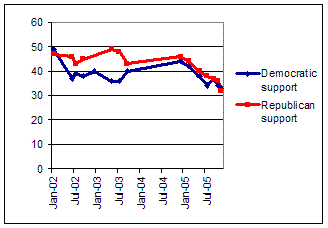
The graph to the right shows the popularity of the Democrats and Republicans as recorded in NBC News/Wall Street Journal polls. Note the decline for the GOP and the failure of the Democrats to budge upwards even a tick. In essence, Americans have gone from favoring the Republicans to favoring no one.

My boss, Bill Galston, is leaving us in January to go to the Brookings Institution. I don’t think any other academic in America has as much political influence on the Democratic Party. When he and Elaine Kamarck released their latest strategy paper recently (“The Politics of Polarization”), both The New York Times and The Washington Post ran news stories describing it. Bill and I very rarely talk about partisan or ideological politics, because our shared professional work is strictly non-partisan. However, he gave a public talk yesterday on his new paper, and I attended it.

We have intellectual freedom at the University of Maryland, so I reserve the right to disagree with my boss. Nevertheless, I’d like to emphasize part of the Kamarck-and-Galston argument that I particularly strongly endorse. This argument says that you can’t get people to vote for you unless you have a plausible and coherent answer to national problems. No amount of skillful leadership and rhetoric and “framing” can paper over incoherence. Between 1988 and 1992, the Democrats had big internal fights over welfare and macroeconomics. I’m not certain that the best side won, but there was a decisive conclusion. Bill Clinton took control of the national party and balanced budgets and reformed welfare. As a result, the public’s opinion of the Democrats on economic and social issues changed fundamentally and for the better.

However, the Democrats never resolved their profound disagreements over foreign policy. They won pluralities of the national vote in 1992, 1996, and 2000 without taking clear positions on difficult international and defense issues. They got away with that because foreign policy was less important between the end of the Cold War and 9/11/01 than at any time since Pearl Harbor. They cannot get away with it now. The Democratic Party includes genuine Peaceniks, John Murtha-style tough guys, Madeleine Albright internationalists who say “use it or lose it” about the US military, “bring America home” types, and everything in between. They will have to fight it out until one faction wins. They will then be able to present the public with a clear alternative to the Bush position.

Yesterday, Bill described John Kerry as the perfect representative of his party in 2004. Voting for the war and then against the bill to fund it put Kerry precisely at the median of the Democratic coalition. That is why he defeated primary opponents whose positions were more consistently pro- and anti-war. It is also a big reason why he lost in November.

The current unpopularity of the GOP means little. In 2006, they will be protected by the safety of congressional districts. In 2008, they will put up an entirely new face as their presidential candidate; he will probably criticize the Bush administration. The only thing that matters for the future of partisan politics is whether the Democrats can increase their support. Since the public is seriously concerned about foreign policy, the Democrats need a positive international vision with some detail and some bite.

Two competing visions might be considered:

1. Lower our international profile. Make concerted efforts to reduce dependence on mideast oil. Reduce defense spending over time and use the savings on domestic investments. Deal with issues like Israel-Palestine and the Korean peninsula only as part of coalitions. Disentangle from Iraq. Concentrate on remaining a major economic power that can afford a dominant but defensive military.

2. Aggressively pursue terrorists and rogue states. However, disentangle from Iraq, where too many of our troops are pinned down in unfavorable circumstances. Pursue Rumsfeld’s pre-9/11 military reforms and use a lighter, quicker, more flexible military in North Africa, Central Asia, Southeast Asia, and wherever the situation favors us.

options for Iraq

Nothing is more important than having concrete alternatives for America’s future in Iraq. There cannot be a useful–or even a barely dignified–debate until there are choices on the table. If the debate is only about whether Bush lied and whether the Democrats are cowards, then we are all guaranteed to lose.

The Murtha resolution has put a basket of general strategies on the table for our consideration:

Section 1. The deployment of United States forces in Iraq, by direction of Congress, is hereby terminated and the forces involved are to be redeployed at the earliest practicable date.

Section 2. A quick-reaction U.S. force and an over-the-horizon presence of U.S Marines shall be deployed in the region.

Section 3. The United States of America shall pursue security and stability in Iraq through diplomacy.

These ideas are separable, and each one is subject to interpretation. For instance, the “earliest practicable date” could be defined in many ways–from the moment when we can extract our forces safely (i.e., very soon) to the day when the Iraqi military is capable of ensuring order (i.e., maybe never).

The “quick-reaction” force could be deliberately located inside Iraq and deployed at the request of the Iraqi government (subject to US consent). Or it could be deliberately located outside of Iraq in order to signal that we have no ambitions to establish permanent bases there. It could be large or small, aggressive or basically just a deterrent force.

“Diplomacy” (mentioned in Section 3) is a good word, but a very vague one. With whom would we engage in dialogues and negotiations, and with what purpose? We could talk to the Iranians and Syrians about not supporting the insurgency; whether that would achieve anything depends on how important those countries are to the insurgents and whether they are open to negotiating. We could talk to the insurgents themselves, or persuade Iraq’s Shiite leaders to do so. We could talk to the Europeans about providing more military forces and reconstruction assistance. I’m not sure what incentive they have to comply in a serious way. It would be interesting, however, if leading Americans outside the administration could work out hypothetical plans with leading Europeans and leading Arabs for a joint response to the Iraqi mess. They could then advocate this response in public forums in their respective countries. (By the way, that is a very appropriate role for leading Democrats between now and 2008.)

In general, our citizens could talk to Iraqis and people from other Arab and Moslem countries outside of governmental channels. Such dialogues are surely desirable, but not likely to produce enormous benefits in the short term.

Finally, in principle, we could try to organize a Mideast summit that considered Iraq, Syria-Lebanon, Israel-Palestine, and the Kurds all together. That sounds like a herculean task, perhaps best undertaken after years of preliminary work. Furthermore, it doesn’t seem promising for the US to be the official convener.

criminalizing policy

I don’t know how many people agree with the following letter in yesterday’s New York Times, but it expresses just the view that worries me most right now:

This investigation [of the Plame case] is not simply about the disclosure of the identity of an undercover C.I.A. operative or politics as usual. It involves the lies and deceit of an administration in taking this country into a war of incredibly stupid proportions in which the mainstream media, including your newspaper, played an important role.

The writer wants to make the criminal investigation of Karl Rove and Scooter Libby (and perhaps others) into a literal prosecution of the Bush Administration for its conduct in the Iraq war. Of course, I realize that the invasion was an enormously consequential decision: consider the 2,000 American dead and the more than 25,000 dead Iraqi civilians. At least in retrospect, it looks like a terrible choice. I also realize that the administration was dishonest in the prewar argument. However, politics is generally a serious business. Whether we provide military aid to Colombia, whether we permit or ban abortion, whether we prohibit or legalize cocaine, even where we set Medicaid reimbursement levels–these are decisions with life-and-death consequences. Moreover, participants in these debates quite routinely lie. It is crucial that we handle even the most consequential (and even the worst) of these decisions democratically, by arguing for one side and trying to mobilize popular opinion. Bringing criminal charges is a way of evading the democratic process.

Furthermore, I reject the diagnosis that we had a poorly informed national deliberation about whether to invade Iraq because some administration officials resorted to malicious leaks and general dishonesty. That’s true, but it’s far from the whole story. Even given the advantages that an incumbent administration holds in debates about foreign policy, the Bush team could have been challenged by the Pentagon, Congress, the Democratic Party, Bill Clinton and alumni of his administration, the Blair Government, academic experts, the press, and average citizens. The failure of almost all these groups to mount a challenge is evidence that we have a deep and widespread problem. Prosecuting people in the Plame case will do nothing to fix it.

I am not arguing that Patrick Fitzgerald should refrain from indicting anyone. He may conclude that laws were broken, and then the rule of law requires accountability. What I object to is the interpretation that the Plame investigation has put the Bush administration on trial for the whole Iraq war. That would be a dangerously undemocratic development–not to mention an excellent way for everyone else to dodge responsibility.

Tony Blair and the Doctrine of Double Effect

Reflecting on the July 7 bombings, the leftist MP George Galloway (on whom I have written before) said, “London has reaped the involvement of Mr. Blair’s involvement in Iraq.” Most people to Galloway’s right–which means most people–think he is wrong to blame Blair for the terrorism. Yet it seems likely that a causal chain does connect the bombings to British participation in the Iraq invasion. Extremist Muslim radicals attacked UK targets only once they had become incensed by the presence of British “crusaders” in Iraq. The use of terrorism against civilian British targets was a fairly foreseeable result of the invasion and occupation.

I wouldn’t try to deny Blair’s causal role, but I would argue that someone can be a cause of something without being morally responsible for it. Blair set in motion a chain of events that led to the bombings, but the bombers are completely responsible for what they did, and Blair is completely innocent of it. Thomas Aquinas’ Doctrine of Double Effect comes in handy here. The New Catholic Encyclopedia, as quoted in the Stanford Encyclopedia of Philosophy, explains that the Doctrine excuses an act (in this case, the invasion) that has bad results under these conditions:

1. The act itself must be morally good or at least indifferent. 2. The agent may not positively will the bad effect but may permit it. If he could attain the good effect without the bad effect he should do so. The bad effect is sometimes said to be indirectly voluntary. 3. The good effect must flow from the action at least as immediately (in the order of causality, though not necessarily in the order of time) as the bad effect. In other words the good effect must be produced directly by the action, not by the bad effect. Otherwise the agent would be using a bad means to a good end, which is never allowed. 4. The good effect must be sufficiently desirable to compensate for the allowing of the bad effect.

Thus, to take Tony Blair’s side, we would say: The act of invading Iraq to remove Saddam Hussein was morally good. Even if its net consequences turn out to be bad for Iraq (mainly because of the incompetent US leadership), British participation was well-intentioned and reasonable. Blair did not will a terrorist response to the invasion, even if he had reason to predict it. The removal of Saddam was a direct consequence of the invasion; the London bombings were highly indirect results. Finally, the end that Blair willed was sufficiently good to compensate for the death of Londoners.

Continue reading

the Iraqi election, suicide bombing, & rational choice theory

An election is partly a public good, in the precise economist’s sense. If representatives are selected peacefully and officials are made accountable to the majority, that is a good thing for most people. This good is indivisible. I cannot decide to forgo the benefits to me personally of democratic elections, nor sell my stake to someone else. Like national defense or the ozone layer, elections benefit all (or at least the whole majority faction), if they serve anyone.

There is a well-known problem with public goods. Whether a democratic election occurs depends on many people’s behavior, yet each person benefits regardless of what he or she does. For example, you gain from our political system?whether or not you vote. Thus you may be tempted to free-ride and let others bear the burden of voting. Or you may feel that it’s pointless to promote this public good, since others are unlikely to do their share.

Continue reading