Category Archives: Uncategorized

why you should read the newspaper

We’re told that the President of the United States doesn’t read beyond the front page because he detects a hostile ideological bias in most reporting. He says:

My antennae are finely attuned …. I can figure out what so-called ‘news’ pieces are going to be full of opinion, as opposed to news. So I’m keenly aware of what’s in the papers, kind of the issue du jour. But I’m also aware of the facts. …. It can be a frustrating experience to pay attention to somebody’s false opinion or somebody’s characterization, which simply isn’t true.

Meanwhile, I have known many colleagues who think that all reporting and commentary in the “corporate” press is false and deliberately misleading. These leftists would be just as happy as Instapundit to see the word “lies” spray-painted across the New York Times.

I’m a consistent critic of the major newspapers myself–and TV news is beneath contempt. But I don’t see how you can be a responsible observer of the world unless you use the raw material that the mainstream press provides. Sometimes the quality of coverage is poor. But to reject it all is to walk in that “absolute night when all cows are black.” If you despise the most detailed sources of information, then you can make no distinctions except on the basis of your original prejudices.

Besides, sometimes we distrust the news because it’s uncomfortable stuff. Conservatives don’t like to read about incompetent Republican presidents or about the prevalence of poverty and racism. Liberals don’t like to read about the real failures of government and the real costs and limits of regulation. Centrists don’t like to read that there are legitimate arguments between right and left. Yet real progress comes from facing these difficult facts.

I’m increasingly worried about a kind of criticism that I suspect George Bush employs, along with many other Americans. Chris Betram puts it well: readers look for “symptomatic silences” and “accuse people of indifference or lack of balance for failing to mention some event or incident.”

It’s easy to play this game. You make up your own mind about what’s important (based on reading some news source) and then assess other publications–including editorial columns and blogs–to see whether they accord an appropriate amount of space to each story. I guess that’s an acceptable way to criticize newspapers that claim to report “all the news that’s fit to print” (or the equivalent). However, it should never be an excuse for failing to read the news. Even if a newspaper devotes the wrong amount of space to each item because of a systematic ideological bias, we can still get lots of information from reading it. To assume that other people will be miseducated because editors emphasize the wrong stories is to hold our fellow citizens in rather low regard.

For my own part, I can’t figure out how to assess charges of left-wing or right-wing bias in the press. There’s too much diversity in the coverage, and the political spectrum is too poorly defined today. [Follow up: see Jay Rosen’s latest post on the same subject.] I do detect a disturbing set of professional biases in favor of ….

  • conflict rather than consensus
  • deficits rather than assets
  • political strategy rather than policy
  • motives of political actors rather than quality of decisions
  • campaigns rather than government
  • federal government rather than states
  • government rather than civil society
  • the US rather than the rest of the world
  • These are problems, but they don’t excuse us from reading the news.
    charter schools and democracy

    I’m enthusiastic about charter schools, but not for the standard reasons. A charter school is a public institution that operates independently, free from most of the usual bureaucratic tangles, with a direct “charter” from some higher authority such as the city or state. Charter schools are supposed to improve outcomes for the kids they enroll, by providing alternative approaches precisely tailored to their students. They are also supposed to improve the performance of public education generally, by incubating new models and by increasing parental choice (hence, competition).

    Charters don’t seem to work particularly well for these purposes–no better than standard schools. (See, just for example, this RAND report, in .pdf.) It’s too early to say for sure, but charter schools certainly don’t look like a magic formula for higher test scores or graduation rates.

    On the other hand, they do no harm, at least on average. And they have a huge advantage that’s distinct from student educational outcomes. As a society, we need more opportunities to propose solutions to public problems, band together voluntarily, and then work directly to implement our ideas. This is “public work”–one of the most satisfying aspects of citizenship, and a great American tradition. In general, opportunities for public work have shrunk over the last century because of increasing professionalism, standardization and bureaucracy, and a diminished role for the public sector as a whole. Social work and education used to be great fields for public work, but they are now exclusively the domains of credentialed specialists who are often unable to innovate.

    This is where charter schools come in. Someone has a new idea, persuades a few friends to join her as teachers, and together they create a new institution. At any rate, that’s the story of the charters that I know personally: Cesar Chavez in Washington and the East Bay Conservation Corps in Oakland. Typically, a charter school can’t get off the ground without supportive parents, so the odds are relatively good that parents will play active roles in its governance. Flexibility, creativity, and parental participation don’t guarantee better educational results, as the RAND study shows. But they are intrinsically valuable goods–much more important, in my book, than a few extra points on the SAT.

    Some ideas for charter schools are good; others are lousy. And some of the best ideas aren’t well executed. The average results for charters appear to be about the same as the mean for other public schools, but I suspect this masks a lot of variation–a wide range from best to worst. That range is a consequence of democracy. The worst charters can be shut down, but the damage they do is the price we must pay for creativity in the public sector. I think that price is well worth paying.

    attitudes toward gay rights, by generation

    Yesterday, Matt Yglesias wrote on his very popular blog: “Some social conservative types have speculated to me that the overwhelming pro-gay sentiment among young people can be counteracted by the natural conservatizing effects of aging.” In other words, people will “naturally” grow more hostile to gay marriage as they enter adulthood. Yglesias disputed this prediction, and he’s right. Some pretty specific data show that people tend to grow increasingly tolerant toward gays as they age–at least in the current era.

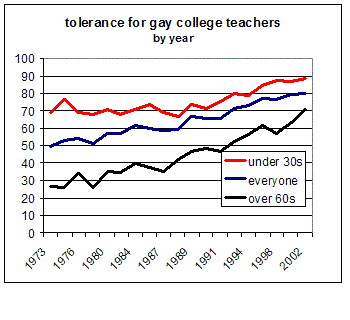
    No one conducted surveys on gay marriage until recently. Our own survey found strong support for gay marriage and civil unions, but it was a snapshot of young Americans, with no adult comparison group, and it told us nothing about trends. However, the General Social Survey has consistently asked questions about other gay rights since 1973. For instance, the GSS asks: “what about a man who admits that he is a homosexual? Should such a person be allowed to teach in a college or university, or not?” This is a useful question statistically, because it divides the population into comparable-size groups that are for and against. (The GSS code name for this question, amusingly, is “colhomo.”)

    As shown in the following graph (and as one would expect), tolerance for gay college teachers has increased since 1973, when the question was first asked. At any given time, the most tolerant people are the youngest:

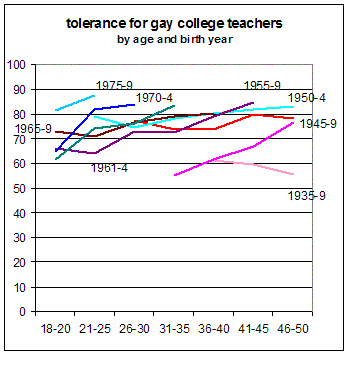
    However, this first graph doesn’t tell us whether individuals become more or less tolerant over time. Perhaps each new generation starts life more tolerant than the previous ones, and thereby causes the average level of tolerance to rise, yet individuals tend to become more conservative as they age. To see whether that’s true, I looked at cohorts, and graphed their evolution over time. With the possible exception of those born in the 1930s (for whom we don’t have much data), it appears that people grow more tolerant as they age. Each of these lines represents an age cohort (i.e., part of a generation), and seven out of eight lines slope upward:

    Social scientists talk about “age effects,” which hit average human beings as we move through the stages of the life-cycle. For instance, becoming more interested in politics is an age effect of early adulthood. They also talk about “cohort effects,” which are qualities that a group of people has permanently, by virtue of what happened to their society when they were young. For example, Baby Boomers were permanently marked by post-War affluence, suburbanization, and Vietnam. Finally, there are historical effects that hit everyone in a society at a given time, regardless of their age. It’s my sense that there may be a small age effect here: people become more tolerant of gays as they mature and get to know openly gay people. (This was a finding of our survey.) However, the biggest effect here is historical. Everyone is becoming more tolerant, regardless of age.

    Leaders for Tomorrow

    I’ve agreed to direct a new undergraduate program at the University of Maryland, starting next fall. It’s called Leaders for Tomorrow. Participants will have access to funds to support their own travel, summer internships, and other activities relevant to their work. Everyone in the first batch of admitted LFT students has also received a full scholarship (including room and board) from some other source.

    The goals of the program are to attract some of the nation?s best undergraduates, to prepare them to compete for prestigious national scholarships such as the Rhodes and Marshall, and to enhance a campus-wide student culture of scholarship, leadership, and service. I’m particularly interested in helping talented undergraduates to bring some coherence to their various activities inside and beyond the classroom. I’m all for breadth, yet I think our students would benefit from being more strategic and purposive.

    If you attend an Ivy-size college (about 6,000 undergraduates), it needs an endowment of $276 million to generate $2,300 worth of special extracurricular programs for each student. My university is much bigger than that, but it has a much smaller endowment. However, we’re earmarking something like $2,300 in cash to benefit each LFT student. I think you can make a pretty good case that Maryland (which has enormous shared assets) is a better place for these students to attend than some of the top colleges in America.

    I’m imagining that most of the LFT students will work independently on extracurricular activities and courses, and we will convene regularly to discuss our separate experiences and to participate in special programs such as “field trips” and service opportunities. However, I’ll be especially excited if the LFT students do projects together. I have all kinds of ideas (creating a venue for publishing student research, organizing after-school classes in the County schools, etc. etc.); but I’m hoping that the LFT students can generate ideas of their own. They will have four years ahead of them when they arrive in September, so I’ll be patient and let them consider alternatives for a year, if necessary.

    among the ethnographers

    I don’t think I’ll be able to write anything substantial today, because I have meetings scheduled virtually without a break from 9 am until the evening. The one I’m most looking forward to is actually a seminar. Some advanced anthropology students at the University of Maryland have been collecting data in the same location that our high school students are mapping (see yesterday). We’re hoping to combine the findings from both groups, to generate really interesting maps. This evening, I’ll observe while the students present their findings from the semester.