Category Archives: Uncategorized

the aesthetics of suburbs

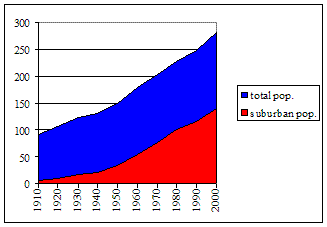
This post was prompted by a family weekend in some beautiful parts of northern Virginia?which necessitated a lot of travel through ugly northern Virginia suburbs. I’ve always been a city person, prone to disparage suburban life on political, ethical, environmental, and aesthetic grounds. However, I recognize some important counter-arguments. Suburbs are becoming increasingly diverse and integrated. As they have grown, they have developed sophisticated cultural institutions. Suburban landscapes may be ugly, but our cities aren?t all gleaming Manhattans, either. For every Telegraph Hill or Michigan Avenue, there are hundreds of square blocks of slums and ?brownfields? in our urban centers. Contrary to what I would have guessed, suburbanites (according to Robert Putnam) are slightly more involved in voluntary associations than urbanites are. In short, prejudice against suburbanites could be simple snobbery, closely related to the condescension that certain self-styled ?intellectuals? have traditionally felt toward the bourgeoisie. After all, 150 million Americans have voted with their feet by moving to, or remaining in, the suburbs. Since they know their own circumstances best, their choice demands respect.

But the fear of being charged with snobbery should not prevent us from grappling with aesthetic problems. The beauty (or ugliness) of our environment is important. And I maintain that suburbs are ugly, especially if one considers their relative affluence. A retail strip in Bethesda, MD may be more attractive than many blighted streets in the Southeast quadrant of Washington, DC. But residents of Bethesda occupy homes with a median market value of $396,000 (in 2000). Their median household income was above $99,000 that year. Compared to urbanites of the same wealth, they live in ugly surroundings. Strip malls are uglier than shopping streets. Suburban office parks are uglier than contiguous office buildings. Clusters of wires are uglier than buried ones. On-ramps are uglier than urban intersections. Ranch houses tend to be uglier than row houses. I think huge lawns are uglier than front yards. Big revolving signs for fast food restaurants are certainly uglier than shop fronts.

It?s important to recognize that the suburban landscape is very recent. More than 100 million people had to be housed in new communities in the space of 50 years. Maybe these encampments will look better once we have settled in. Maybe we?ll figure out ways to improve the look of the familiar combination of a wide road, grassy strip, parking lot, and cement-block store. Higher density may improve aesthetics, simply because all that wasted?cleared but vacant?land in the suburbs is ugly.

But we?ll have to overcome another kind of problem, too: a dynamic that discourages investment in suburban public spaces. In cities, private owners have motives to invest in the public appearance of their property: a shop-window, a fa?ade, or a lobby can be an efficient advertisement. Banks, hotels, and department stores are often major civic ornaments, constructed at private expense; but even traditional tenement houses had handsome cornices. The worst buildings in cities are often public ones: for example, housing ?projects? constructed by cheap authorities for the poorest residents.

In contrast, there is profound underinvestment in the outward appearance of suburban buildings. Even a fancy office park will often show basically blank walls to the outside. It is designed for the people in the offices. Visitors come by car and don?t need to be drawn in or impressed by the fa?ade. There are expensive suburban restaurants with ?designer? interiors that sit in completely undistinguished parking lots. The new arts center in Bethesda has received positive reviews for its glamorous architecture; but you can?t see the building from the nearby main road that carries probably 2,000 vehicles/hour at its peak. For all those ?passers-by,? the architecture means nothing.

I suspect that this underinvestment is partly a function of low density. It usually doesn?t pay in a suburb to use architecture and landscaping as advertisements?especially when people zoom past in cars. Another cause of the problem may be rapid growth. If everything around your building looks ugly and temporary, then it doesn?t pay to try to improve the landscape by investing in the small piece of it that you own. Third, suburbs compete madly for new construction, and they can?t regulate aesthetics without simply losing development to the next jurisdiction. Finally, it may be individualism that explains both the migration to the ?crabgrass frontier? and the failure, once there, to invest in public spaces.

service instead of politics? blame Clinton

When trying to explain trends in civic participation, we shouldn’t overlook major political events and how they influence ideological groups.

When I was in college, in the late 1980s, I played a very small role in national discussions about how to increase opportunities for service. These discussions helped lay the groundwork for the Points of Light Foundation and then the Corporation for National and Community Service. Most of the young people in those discussions were left-liberals. For us, service seemed useful because it might sensitize people to problems like poverty and racism and lead to political action. However, service would be harmful, we thought, if it became an end in itself or a palliative. These were the explicit conclusions of a Wingspread retreat on service that I attended in 1988.

Thirteen years later, in 2001, Campus Compact brought a new group of college students to Wingspread to discuss civic engagement. These students said:

For the most part, we are frustrated with conventional politics, viewing it as inaccessible. [However,] while we are disillusioned with conventional politics (and therefore most forms of political activity), we are deeply involved in civic issues through non-traditional forms of engagement. We are neither apathetic nor disengaged. In fact, what many perceive as disengagement may actually be a conscious choice; for example, a few of us ? actively avoided voting, not wanting to participate in what some of us view as a deeply flawed electoral process. ? While we still hope to be able to participate in our political system effectively through traditional means, service is a viable and preferable (if not superior) alternative at this time.

I suspect that there was one major reason for the change in attitudes toward service among left-liberal youth: the Clinton Administration. In 1988, most young proponents of civic engagement, having grown up under Reagan, believed that a Democratic electoral victory was much more important than any form of direct service. In 2001, having experienced a Democratic presidency, idealistic young liberals were highly skeptical of government and politics as paths to social change. Note that a similar pattern of mobilization and disillusionment could easily affect conservative youth under different political circumstances.

The title of this post is basically facetious, since I think that the Clinton Administration was at least partly successful. But a Democratic president had much less impact than left-liberal college students would have hoped, ca. 1988. And disappointment can be very demobolizing.

the torture lawyers

My friend and former colleague David Luban has a very useful article in Slate explaining why the lawyers who advised the Bush administration to allow torture (“former White House counsel Alberto Gonzales, vice presidential counsel David Addington, Justice Department lawyers Jay Bybee and John Yoo, and Pentagon counsel William Haynes”) violated legal ethics. Luban’s analogy between those lawyers and Lynne Stewart–Sheik Omar Abdel Rahman’s defense attorney, recently convicted of conspiring with him–is suggestive but not necessarily tight. The real payoff of Luban’s piece is his explanation of the role of legal advisor versus that of advocate. The Bush lawyers acted as advocates when they were employed to give advice, and that violates legal ethics.

academic freedom

In my usual style, here is a very belated comment on two once-“hot” news stories: Larry Summers and Ward Churchill. For all their differences, these men are both university employees who got into trouble for their public speech. In both cases, “academic freedom” has been cited as a defense.

In my opinion, “academic freedom” is not an individual civil right that academics can wield in conflicts with their employers. Academics, like everyone else, have First Amendment rights, but those are rights against the state. The First Amendment does not require a university to pay us to say anything we like, nor must it grant us academic credit or preferment for our speech. Universities carefully and intensively regulate the speech of their students, professors, and administrators. You can’t receive credit or a degree for your writing unless it fulfills a professor’s assignment and meets all kinds of canonical standards of relevance and rigor. You can’t get tenure unless your work is acceptable to the mainstream discipline in which you work. Even once you have tenure, you can’t win grants, promotions, or opportunities to publish without subjecting your “speech” to peer review for content. Thus if academic freedom were a right of individuals, it would be a myth.

Academic freedom is not an individual civil right, but rather an institutional prerogative. When we support academic freedom, we mean that colleges and universities, scholarly associations, journals, and presses should be free to set their own standards for expression without (much) state interference. In other words, the ideal is autonomy for certain professional associations, not rights for their employees as individuals.

Tenure causes confusion: it makes us think that the central commitment of a university is to the individual autonomy of professors. But tenure only applies to senior faculty (not to students, junior faculty, or administrators). Moreover, it is part of a larger system. It is aimed against one problem–invidious political pressure on professors not to teach or publish unpopular ideas. That is a real threat, but universities also worry about “free speech” that is incompetent, undisciplined, or irrelevant. To address that problem, they put academics through a lengthy and grueling socialization process before they grant tenure. And even after tenure, they apply all kinds of pressure to make faculty express themselves in particular ways.

Which brings me to the two cases of recent weeks. I haven’t made a study of Ward Churchill’s writing, nor do I have time to do so. But there are tenured professors–possibly including Dr. Churchill–who are radical blowhards: offensive and totally lacking in rigor and discipline. Such people are one price we pay for the tenure system. (Some other costs are the burnouts and timeservers on our faculties.) If tenure makes sense, it’s because the advantage of protecting trenchant, insighful radicals outweighs the cost of all those blowhards and timeservers. I don’t know for sure that this price is worth paying–it probably is. In any case, we should evaluate tenure overall, and not let particular cases dominate our thinking. Thus Churchill may have to be allowed to speak offensively and foolishly in order to uphold an institutional rule that is valuable, overall.

As for Larry Summers: some have said that he “modeled” free speech by making a politically incorrect statement about women in science. I would reply that he modeled free speech but without rigor or discipline. Moreover, he is an administrator, and as such his primary duty is to shape and implement policies. Harvard ostensibly has a policy of attracting more female scientists. Summers’ comment undermined Harvard’s policy. As such, it was damaging. He was like a corporate executive who criticizes his company’s product, or a U.S. ambassador who attacks American foreign policy in public. The First Amendment covers his speech, but that only means that he can’t be prosecuted for it. He has no right to be paid for it. If Harvard chooses to retain him, which seems very likely, it will be because Summers’ talents outweigh his mistakes. But his comment about women was a mistake, and “academic freedom” is no excuse.

[Added Feb. 17: It can be courageous and honorable for an employee to attack the policies of his or her organization, if the criticism is valid. However, such a critic must also be prepared to face the consequences. For instance, a US diplomat who criticizes American foreign policy may deserve public praise but ought to submit his or her resignation letter along with the critique. The same applies to a university president who undermines the institution’s policies. But see Andrew Canter’s challenging response in the comments.]

By the way, I don’t have tenure and have never been on a tenure track. I’m fairly grateful not to have gone through the socialization process that tenure would have entailed.

how institutions socialize young people for citizenship

In 1928, Karl Mannheim argued that people tend to form stable civic identities in their late teens. As adolescents emerge from the relatively narrow horizons of their families and neighborhoods, they confront the broader world of governments, ideologies, parties, and nation-states. They must adopt some stance toward this world, whether it is passive acceptance, alienation, enthusiastic embrace, or personal obligation. After people form a stance, the effort required to change their minds is too costly unless major historical events intervene and require a reassessment. Given the relatively low salience of public life, inertia tends to dominate for the rest of our lives.

If Mannheim was even partly right, then it is important to ask how our institutions socialize young people for lifetimes of civic and political participation. The impact of these institutions is likely to change as their structure and behavior evolve. Thus a study of institutional change is crucial for our analysis of political development.

I suspect that the following are some of the most significant ways in which American institutions have changed their effects on political socialization over the past 25 years:

  • Electoral politics: Thanks to sophisticated gerrymandering, there is ever less competition for state legislatures and the US House. As a result, young people grow up without the experience of debate in their communities and may conclude that controversy is unnecessary or artificial, something that Washington political elites stir up for tactical reasons. The lack of competition also means that elected officials are relatively insulated from accountability and relatively uninterested in seeking young people?s support. We know from field experiments that young people often vote when asked. The decline in political competitiveness means that they are less likely to receive a request to vote.
  • Meanwhile, sophisticated marketing strategies and technologies have allowed consultant-driven campaigns to focus their efforts on groups of people with known voting histories. Young people have unknown voting preferences and are relatively unlikely to participate. Thus they are usually left off target lists. To make matters worse, their services as volunteers are not needed as much as in the past, because campaigns depend on expert consultants, mailing lists, and professionally produced advertising.
  • Civil society: As Elinor Ostrom notes, ?Some aspects of the science of association are both counterintuitive and counterintentional, and thus must be taught to each generation as part of the culture of a democratic citizenry.? Associations have incentives to recruit young people and teach them skills necessary for the organizations? maintenance. If associations recruit fewer members, that is bad for political socialization. Unfortunately, some important organizations that once recruited young people have lost membership. The most obvious examples are labor unions. In 2000, just 13% of 15-24s were union members, far less than fifty years ago. Religious congregations can also teach civic skills. But regular religious attendance among high school seniors declined from 41 percent in 1976 to 33 percent in 2000. During this period, high school seniors did not show any major change in attitudes toward religion, but they became considerably less likely to participate in organized religious groups.
  • The news media: The modern mass media are fragmented and allow people to opt out of news more easily than in the past. There also may be more sorting by level of knowledge; some newspapers provide highly sophisticated information to global audiences via the Internet, while other news sources (such as commercial web portals and music radio stations) provide extremely superficial coverage tilted toward entertainment. Organs that might serve diverse audiences, such as metropolitan daily newspapers, are endangered in the current market. Meanwhile, most people feel that news programs have become less civil, perhaps because they must compete more avidly for ratings. Diana Mutz and Byron Reeves have found that people are entertained by angry debates, yet such confrontations reduce trust in government and politics.
  • There is a problem with youth civic engagement, but it’s important not to locate the problem inside young people’s heads if the real cause of their alienation lies in institutions.