Category Archives: Uncategorized

network mapping, civic education, & social capital

If you interview community members or leaders of local organizations and ask them what other organizations they work with, you can use software to generate a “network map” that shows all the linkages among organizations and allows you to identify any gaps in the network. For an example of such a map, see my depiction of major links in today’s civic renewal movement. (I generated this image using TouchGraph’s GoogleBrowser, so the connections represent links between websites, not reports of actual collaborations.)

Network mapping seems promising to me as a tool for community organizing: it allows you to see how your community could be strengthened by forging new connections among nodes that are not in contact. It also seems promising as a form of civic education. Students could perform network-mapping of their schools or communities and learn a lot about civil society.

Indeed, yesterday, three University of Maryland students began a network-mapping pilot project in Prince George’s County, MD, under my direction. They are terrific students, but since there are only three of them, they probably won’t be able to achieve more than get the process rolling so that others can follow after them. I am hoping that they’ll generate at least an interesting preliminary graph that will tell us something about the place of the University in the County.

By the way, when scholars like Robert Putnam estimate “social capital” by asking people how many associations they belong to, whether they invite friends over for dinner, and whether they trust other people, I would say that they are using proxy measures to assess the strength and density of actual collaborations in a community. Thus I would say that a network map is a more direct (although more labor-intensive) measure of “social capital” than anything based on survey data. This is partly because I believe the purpose of social capital is to address social problems; I am not interested in connectedness or sociability for its own sake.
youth civic engagement: an “institutional turn”

Maybe every generation in every democracy gives its elders reasons to worry about the future. Citizens are made, not born; each generation needs deliberate, critical guidance from the older ones.

Looking at recent trends in the US, we see particular problems, including: a steep decline in youth interest in public affairs (graph); low levels of knowledge; widespread skepticism that it is possible to make a positive difference; and a decline in youth turnout of about one third (pdf) until the uptick last November. (As a discrete act, voting can be over-emphasized; but it is a useful proxy for knowledge, connectedness, and commitment.)

I see two basic ways to interpret these trends and respond to them. One is to assume that there is something wrong with the pyschology of young people: their knowledge, skills, and values. These deficits may not be their fault; we can blame schools, the media, parents, and others. But the deficits are located inside young people’s heads (so to speak). If that’s the situation, then we should be interested in the efficiency of various “interventions”–civic education programs, community service opportunities, or voter-canvassing drives–to change young people’s psychology while they are still in a formative stage of life.

The other “model” assumes that the problem is not inside youth’s heads, but in major institutions that are not worthy of being engaged. For example, maybe kids don’t read newspapers because newspapers aren’t that great to read. Maybe they don’t vote because the vast majority of elections are decided when the districts are drawn. Maybe they aren’t interested in “public affairs” because public issues are not being framed in useful ways.

In this model, youth attitudes, knowledge, and skills are not simply “dependent variables” that should be raised as much as possible through interventions such as “civic ed.” They are rather (or partly) symptoms of a need for deeper social change.

There may nevertheless be arguments in favor of programs that work directly on young people’s minds and hearts. It is easier to change social studies than reform politics. Thus if we can enhance civic skills through better social-studies education, maybe we can help the next generation to press for political reform (on its own terms, not ours). Or if we can raise youth turnout through get-out-the-vote efforts, which seems to have happened in ’04, then maybe we can create a more competitive and unpredictable electorate, thereby changing campaigns and politics. Nevertheless, working on kids’ pyschology is an indirect strategy, and it’s worth constantly asking two more basic questions: What kind of polity is worthy of full engagement? And how do we get there?

spam attack

This site is really under attack today. In addition to the scores of spurious “trackback pings” than I’ve been receiving every day, an organization has now posted more than 200 comments that are really advertisements for its product. Their software puts no more than one comment on each of my posts, so that I must open up more than 200 separate records and painstakingly remove each ad. Their spam software uses a different, fake IP address each time so that I can’t block it from posting. Instead of writing something substantive, I’ve been trying to clean up the site and have also inquired about changing my software. I hope to be back in business tomorrow, but I may have to delay blogging until I can solve this problem. (Someone who can spam me 200 times in six hours can spam me 2,000 times and do me in.) Isn’t interactivity great?

tolerance & generational change

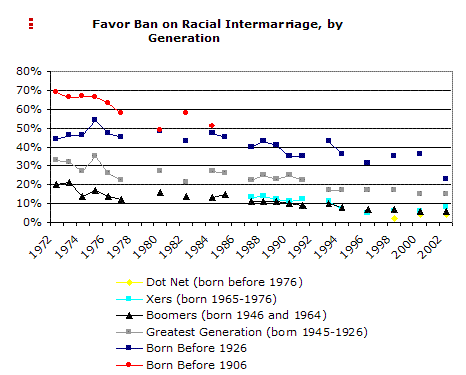
Yesterday, CIRCLE released a detailed report (pdf) on the evolution of young people’s attitudes toward racial minorities, immigrants, and gays. The report finds substantial increases in tolerance, although not much increase in actual interactions among racial groups. My favorite graph is the one on the right. It’s a perfect illustration of Karl Mannheim’s theory of generations, which holds that our political values are permanently shaped by our experiences as young adults. Why have Americans become increasingly favorable toward interracial marriage since the 1960s? Not because many individuals have changed their minds over their lifetimes, but because each generation has come of age in a more tolerant era and remained at a consistent level of support. The underlying theory is that we are forced to make up our minds about major questions when we first encounter them. Thereafter, changing one’s opinion takes a lot of effort, so we rarely do so. Those who first considered the issue of interracial marriage in 1930 are permanently different from those who first heard of it in 1980. (Incidentally, this pattern is good news, because it suggests that tolerance will rise inexorably as today’s young people predominate in the population.)

who’s more powerful, Bill Gates or Kim Jong-il?

This is a silly question, except that it can prompt some serious thinking about the nature of power, the state versus the market, and monopoly.

Let’s say that “power” is the capacity to do things you want to do. Clearly, the Microsoft Chairman and “chief software architect” and the Chairman of North Korea’s National Defense Commission (also known as the country’s dictator) can each do things that the other cannot. Bill Gates can shape the daily experience of, I suppose, billions of human beings. He can influence the flow of global ideas and capital and the creation of new forms of culture. He can employ thousands, and fire any employees he chooses. He cannot, however, order people killed, turn Seoul into a “sea of fire,” or sell nuclear bombs to al-Qaeda that might incinerate Manhattan. Nor can he order people to listen to his six operas, or have a conspicuously weird sex life. Kim Jong-il can do all of the latter things, but he cannot travel freely or have a frank conversation with anyone–or make the North Korean economy prosper while maintaining a totalitarian state.

As Hellmut Lotz (a Maryland graduate student) notes, a dictator cannot retire. Once he loses control of the military and police, he cannot guarantee his own security. He is inevitably a threat to the successor regime, which may decide to destroy him–regardless of any deal he may have struck before exiting power. Augusto Pinochet is just the latest example of an ex-dictator who has paid a serious price for relinquishing control. In contrast, Bill Gates can step down at any time and retain any amount of wealth and influence he likes.

In a perfectly competitive market, Gates’ “power” would be very limited. He would have to produce software that people wanted to buy. He would be constantly maximizing his products’ popularity, at peril of losing his position on top of a publicly-traded corporation. Any discretion that Gates does enjoy results from Microsoft’s quasi-monopoly position. But his monopoly is insecure.

For his part, Kim Jong-il relies on all those guys with guns and bombs in the North Korean security apparatus. If they decide collectively to withdraw support, he’s dead. Fortunately for him, soldiers in a totalitarian regime cannot safely communicate–unlike investors and consumers in a free market.

Bill Gates was part of the “personal computer revolution,” which has certainly changed billions of people’s lives. However, it is not easy to estimate his personal contribution to that revolution. On one theory, he was the very clever (and lucky) guy who capitalized on an inevitable technological development by getting there first. This is not to minimize his intelligence, but it does suggest that he wasn’t very powerful. On the other hand, the discretionary decisions that Gates made early in Microsoft’s history have had enormous and perhaps irreversible affects on the precise way that software works today.

It’s easy to see that Microsoft has been on the side of history over the last 30 years, whereas North Korea is doomed. But that doesn’t by itself show that Bill Gates is more powerful than Kim Jong-il. We don’t say that a dinghy being swept to shore by a strong tide has more power than one battling to stay at sea.