Every now and then, I post a summary of what’s going on in my work life. These summaries seem worthwhile, since often people email me to ask practical questions connected to what I’ve written. So here goes …
Category Archives: Uncategorized
museums for freedom and democracy
I spent yesterday in Philadelphia, helping the National Constitution Center with its strategic planning process. The Center is a museum for the U.S. Constitution, located in sight of Independence Hall. It’s also an educational center with a significant and growing web presence. It’s new, but it has substantial assets: an impressive building, a great location, and some fine exhibits.
This was my sole suggestion at the meeting: Make the Constitution Center (both the building and the website) a place where people can create excellent materials connected to the Constitution and democracy. Fill the blank walls with projects created by students and others–not just crayon drawings, but elaborate installations that represent a lot of careful work that’s relevant to some aspect of the Constitution. Provide facilities for creative work, such as audio and video production studios and traditional stages. Local Philadelphia groups like Scribe and the Temple Youth Voices Project could be among those that used these facilities. Finally, provide opportunities for ephemeral creativity and expression–speakers’ corners, public meeting rooms for civic groups, videoconference centers for civic discussions across long distances, blogs and physical bulletin boards, a printing press, tables with sand or clay for impromptu sculpture.
I had three reasons for making this proposal. First, I believe that the Constitution of the United States is not simply a plan for our official institutions; it is also a charter for a free people who are supposed to create their common-wealth. Therefore, a creative space is the best embodiment of the Constitution, as long as people are assisted in creating relevant materials.
Second, we live at a time when electronic technologies give us a choice. We can produce ever more sophisticated and enthralling spectacles that capture people’s attention but leave them basically passive. I once described the Cerritos, California, Public Library as that kind of place. It’s a public building that’s in danger of turning into a pro bono theme park. Alternatively, we can open free spaces in which unprecedented numbers of people can be creative–the World Wide Web being the best example.
For any museum that lacks a remarkable collection of unique objects, becoming a theme park is a serious risk. Opening a creative space is a better route. In his essay on “Art in the Age of Mechanical Reproduction,” Walter Benjamin argued that once art objects can be mass-produced, it becomes possible for powerful institutions to generate mass spectacles; and that is the root of fascism. It’s not such a great idea to prize unreproducible objects–like the Liberty Bell or the actual, original Constitution–because only a few people can possibly can see or own these items. But at least an unreproducible object is hard to use to manipulate mass opinion. Benjamin’s argument suggests that mass institutions pose a danger, unless they allow people to create.
Third, I disagree with the following reasoning: “Young people–and even grown-ups–are woefully ignorant of our Constitution. Polls consistently find them wanting. We need to change them, and the best means is professional media. A state-of-the-art interactive museum, created and vetted by experts, is an example.” I reject this reasoning because I don’t believe that people can be spoonfed civic or political information that they don’t want, especially in a highly competitive marketplace. The alternative, once again, is to give people opportunities to become active creators of the commonwealth, so that they have reasons to understand and to value their rights.
Incidentally, I had been planning to write pretty much this very post since last Friday, not in reference to the National Constitution Center, but rather in response to an article about the International Freedom Center that is planned for the World Trade Center site in Manhattan. The Freedom Center is likely to be a spectacle, a didactic theme park created by well-intentioned people like the ACLU. But it could be much better than that.
social science, for good and ill
I’m on my way to Philadelphia today, to help the folks at the National Constitution Center think about their next steps. Yesterday morning, I went to Capitol Hill to watch my colleague and friend Judith Torney-Purta win a “Decade of Behavior” award. The “Decade of Behavior” (2000-2010) is actually a collaborative project by the various social science disciplines to “highlight how behavioral and social science research provides insight and solutions to pressing social concerns.” Judith was the pyschologist chosen to be honored for her lifetime of work on children’s civic development.
The political scientist was James Gibson. He seemed to be a good person, and he won my trust by saying that he had “fallen in love” with South Africa during his ten years of research there. (I always like scholarship that combines with love.) He also showed a lot of respect for the South African leadership.
Nevertheless, I was a bit disturbed by his introduction. I mention it not to criticize him–since I don’t know his overall project–but as an example of a form of social science that I find dangerous rather than helpful. Gibson said that he was pessimistic about the future of democracy in South Africa because quantitative social science has found that the following are predictors of democratic stability: wealth, economic equality, ethnic homogeneity, and direct influence from Britain. South Africa is poor on a per-capita basis; it has terrible inequality (a GINI of 59.3) and a deeply heterogenous population. Only the British colonial influence looks favorable, and it was short-lived.
Senator Frist, the Constitution, and filibusters
This morning, on the Senate floor, Majority Leader Bill Frist said:
Mr. President, I rise today as the leader of the majority party of the Senate.
But I do not rise for party. I rise for principle.
I rise for the principle that judicial nominees with the support of a majority of senators deserve up-or-down votes on this floor. …
The minority should allow senators to fulfill our constitutional responsibility to give advice and consent and vote.
A statement of constitutional principle by the Senate Majority Leader deserves respectful scrutiny. So let’s scrutinize.
young African Americans and Latinos turned out in force
According to CIRCLE’s latest fact sheet (pdf), voter turnout among young African Americans rose by 15 percentage points between 2000 and 2004, from 38 percent to 53 percent. For Latinos, voter turnout rose by 21 percentage points between 2000 and 2004, from 32 percent to 53 percent. In the last election, young Latinos and African Americans voted at the same rate as young Whites. Whites under the age of 30 favored Bush, but Kerry took the under-30 vote because of solid support from young Latinos and an overwhelming lead among young Blacks.
Young voters are becoming more diverse over time, as a result of a more diverse population and increased minority turnout:
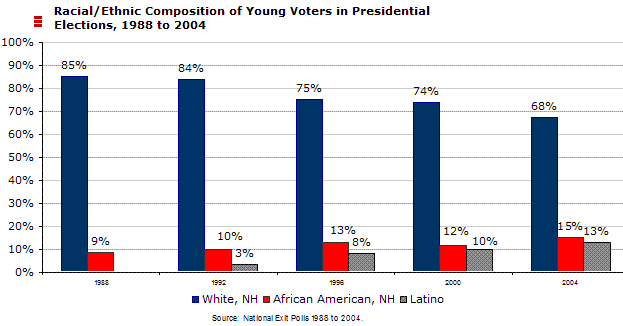
Estimating turnout by race is an inexact science, since the actual race (or ethnicity) of a voter is never officially recorded. At CIRCLE, we joke that our latest fact sheet is two pages of results plus three pages of caveats. (I spent a lot of time helping to write the latter.) However, all cautions aside, this study is based on apples-to-apples comparisons and makes reasonable estimates.