Category Archives: Uncategorized

costs and benefits of voting

When you ask citizens why they didn’t vote, many say that the process was inconvenient and time-consuming. (See the table below, which uses 2002 Census survey data.) Their answers suggest that we could increase participation by making it easier to vote, e.g., by turning election day into a national holiday, by allowing early voting or voting-by-mail, or permitting citizens to vote online. But evidence from states that have adopted some of these reforms shows a modest impact. The Motor-Voter law, which was supposed to increase turnout by simplifying registration, did raise the registration rate but not actual turnout in elections.

I have come to think that answers to surveys like the following are misleading. After all, costs and benefits are two sides of the same coin. Someone who says that he lacked the time to vote is also saying that voting was not especially important to him. He actually had time; but other things seemed relatively more pressing. I think the turnout issue comes down to motivation. When issues seem important, when outcomes are uncertain, and when campaigns reach out to mobilize and inform voters, turnout goes up–as it did sharply in ’04.

too busy, schedule conflicts 27.1%
out of town, away from home 10.4
transportation problems 1.7
all time and convenience problems 40.6
not interested or felt vote would make no difference 12.0
did not like candidates or campaign issues 7.3
all dissatisfaction issues 19.3
illness or disability 13.1
bad weather 0.7
all special barriers 13.8
registration problems 4.1
forgot to vote 5.7
other reasons (not specified), don’t know, or refused 16.5

the future of public broadcasting

I know quite a few people who work in and around public broadcasting; and over the years I have been involved in several behind-the-scenes projects with them. So my heart is with public radio and television. However, I wonder if there really is a future for federally-funded mass media. It seems to me that several major factors are working against it:

1. Liberals and conservatives both sincerely believe that the mainstream private media are strongly biased against them. This doesn’t mean that they are both right; but their feelings are genuine and deeply held. It’s difficult to influence Fox or CBS if you don’t like its prograns, but any organized group can apply political pressure to the Corporation for Public Broadcasting. Therefore, as long as liberals and conservatives feel victimized by most of the mass media, they will be sorely tempted to try to move CPB in a favorable direction. Trying to argue for “neutrality” or “balance” won’t protect public broadcasting, because there is no such thing as an ideologically neutral form of communication. Nor will it work to argue for “independence.” Some governing board must run CPB, and its members must somehow be chosen by politicians. Short of empanelling a jury of random citizens to manage public broadcasting, there is no such thing as “independence.”

2. Many Americans are moved by what I have called the “Jeffersonian principle.” Jefferson once wrote, “to compel a man to furnish contributions of money for the propagation of opinions which he disbelieves and abhors, is sinful and tyrannical.” It’s actually impossible to have a government without compelling people to fund the “propagation of opinions” that they dislike. For example, as long as we pay the salary of a president, he (or she) may say things we abhor. Nevertheless, Americans see a moral harm if they are forced to pay tax dollars for communications that they disagree with. It doesn’t matter how trivial the cost. Therefore, people will get much more angry about programming supported by CPB than anything on the commercial networks.

3. CPB has always had a top-down model: famous and distinguished people conduct a “peer review” processes to allocate funds. This is elitism, for better and for worse. It certainly doesn’t help to build a strong popular base.

4. A major rationale for public funding was the monopoly of the major networks ca. 1970. On its face, the media environment appears much more competitive and pluralistic today.

5. Much of the most creative “public media” doesn’t seem to need federal money or access to the broadcast spectrum. It consists of websites, low-power radio stations, blogs, podcasts, and other quasi-amateur work.

I’m torn between two strategic arguments. One says: All the grassroots, amateur media work is small potatoes. It’s destined for a niche market of hippies and hackers. We can work to grant low-power radio stations more rights and to relax certain intellectual-property laws to enhance the free sharing of information, but these reforms will have a marginal impact, at best. Ultimately, any great democracy must create an organized, mass public media space, of which the BBC is a classic example.

The other says: Congress will never appropriate substantial amounts of money for a broadcast system that’s of high quality and independent (whatever that would mean). Fortunately, many-to-many media like blogs can compete with mass commercial media, because the former are more creative and more fun. Thus the realistic strategy is not to worry about CPB but to put our energies into a media system that’s pluralistic, decentralized, and basically free of federal dollars.

the civic renewal movement (3)

In two recent posts, I began to describe the current movement for civic renewal. First, I listed some key elements of the movement; then I identified some common themes. In this last of the three posts, my topic is “the strength and growth of the movement.”

I am convinced that the civic renewal movement now forms a reasonably tight and robust network. My basis for that claim is the set of social ties that I observe as part of my official work, which involves numerous meetings and conferences in many parts of the United States (probably more than 75 per year). I am constantly struck by the appearance of the same people, or of people who know others in the broader network.

This is a mere impression. It could be tested with rigorous network analysis, which I believe would be quite useful. In brief, researchers would begin with several key organizations (such as the ones listed above) and ask decision-makers what other groups they collaborate with. Researchers would then move to those groups and ask, in turn, about their collaborations. Software can automatically generate network maps based on such data. I would hypothesize that a network map of civic renewal would show many links binding the whole field.

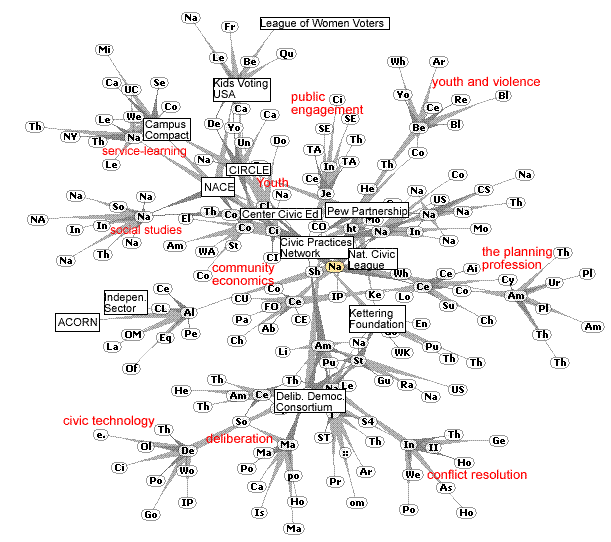
Lacking the resources actually to conduct such a study, I have used a very imperfect substitute. Instead of asking people to list their partners, I have examined electronic links among organizations? websites. Those links that are captured by the Google search engine can be depicted as a diagram. (Very regular readers may remember me doing something like this once before.) The image below shows major web links from three nodes–the National Allicance for Civic Education, the Deliberative Democracy Consortium, and the Pew Partnership for Civic Change–and from groups to which they link. I chose these three nodes as starting points because of my (highly subjective) sense that they represent important consolidations of practice since the 1990s. In particular, civic education and deliberation were fractious fields that began relatively late to form bridging networks?and then only as a result of rather careful and deliberate diplomacy.

Points on the graph represent organizational websites. Lines represent links among sites, as detected by an automated (and imperfect) Google search. I have written out the names of some of the points for illustrative purposes. The phrases in red are my generalizations about types of organization that cluster together.

Overall, the diagram shows a robust network: one can move by multiple paths from each sector of civic renewal to the others. I am certain that a more detailed process would reveal additional links. For example, I know that people in the civic technology sector (bottom left) work with people in service-learning (top left), even though the diagram shows no direct links.

It is important to note that the civic renewal movement may be robust and coherent, but it is insufficiently diverse. Most of the organizations listed above are predominantly, sometimes exclusively, white. Minorities are best represented in the work that involves community economic development; they are not well represented in civic education or in much of the deliberation field.

My second claim involves growth. I believe that the civic renewal movement is stronger, larger, and more influential than it was 10 or 20 years ago. This is a difficult claim to substantiate. When we work in social movements, we tend to make two historical assertions without hard evidence. To motivate ourselves and to win allies, we tend to assert that our problem is getting worse, and that a movement has recently formed to counteract it. Given the ?churning? that is endemic to American civil society, it is not obvious that the country?s civic condition really has declined or that a civic renewal movement has recently developed. Maybe every generation could make the same claims.

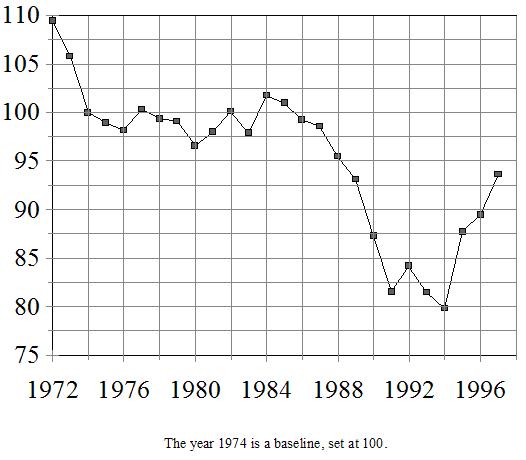
However, some aspects of civic life certainly have declined, and some new strategies and organizations certainly have formed to renew civil society. When the National Commission on Civic Renewal created an Index of National Civic Health (INCH) in 1999 (comprising 22 variables), we generated the trend line shown below.

I believe that the steep decline of INCH between 1984 and 1991?reflected in almost all of its 22 component variables?created genuine alarm and caused people to focus on civic renewal by the mid-1990s. For various reasons, including the work of these people, the situation had begun to improve by 2000. This is not to say that INCH includes all relevant variables or that there is consensus in favor of the proposition that ?civic health? had declined. But there was pretty widespread agreement, rooted in people?s daily experience, that we had a problem. (Unfortunately, I don?t have comparable data for after 2000, so I can?t continue the trend line after Sept. 11 and the first Bush Administration.)

If I were to tell story of the current civic renewal movement in America, it would incorporate the following developments and episodes:

  • The aftermath of the Great Society. During President Johnson?s War on Poverty, the Federal Government paid the salaries of thousands of people who worked at the grassroots level, organizing communities and running programs. The Great Society included elements of bureacuracy and centralization, but it also required the ?Maximum Feasible Participation? of citizens. As a result, there was a lot of civic experimentation. Some people who were heavily involved in those experiments later switched over to electoral politics. Some burned out or lost the opportunity to serve when their budgets were cut. But a considerable number continued to experiment and learn, often moving from federal programs to nonprofits. When they lost their government grants, they developed local financial sources. When they got tired of fighting city hall, they developed collaborative relationships with local governments. This human trajectory is a major theme in Sirianni and Friedland’s Civic Innovation in America. It means that there’s a generational aspect to the Civic Renewal movement. The movement partly reflects the maturation of the Baby Boom and the arrival of younger people whom the Boomers mentored.
  • The defeat of the Soviet Union at the hands of civil society. Well before 1989, most leftists in the West had become thoroughly disenchanted with the Leninist regimes of the Warsaw Pact. Nevertheless, the fall of the Soviet Union and the triumph of Havel, Walesa, Gopnik, Sakharov, and the other dissidents was an important moment for the Western left. It clearly displayed the moral superiority of civic work over Marxist state-centered politics. And it revealed that civic culture was an important historical force, not merely a phenomenon of the underlying economic system. Because dissidents built healthy civic spaces in Poland, the former Czechoslovakia, and Hungary, those countries could overthrow communism and build democracy. In countries that lacked a strong civic culture, the same overthrow led to civil war.
  • The crisis in development: As authors like James C. Scott and Michael Edwards have argued, economic development is usually disastrous when it relies on social engineering and top-down mandates. Even when governments are reasonably well-meaning, as in Tanzania or India, state efforts to promote growth and equity usually backfire. Again, what seems to matter most are democratic institutions and political culture. As Edwards argues, “It’s the polity, stupid.” Edwards had a stint at the World Bank at a time when many of the lending institutions were beginning to recognize the importance of civil society.
  • The “Bowling Alone” thesis. More interesting, perhaps, than Robert Putnam’s argument and data was the enormous impact of his short article in the Journal of Democracy. As Bill Galston wrote, ?Seldom has a thesis moved so quickly from scholarly obscurity to conventional wisdom. By January 1996 the Washington Post was featuring a six-part series of front-page articles on the decline of trust, and Beltway pundits had learned the vocabulary of social capital.? The National Commission on Civic Renewal was a direct result of Putnam’s article, as were many other projects and initiatives.
  • the civic renewal movement (2)

    Yesterday, I listed some major fields of practice that I consider important to the overall movement for civic renewal in America. Today (while I attend a day-long meeting on service-learning), I will summarize some of the common themes that define all those fields.

    1. Civic renewal work is open-ended: Instead of defining problems and solutions in advance, many leaders of the networks that I described yesterday prefer to create open forums in which diverse groups of citizens can set their own course. I realize that perfect neutrality is impossible. (Even in a deliberative exercise, someone must issue an invitation that will somehow shape the conversation that ensues.) Besides, being “open” to diverse views is not always wise; it’s fine to commit oneself to fighting poverty or AIDS, or even defeating a particular political party. But the civic renewal movement is defined by a commitment to helping citizens make their own decisions. I find this commitment appealing for several reasons: it reflects the best spirit of liberal education, it builds citizens’ capacities for self-government, and it creates the hope that we may together develop alternative policy options and ideologies, for none of the existing ones seem impressive.

    2. Civic renewal work combines deliberation with action: Many of the projects I described yesterday involve careful, reflective conversations among diverse people. They also involve political work–not only voting or otherwise influencing the state, but also managing common resources and building local institutions. Deliberation without work is empty, but work without deliberation is blind.

    3. Civic renewal work treats the political culture as an important variable: There are ideologies according to which the “root causes” of poverty, crime, racial exclusion, and even environmental degradation are all economic. If that were true, it would be superficial to work on public deliberation or civic education; we should first make society more equal and fair. Under conditions of injustice, public discussions would simply reflect (and perhaps even legitimize) the inequality of knowledge, status, power, and other resources. However, participants in the civic-renewal movement reject this argument, seeing it as a recipe for hopelessness–and a way to avoid actual public deliberations). Instead, they place their bets on enhancing people’s political opportunities, even while economic conditions are unfair.

    4. Civic renewal work builds sustained civic capacity: Although each project is devoted to a specific task, the leaders of these projects are always thinking about other matters as well–especially, how to involve more people in politics, strengthen the social ties that individuals can use to solve common problems, enhance institutions, and make better information available.

    5. Civic renewal work is non-partisan: There is nothing wrong with affiliating with a party or holding ideological views (I do). However, open-ended work is, by definition, distinct from partisan work. At a time of intense partisan polarization, it’s important that some people, some of the time, are concerned about the overall political system and culture in which our two major parties compete.

    6. Civic renewal work is concerned with the human scale: Politics certainly takes place at a macro level–in national elections, the mass media, and struggles among nations. The macro level is important, but so is the micro, because it is only in groupings of modest, tangible size that people can develop the skills, attitudes, and networks that allow them to participate effectively in national affairs. (See “two levels of politics” for more on this.)

    the civic renewal movement

    In three consecutive posts this week, I plan to argue that there is a strong, coherent, interconnected movement for civic renewal in America. This first post simply describes some major elements of that movement. In no particular order, they include:

    deliberative democracy work

    For some thirty years, people have been organizing groups of citizens at a human scale (say, five to 500 people) to discuss public issues, with background materials and some kind of moderation or facilitation. Major organizations in this field include the National Issues Forums (self-selected adults deliberating face-to-face, with published guides), Study Circles (a similar process, but usually more embedded in community organizing), Deliberative Polls (randomly selected citizens who meet for several days), and online forums such as E-The People. Models and practices are proliferating; in fact, my forthcoming book, co-edited with John Gastil, describes more than a dozen in detail. Most of the relevant groups have come together in the Deliberative Democracy Consortium.

    Work on deliberation shades into conflict-mediation efforts, inter-group dialogues (which usually involve discussions of identities and relationships rather than issues), and even new mechanisms that governmental bodies are using to “consult” the public. The National Coalition for Dialogue and Deliberation is a broad forum for all these practices.

    community-based wealth generation

    Deliberation also occurs within non-profit corporations that aim to create jobs and income, and that are formally tied to neighborhoods or to specific rural areas. These corporations include co-ops, land trusts, and community development corporations (CDCs), among others. Community Wealth.org is a good clearinghouse of information. As I argued last week, capital-mobility is a major challenge for democracies, because citizens must do what companies want or else investments will move away. Creating corporations that are tied to communities is a promising solution, and there are more of these corporations every year.

    democratic community-organizing work

    The Industrial Areas Foundation (which has created and worked with many CDCs and other neighborhood corporations) represents a form of community organizing that builds poor people’s political capacity as well as their wealth. Instead of defining a community’s problems and advocating solutions, IAF organizers encourage relatively open-ended discussions that lead to concrete actions (such as the construction of 2,900 townhouses in Brooklyn, NY), thereby generating civic power. IAF is a major force in this field, but not the only one. A related stream of practice is Asset-Based Community Development (ABCD), which emphasizes the importance of cataloguing and publicizing the assets of any community as a prelude to development. The aim is to shift from thinking of poor communities as baskets of problems, and instead recognizing their intrinsic capacities.

    civic education

    From the 1960s through the 1990s, most scholars argued that explicit civic education had no lasting effects. In the same period (although not only because of the scholarly naysayers), schools tended to abandon civic courses and curricula. Nevertheless, a set of nonprofit organizations continued to provide textbooks, programs, and seminars for teachers. These groups included the Center for Civic Education, the Constitutional Rights Foundation, Streetlaw, and the Bill of Rights Institute, among others. Their programs have usually combined focus on perennial democratic principles with the investigation of immediate issues relevant to students. They also tend to combine experiential learning (e.g., debate, community-service, advocacy) with reading and writing.

    Since 1999, these nonprofits, traditionally fractious, have come together to create the National Alliance for Civic Education and then the Campaign for the Civic Mission of Schools. The Campaign is a coalition of the leading organizations that specialize in formal civic education, plus major organizations that have pledged to support their agenda, including the American Bar Association, both national teachers’ unions, the National Conference of State Legislatures, and 35 more.

    service-learning

    A particular strand of civic education involves combinations of community service with academic study of the same topic. Service-learning is popular not only in k-12 schools (about a third of which now offer it), but also in colleges. Much service-learning is non-political; it involves acts of charity and service, such as cleaning up a park or visiting elders. Often the underlying theory derives from experiential education (i.e., kids learn best from doing) and doesn’t have much to do with civic or political values. However, within the large field of service-learning, there is avid discussion of how to engage young people in solving social problems–as a pedagogy.

    community youth development

    Much of the best civic education takes place not in schools but in youth groups that are concerned primarily with healthy adolescent development. Increasingly, adults in 4-H, the Scouts, and urban youth centers believe that engaging teenagers in studying and addressing local social problems is a good way to develop their intellects and characters and to keep them safe. Much like proponents of asset-based community development, these people want to treat their subjects (in this case, kids) as partners and assets, not as bundles of problems. They also emphasize local geographical communities as excellent subjects for youth to study and as venues for youth work. The Innovation Center for Community and Youth Development and the Forum for Youth Investment are important hubs in this movement. The Coalition for Community Schools brings a similar set of values to its work with k-12 schools.

    work to defend and expand the commons

    The “Tragedy of the Commons” is the tendency of any resource that isn’t privately owned to be degraded as people over-use it or fail to invest in it. The Tragedy is real: consider the collapse of global fish stocks due to over-exploitation. However, many un-owned resources actually flourish for generations or even centuries. And robust new “commons” are developing: above all, cyberspace (understood as a whole structure, not as a series of privately owned components). Scholars like Elinor Ostrom, working closely with communities, have begun to understand the principles that underlie effective commons–whether they happen to involve grasslands or scientific knowledge. Practical work to protect and enhance commons is underway within the American Libraries Association and in the environmental field. Since the keys to robust, sustainable commons include public deliberation and the wide dispersal of civic skills and attitudes, commons work is closely related to civic renewal.

    work on a new generation of public media

    When we hear the phrase “public media,” we may think first of publicly subsidized organizations that produce and broadcast shows to mass audiences. Indeed, within the constellation of PBS, the Corporation for Public Broadcasting, NewsHour Productions, and the state PBS affiliates, there is some interesting work going on that could support civic renewal. The Center for Social Media recently received a large Ford grant to explore the future of public media. People at that Center recognize that “public media” is much broader than CPB; it should include any use of any communications medium to promote the creation and sharing of ideas and cultural products relevant to public issues. So defined, the most compelling public media today originates from thousands of grassroots groups that are creating websites, email-based discussions, and audio and video segments. J-Lab, the Institute for Interactive Journalism, represents a hub for this work.

    There is also relevant work inside newspapers. In the 1990s, many professional journalists were interested in writing the news in ways that would better support public deliberation. That movement–variously called “civic journalism” or “public journalism”–has run out of steam as a political force, but it has left an important residue in newsrooms. Furthermore, because of the Internet, newspapers are desperate to become more “interactive.” Although interactivity can be a mere gimmick or a way to enhance an individual’s experience on a website, some journalists are experimenting with interactive features like blogs for democratic purposes. Jay Rosen keeps track of them.

    Public media work and work to defend the commons come together in the field of positive hip-hop. Youth of all races are now producing music and poetry that confronts serious social problems and that depicts themselves as three-dimensional human beings, not as thugs. Hip-hop usually involves borrowing, quoting, and parodying snippets from the mass media. This is a powerful democratic activity, but it can violate over-restrictive copyright laws–which is why the idea of a commons is relevant. Young people in the hip-hop world are increasingly aware that they have a stake in dry issues like copyright.

    development of social software

    I mentioned blogs in the last section. They are one example of a new behavior that is enabled by software. Many developers are working on other software to enhance discussion and collaboration. Examples include “real simple syndication” (RSS), wikis, and “content management” systems that allow many citizens to create public documents together. (A great example is a whole newspaper, the Bakersfield, CA, Northwest Voice, that consists entirely of material submitted by citizens.) While some of this frenzied innovation is driven by purely technical interests and goals (and by the prospect of making money), there is also a strong subculture of “hackers” who are committed to the commons and to democracy.

    the engaged university

    Some universities are playing central roles in civic renewal work, as they move from service to partnerships; as they rediscover the importance of the geographical communities in which they are located; as they reflect on the democratic potential of their power as employers, builders, and consumers; and as they conduct sophisticated research that requires learning with and from non-academics. Minnesota (see the Council on Public Engagement), Michigan (see Imagining America), Penn (see the Center for Community Partnerships), and Maryland (see the Democracy Collaborative) are leaders. Campus Compact is a major hub.