Category Archives: Uncategorized

a new map of civic renewal

Several times before, I have made “maps” of the civic renewal movement, using software to diagram the links among websites in the civic field. (See this effort and then this one.) Web links are not reliable evidence of collaboration. However, people create links because they consider another site interesting or important, and that means something. Network-mapping software starts with a short list of sites that you provide as examples of a field or movement. The software analyzes web links among those sites and clusters them together depending on how closely they are interlinked. It also finds other sites that have many links to the ones you started with, and adds them to the map. By examining the final product, you can draw some inferences about what organizations belong in a field, which ones are central or peripheral, and where gaps exist.

I previously used TouchGraph’s GoogleBrowser, which is cool and easy. This week, however, I tried again with IssueCrawler from the Govcom.org Foundation in Amsterdam. IssueCrawler is more sophisticated and flexible. After “crawling” hundreds of linked sites, it generated a cluster map of civic renewal and a circle map of civic renewal. The cluster map is best for showing which organizations are central. The circle map shows the density of links within the network: a very dense community would look like a ball of thread. (Note: You may need to install a browser plug-in to view these .svg files: you can get it here.)
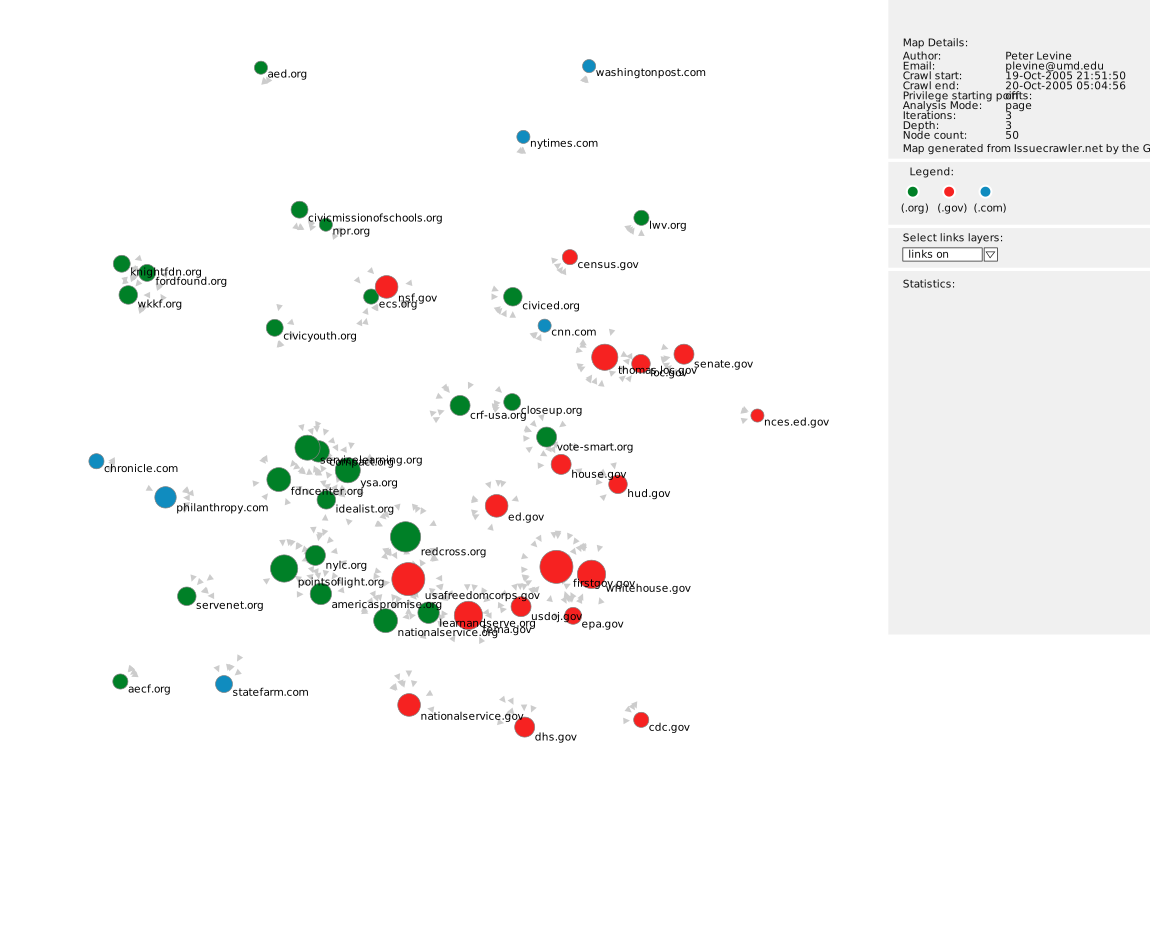
Overall, the cluster map shows a set of youth engagement and volunteering organizations that are linked, on one side, to foundations (which fund them) and on the other to government agencies (because they link to official information and interact with the state). A few commercial news sites also appear.

Alas, I forgot to save a list of my initial nodes. However, I’m sure that I started with sites that represented deliberative democracy, community economic development, civic education, and voluntary service. Among the good sites that disappeared from the analysis were the Civic Practices Network and the Pew Partnership for Civic Change. This doesn’t show that these sites are unimportant; only that they don’t connect to the world of civic education and community service that the computer decided was central.

I’m not terribly impressed by the product of this particular IssueCrawler search, although it may show that the civic renewal field is less unified than I had previously thought. If the maps mean anything, they indicate that the world of youth civic education and service is unconnected to deliberative democracy and community development–and that would be bad news if true. In any case, the software is useful and powerful, and I want to learn to use it better.

network organizations

Today and yesterday, I’m participating in steering committee meetings ofthe Deliberative Democracy Consortium. Tomorrow, I’ll be chairing the steering committee of the Campaign for the Civic Mission of Schools. I also participate in three or four other organizations that have similar forms. They all have small paid staffs that are funded by grants from foundations. Individuals and ex officio representatives of nonprofit groups serve on their steering committees and do quite a lot of the work, on a voluntary basis.

I love this kind of organization and donate, I suppose, thousands of hours per year to them in the aggregate. They have great potential. They also face some characteristic challenges, including:

  • competition for limited funds between the staff of each network organization and its various members
  • unclear lines of authority, since the staff are accountable to the funders, but they are also expected to be “steered” by their steering committees
  • unequal and sometimes sporadic contributions of voluntary effort from steering committee members
  • a tradeoff between trying to create a “big tent” and pursuing a focused agenda
  • A combination of these challenges has made the National Alliance for Civic Education, which I helped to found, basically moribund. The groups I’m meeting with this week are in pretty good shape, as are Imagining America and the umbrella organizations in service-learning. All these organizations need to learn how to use new technologies to get more people involved in doing their work; and they all need to expand their revenue sources so as to diminish competition for funds. But it may be that the challenges that these groups face are perennial, and that’s why civil society is constantly “churning”–generating new networks while others fall apart.

    Karl Rove and the first amendment

    Some time ago, I wrote a post entitled “Why I Don’t Care About Karl Rove” that provoked passionate criticism on a few other sites. I was concerned about all the excitement that the Plame investigation was causing on the left, because I thought the scandal was a distraction. The Bush administration is on its way out, and the only thing that matters now is the national debate about issues and ideologies.

    The problem with the administration has always been its overt priorities and decisions, not the secret behavior of key players. If Rove is convicted of a crime, that will have little effect on the future of politics, because he and his chief client will not be on the ballot in ’06 or ’08. I doubt very much that voters will draw the conclusion that Republicans are law-breakers. They have plenty of experience with Democrats who have been convicted of more mainstream crimes. Instead, they will be reminded that politics is a hard-ball game played by crafty Washington professionals that has little to do with ideas and makes little room for citizens.

    Those were the important points, but I realize that I have another qualm about the Plame investigation. If Karl Rove did identify Valerie Plame to reporters, then he shared information with the press. Our presumption should always be that such speech is protected by the First Amendment. It is precisely when we despise the speaker and his motives that we should be most careful about constitutional rights.

    There is a law (“section 421”) against revealing the name of a covert CIA agent “when the United States is taking affirmative measures to conceal such covert agent’s intelligence relationship to the United States.” I guess this law is constitutional. However, I’m not sure I like it; I’m not sure I like any law that is very little known and hardly ever enforced, especially if it prohibits the release of true information to the public. If the statute is enforced in this case, then it must apply to everyone who leaks the names of covert agents–not just political operatives like Karl Rove, but also patriots who want the press to know that the CIA is involved in bad behavior. If the Special Prosecutor ignores section 421 and instead uses a broad conspiracy or espionage charge, then we should be even more concerned about an expansion of state power and new restraints on the press.

    William Kristol seems to think that Democrats are deliberately trying to criminalize conservative leaders, as shown by the ongoing investigations of Frist, DeLay, Rove and others. I don’t see how that can be true, since several of the investigations are controlled by Republican appointees or civil servants working in the Bush administration. Harry Brighouse has a simpler answer: Lots of criminal investigations are underway “because there seems to be prima facie evidence that prominent conservative Republicans were up to their eyes in criminal activities.”

    My thought: People who are under investigation are innocent until proven guilty. The political consequences of any convictions would probably be bad for Bush, although they might provoke a backlash favorable to his interests. In any case, it is crucial not to focus on the short-term political consequences for any person or party, but rather on justice and the long-term consequences for law and our political culture. To be sure, failing to investigate people like Rove, Libby, Frist, and DeLay could create a culture of impunity. On the other hand, targeting politicians for prosecution can be just as damaging, if it makes public service appear dangerous, if it convinces the opposition party to rely on criminal convictions rather than arguments about policy, or if it causes us to ignore constitutional principles (as was clearly the case in the Ken Starr investigation). Rove has done “collateral damage” to American political culture, but that doesn’t excuse prosecuting him in ways that would make matters even worse.

    Mobilizing American’s Youth (MAY)

    I had an inspiring meeting this morning with folks from Mobilizing American’s Youth. MAY has more than 25 “mobilizer teams” across the country that bring together youth of diverse ideological perspectives to discuss issues and develop common agendas. They train these teams, partly using their Mobilizer’s Guidebook. They also have an online Youth Policy Action Center that provides information about issues and easy ways to make one’s voice heard. MAY is a perfect example of the core values of the “civic renewal movement,” as I’m calling it. MAY is ideologically open-ended and pragmatic, deliberative, collaborative, committed to political engagement (voting and beyond), and oriented to the civic development and leadership of the next generation. Whenever you are about to despair about our political culture, you need to interact with a group like this one.

    en route

    I try to post something substantive here every workday. In fact, I’ve addressed one topic or another for the last 700 days except during family vacations. However, as Monday, Oct. 10 begins, I’m waiting for a delayed midnight flight from Atlanta to Columbus, OH. (We were in rural Georgia for a true Southern family reunion, complete with a pig roast. I’m going to Columbus for a meeting on service-learning that John Glenn will address.) I feel tired enough, as I await this late flight and the prospect of two days of meetings, that I don’t expect to be able to manage a substantive post until Tuesday at the earliest.

    PS, By the time I got online and had a chance to post this, I learned some news that’s exciting to acknowledge. The great Tom Schelling, a colleague at the Maryland School of Public Policy, has just been awarded the Nobel Prize for Economics. He joins Amartya Sen as one of my two favorite winners ever. He’s not only a brilliantly original social scientist who has wrestled with the vital questions of the day (from nuclear war to global environmental threats); he’s also a beautiful writer and a true gentleman.