Category Archives: Uncategorized

interracial tolerance among the young

My organization is cited in this story in USA Today: Sharon Jayson, “New generation doesn’t blink at interracial relationships”:

Ryan Knapick and Josh Baker have been best friends since fifth grade. Colette Gregory entered the picture in high school. She and Josh are dating now. Knapick is white, Gregory is black and Baker is half-Hispanic. To them, race doesn’t matter. …

He and his friends are among an estimated 46.3 million Americans ages 14 to 24 ? the older segment of the most diverse generation in American society. (Most demographers say this “Millennial” generation began in the early 1980s, after Generation X.) These young people have friends of different races and also may date someone of another race.

This age group is more tolerant and open-minded than previous generations, according to an analysis of studies released last year by the Center for Information and Research on Civic Learning and Engagement, part of the University of Maryland’s School of Public Policy. The center focuses on ages 15 to 25.

While the youngest generation is the most tolerant on record–and that’s a fact worth celebrating–our research showed a gap between attitudes and behaviors. For example, only 4% of young Americans (age 18-25) say that they favor segregated neighborhoods. That’s down from about 25% in the 1970s and it’s lower than the rate among people over age 25. This change is almost entirely attributable to the arrival of new generations: individuals do not seem to change much over their lifetimes. (Source: General Social Survey.)

Nevertheless, more than half of young churchgoers say that their congregations have members of only one race–the same rate as among older people, and not much different since 1975 (GSS). In the Social Capital Benchmark Survey (2002), 66% of young White people who belonged to participatory groups said that all the other members were also White. This rate was not much different for older Whites. In the same survey, just 20% of young people claimed that they had invited a friend of another race to their house–better than the 6% rate among adults over age 56, but still not so common.

Will tolerant answers to survey questions translate into real social change if people remain quite segregated in their daily lives?

religion and politics in the Muslim world and the USA

A colleague returned several months ago from a distinguished meeting of intellectuals from Europe, America, and the Middle East. He reported that the Islamic participants had confused us with France. That is, they thought that the United States was a highly secular, formerly Christian country with low tolerance for faith. Presumably, they drew generalizations about the “West” on the basis of what they know about the European countries that had once colonized them and that now absorb many of their emigrants.

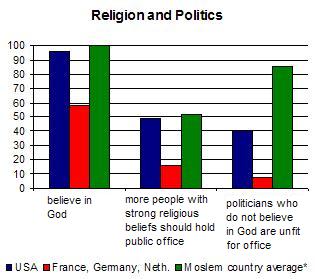
In reality, Americans’ opinions about religion and politics sometimes lie closer to those in the Islamic world than to those of Western Europeans. Above, I show data from the World Values Survey (1999-2003). The “Moslem country average” is an unweighted mean of Algeria, Egypt, Jordan, Morocco, Pakistan, and (for the belief in God question only) Saudi Arabia. I show an average of France, Germany, and the Netherlands as representative of Western Europe.

Since Denmark is in the news, I’ll mention these results: 68.9% of Danes believe in God (compare 100% in Pakistan and Egypt, and 96% in the US), 3.7% of Danes think that a politician who doesn’t believe in God is unfit for office (compare 94.9% in Pakistan); and 5.6% of Danes think that it would be good for more religious people to hold public office (compare 91.2% of Egyptians).

what do parents want?

We human beings are not born free. We are born as completely dependent, totally naive little creatures that are easily influenced and controlled by adults, especially parents. If you want a society dedicated to freedom, then you have to ask whether parents are raising their kids to value liberty. If not, then you face a conundrum: you may have to force people to raise free children. Indeed, this is a common rationale for public schools, which are supposed to expose kids to a broad array of values from which they can choose. If you favor a basket of values that includes compassion, patriotism, and tolerance as well as freedom, then you must certainly worry about whether parents teach these values.

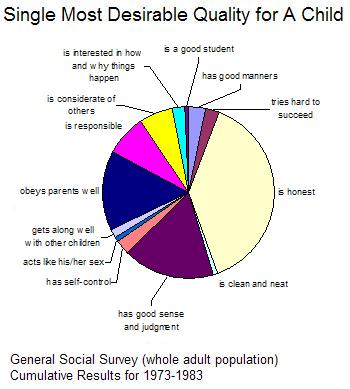
I am therefore highly curious about what parents want for their kids. The pie chart below shows the “qualities” that parents (defined as individuals who had ever had kids) said that they valued most in children. They were surveyed between 1973-1983. I haven’t found more recent data, although it may exist.

Some observations: Honesty dominates, far outstripping considerateness and getting along with others. Only three percent chose the intellectual virtues of curiosity and studiousness. (I wonder whether that number has increased since 1983, as we move deeper into the high-tech era.) Obedience to parents is not the top choice of many people. However, more than half of respondents chose obedience as one of their top three virtues.

[NB: I aggregated a decade’s worth of data to make the sample size as large as possible, but there are no important changes in the answers over that period.]

into the fray

Somewhat contrary to my usual practice, I hereby opine (without expertise or evidence) on two hot topics:

1. New Orleans Mayor Ray Nagin has attracted much criticism–and has apologized–for saying, “This city will be a majority African-American city. It’s the way God wants it to be. You can’t have it no other way. It wouldn’t be New Orleans.” Nagin has been called racist for setting a racial target in that way. It would certainly be out of bounds for someone to suggest (for instance) that Denver must stay 80.6% white. However, lots of people want to preserve or recreate the traditional culture of New Orleans. That culture is inextricably linked to race. I realize that the city was never monoracial. In fact, the traditional culture of New Orleans will be lost if working-class white Cajuns or rich whites from the Garden District choose not to return. It’s a subtle question whether the city needs an African American majority to restore its culture. But New Orleans was 67% Black before Katrina, so anything below 50% would be a big drop–and a big cultural change.

“Culture” is a more comfortable concept than race, but the two cannot be separated. If you hope to preserve or restore the characteristic culture of New Orleans, you have to bring back the Black population.

2. Danish cartoons satirizing (or did they simply depict?) Mohammed have ignited riots in at least half a dozen countries. In cases like this, it seems important to separate the questions that could be asked:

  • Should the Danish Government ban the publication of these cartoons or punish the responsible newspaper, the Jyllands-Posten? No: that would violate freedom of the press.
  • Should the Jyllands-Posten have published the cartoons? No: they aren’t funny, they don’t have news value, and their only purpose appears to have been to demonstrate that the press is free in Denmark. That’s a bad editorial decision, to put it mildly.
  • Should newspapers in several other European countries republish the cartoons to establish their own freedom? No: duplicating a bad editorial decision is an even worse one.
  • In response, should people attack the Danish, Norwegian, Austrian, and US embassies or consulates in multiple countries? No: that’s violent. It’s also a basically impotent form of rage that mainly demonstrates the vulnerability of the rioters.
  • citizenship: choice and duty

    Russell Arben Fox has written a thoughtful essay on localism, populism, and participation. He is skeptical that we can increase the quality or quantity of civic engagement by tinkering with the political system–for instance, by changing the way we draw electoral districts or by decentralizing power. The root of the problem, Fox thinks, is psychological; it is the “privatized model of the modern democratic citizen.”

    Today, people don’t feel assigned to duties in communities. Instead, they are supposed to make judicious choices among politicians and policies in order to get desired outcomes. But it is often easier to move one’s jurisdiction than to affect its policies. (“Exit” is easier than “voice.”) People congregate in the most privileged geographical communities that they can afford, rather than trying to improve the more diverse communities from which they came.

    In short, the overwhelming success–depending on how you define the term–of modern market economies has had the result of many citizens adapting themselves to habits of gratification, self-actualization, immediacy, individuation, and internalized (that is, nonpublic) rationalization. Decisionmaking has been reduced in the lives of too many of us to a perpetually self-generated and always self-revisable internal calculus: what do I want, and what do I want now? I am not saying the disciplines and expectations associated with free markets are flawed; I am saying, however, that market-appropriate behaviors are not appropriate to self-government. A relatively successful market economy, combined with a superficial sense of equality bequeathed to us through a naive understanding of one’s ‘rights,’ results in a general indifference towards others so long as one’s own rights and property are acknowledged; hence, the more the dominant segments of society are socially and economically homogenized (enjoying at least superficially an easily replicable level of prosperity across society), the easier it is for those citizens in that class to retreat within themselves and assume everyone else will do likewise. Our sensitivity to truly public matters decline, and our political muscles atrophy. Of course, the enormous leaps in personalized technology, which have allowed us to connect ourselves to networks of art and information that involve no collective determination or distribution, as well as the abandonment of truly involving civic requirements (like a draft), only reifies this process further.

    I largely agree and would add some supporting points. First, there is evidence that citizenship has shifted from a model of ascribed duties to one of choice. That process of “modernization” occurred in the Progressive Era and was marked by such reforms as: the secret ballot, attacks on political parties (which represented identity groups), the rise of a nonpartisan, independent press, and a profound shift in education. (Instead of sermonizing about duties, schools and universities began to provide arrays of autonomous academic methods and disciplines from which students could freely choose.)

    Second, I agree that the new model of citizenship has flaws:

  • Making judicious choices among policies is very demanding. It takes time, information, and motivation. If this is what citizenship requires, many people will not participate at all. For instance, when party-line voting declines, so does turnout.
  • As Gerry Stoker writes in a passage that Fox quotes, a market system creates expectations of choice, ease of transactions, efficiency, and customer-service that cannot be met in politics, because politics involves debate and conflicting interests. Therefore, people accustomed to consumerism will tend to shun politics.
  • At some deep level, a life spent making instrumental choices is unsatisfying. Perhaps we can choose political parties and politicians in order to advance non-political goals, such as security. But if we choose our family ties, our neighborhoods, our religions, and everything else for instrumental reasons, what is the purpose of it all?
  • Third, I agree with Fox that the modernist definition of citizenship is here to stay; we cannot return to a widespread sense of ascribed duty. In 2002, we surveyed young Americans and asked how they felt about voting. Thirty-one percent said it was a right, and 34% said it was a choice. Twenty percent said that it was a responsibility, and 9% said that it was a duty. These results may change a little over time, but they will not turn upside-down.

    Nevertheless, I suspect that there are political reforms that could improve the current situation. Civic engagement does have an intrinsic appeal, at least for some people some of the time. There are few other venues in which one can deal with diverse peers on terms of rough equality, addressing serious and dignified concerns. Thus, for some people, opportunities to participate create lasting habits; engagement is self-reinforcing. This is especially true for youth: a mass of research in developmental pyschology shows that civic experiences in adolescence have lifelong effects.

    This is where localism comes back. Fox is right that “professional turf-guarding can occur in local jurisdictions.” However, the dramatic consolidation of such jurisdictions has left a lot fewer professionals guarding a lot more turf. Elinor Ostrom calculates that in 1932, 900,000 American families had one member with formal responsibilities on a government panel or board, such as one of the 128,548 school boards then in existence. Given rotation in office, well over 1 million families had some policymaking experience in their own recent memories. Today, thanks to consolidation, there are only 15,000 school districts, an 89% decline. Meanwhile, the population has more than doubled. The result is a decline of probably 95% in all opportunities to serve in local government. The same thing has happened in high schools: a three-generation panel study run by Kent Jennings and Laura Stoker finds a 50% decline in participation in most student groups, thanks largely to the consolidation of schools. (Fewer schools mean fewer seats on student governments.)

    In short, I agree that modernization has created a problematic definition of citizenship (although the older sense of duty had its drawbacks, too). But I think that we could get considerably better results if we increased opportunities to participate.