Category Archives: Uncategorized

privatizing the neighborhood

My colleague Bob Nelson has an article in Reason that’s derived from his book, Private Neighborhoods and the Transformation of Local Government. Nelson makes proposals that will appeal to Reason‘s core audience of libertarians; but they could also attract some lefties.

Today, local governments are creatures of the states, assigned exclusive duties and powers over a defined geographical area. Originally, Nelson argues, municipalities were corporations that formed as voluntary associations and held many of the rights we now associate with businesses: the rights to merge or divide, to purchase other entities, to contract out particular services, and to buy or sell property rights.

Nelson thinks that governmental entities should be granted similar flexibility. Then neighborhoods could secede to satisfy their residents better, or governments could unite to gain economies of scale. The two things could happen simultaneously. For example, neighboring governments could sell their transportation functions (including eminent domain) to a regional entity that would provide economies of scale, but turn their schools over to small nonprofit corporations at the neighborhood level.

Continue reading

federal budget trends

This graph from today’s New York Times, although it doesn’t break any news, provides essential information for citizens–the kind of substantive context that people need but rarely get.

Some observations:

  • As the Times notes, 80% of the budget is military spending, entitlements, and interest payments. Few if any conservatives are really calling for cuts in those areas. The debate is about the remaining 20%. There can be big and palpable consequences from cutting small discretionary domestic programs, but the effects on the deficit are very modest.
  • Although there is some truth to the idea that we live in a time of political polarization, with one party that’s against government and another that’s strongly liberal, it’s easy to overstate the difference. Essentially, both parties want to hold federal spending at between 18 and 21 percent of GDP. Even when conservatives have control of both elected branches of government, they let all three major categories of spending increase; and they don’t seriously propose any substantial cuts. Nor do Democrats have proposals that would increase domestic spending or cut defense on a scale that would cause fundamental change.
  • The great shifts of recent decades were the doubling of federal mandatory spending as the Great Society programs were fully implemented between 1965 and 1975, and the big decrease in military spending between 1968 and 1978, as we withdrew from Vietnam and ended the draft. As a percentage of GDP, all the other changes (the Carter-Reagan military build-up, the rise in domestic discretionary spending in the 1970s and cuts under Reagan, and the spending increases of the last three years) are relatively small.
  • thickening to empire

    Robinson Jeffers, “Shine, Perishing Republic” (1924)

    While this America settles in the mould of its vulgarity, heavily thickening to empire

    And protest, only a bubble in the molten mass, pops and sighs out, and the mass hardens,

    I sadly smiling remember that the flower fades to make fruit, the fruit rots to make earth.

    Out of the mother; and through the spring exultances, ripeness and decadence; and home to the mother.

    You making haste haste on decay: not blameworthy; life is good, be it stubbornly long or suddenly

    A mortal splendor: meteors are not needed less than mountains: shine, perishing republic.

    But for my children, I would have them keep their distance from the thickening center; corruption

    Never has been compulsory, when the cities lie at the monster’s feet there are left the mountains.

    And boys, be in nothing so moderate as in love of man, a clever servant, insufferable master.

    There is the trap that catches noblest spirits, that caught–they say–God, when he walked on earth.


    Notes:

    “Empire”: not, in 1924, mainly a result of conquest and invasion, but a metaphor for all-consuming production and consumption; the American empire of things.

    “You making haste haste on decay”: by rushing, you (Americans) speed up the process of decay.

    Be “in nothing so moderate as in love of man”: contrast the Biblical view: for example, 1 Peter 4:8 “And above all things have fervent charity among yourselves: for charity shall cover the multitude of sins.”

    “There is the trap”: i.e., love of people, which might tempt the poet’s sons to participate in national affairs instead of withdrawing to solitude. (But why does the poet, safe in his mountains, take the trouble to address the republic and its corrupt cities?)

    political equity

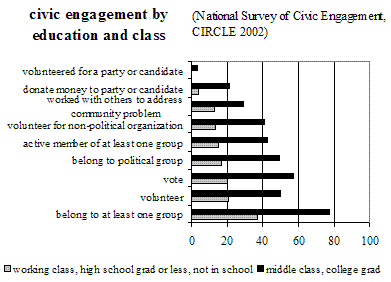
    Although some degree of economic inequality is inevitable or even desirable, all citizens should be equals before the law and government. However, in practice, people with more money and education tend to be more politically effective and to dominate civil society. In the United States, there are striking correlations between most forms of civic engagement and individuals’ education and wealth. The following graph shows self-reported levels of participation for those who say they belong to the working class and who have a high school diploma or less, versus those who call themselves middle class and hold a college degree or more. The more privileged group is at least twice, and often five times, as likely to participate in all categories:

    In principle, there could be an equitable political system with low levels of participation, so long as every demographic group and social stratum participated at the same rate. Then the participants would be a representative sample of the whole population. There are even democracies in which the poor and weak outvote the powerful: for example, in India, where the “untouchable” or Dalit class has higher turnout than the high-caste Brahmins. That is because the poor outnumber the wealthy in India, and political parties have persuaded them that they can benefit tangibly from capturing the state by voting. It seems relatively difficult to mobilize the least advantaged in a country like the United States, where the median family is reasonably well-off and well-educated, and the poor form an electoral minority, incapable of winning elections even if their turnout is high. Also, a sophisticated, media-rich society with a strong independent voluntary sector and a high degree of political freedom rewards people who have resources-?money, skills, energy, or time–to contribute.

    Thus the best method for increasing political equity in a country like the United States is to raise the total number of people who participate in politics and civil society. When total numbers rise, the poor and poorly educated are better represented. This is not a utopian idea. Voter turnout among male citizens reached 81.8 percent in the 1872-?much higher than it is today. There is no essential reason why basic forms of participation such as voting couldn’t return to those levels.