Category Archives: Uncategorized

the age of reason?

Does it make any sense to call the 18th century the Age of Reason? The primacy of reason had been argued long before then and would be defended later. Most (if not all) of the main techniques of rational analysis had been discovered earlier. And many of the era’s leading thinkers held mixed or even negative views about reason. For instance, Hume: “Reason is, and ought only to be, the slave of the passions, and can never pretend to any other office than to serve and obey them.”

Nevertheless, the Age of Reason seems an apt title, as long as we define “reason” in a certain way. It strikes me that 1689-1788 was a time of judicious selectiveness, a period when the intellectual options were deliberately narrowed according to certain rational criteria.

In the seventeenth century, alternatives had proliferated. There were countless Protestant sects as well as new strains of Catholicism. The Scientific Revolution occurred, yet alchemy and astrology also flourished. Vital political ideologies ranged from royal absolutism to the communism of the Diggers, by way of constitutionalism, the Mayflower Compact, and the Protectorate of Oliver Cromwell. Scholars had unearthed a great variety of ancient texts–not only the ones that we view today as “classics,” but also various Hellenistic, late-Roman, and early-Christian books that few people read any more. More Western scholars could manage Greek than at any time since the fall of the Roman Empire; some also learned Aramaic and Coptic. They not only admired Plato and Aristotle, but also Hermes Trismegistus, Dionysus the Psuedo-Areopagite and Zoroaster. Jesuit missionaries and others brought back the earliest reliable information about China, Japan, and India. See the Wikipedia entry on Athanasius Kircher for a sample of what an intellectually omniverous man could know ca. 1660.

To people of education and discretion a century later, it appeared that men like Kircher knew too much. Some of their erudition had been wasted on fruitless topics. The Age of Reason, if we can generalize about it at all, was a time for sorting out the heritage of early-modern Europe, distinguishing science from the occult, the literary canon from the rest of the library, mainstream religion from various radical sects, civilized people from barbarians, and reasonable political options from crazy ones.

Such consolidation was perhaps inevitable, but gradually a desire built up for broader and less temperate options. A rough definition of Romanticism could be: Views and ideas that would have been dismissed as “irrational” between the Glorious Revolution and the storming of the Bastille.
a mild protest

At the University of Maryland, we have a Coalition for Civic Engagement and Leadership. I serve on it, along with many administrators and a few professors and students. A group of undergraduates recently learned of our coalition. Critical of Maryland for failing to encourage activism and engagement, they decided to show up uninvited at our meeting and make a statement–whether we liked it or not.

Of course, we were excited and delighted. What are we but a bunch of ex-student activists who long for the scent of tear gas in the groves of academe? (Or at least a good anti-apartheid rally.) We planned to rush through our official business an hour early so that we could turn our attention to the students when they showed up. Some of my colleagues even helped the protesters to locate the room. They dutifully filed in, exactly on time, and took their seats: some in dreadlocks and tie-dyed shirts. Extremely nice, cautious, and a little diffident, they began to speak about their goal of making the campus, like, more engaged?

My colleagues and I listed politely and then probed the students for more ideas and opinions. At the end, various members of the Coalition complimented the students for their political act, saying that they had already changed the campus for the better. On his way out, one of the young men asked me about admission to the School of Public Policy.

I hardly know how to explore the comic possibilities here.

leadership

At a meeting yesterday, I said, “Leadership is choosing which pressure to cave to.” I’ve had this thought for several years, although I’m not sure whether I made it up or borrowed it from someone. In either case, it was received as a scrap of wisdom, so I pass it on here.

The corollary: To get what you want, organize people to put pressure on you that you want to cave to.

the future of gay rights

In the Detroit News, Deb Price has an article entitled, “Gay marriage’s future lies with DotNet youngsters.” She writes:

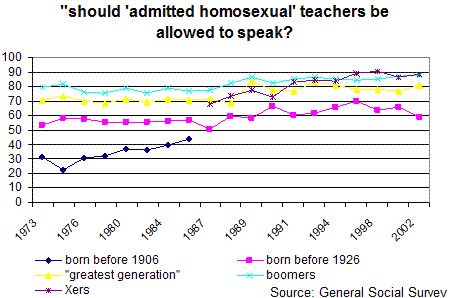
Even two years ago, 15- to 25-year-olds favored gay marriage by 56 percent to 39 percent, according to a national survey by the University of Maryland’s youth think tank, the Center for Information & Research on Civic Learning & Engagement (CIRCLE at civicyouth.org).

“Each generation has come of age being considerably more tolerant and become even more so,” says CIRCLE director Peter Levine, who tracked the attitudes of generational groups over time.

“This youngest generation is very tolerant, a very large group, and they have turned around the voting decline in the first election in which they could vote. If you put all that together, it spells a huge change in gay rights — and one not very far off,” he adds.

I was thinking of this kind of pattern, which is also seen in other survey questions about tolerance for gays:

[I’m also in a podcast by Joanna Welch, talking about the importance of being able to manipulate, recombine, and parody audio recordings of politics.]

stateless college students

Doug McGray has a great cover story in the LA Times Sunday magazine about kids who complete college in the US despite being illegal immigrants. For example, Thi was born in Germany to Vietnamese refugees who took her to the US when she was very small. She is not eligible to work, live, or vote in any country. Her parents didn’t initially understand their own immigration status, but when Thi finally learned from a lawyer that she is stateless, the lawyer said, “Grow some balls. This happens to people.”

People like Thi (an excellent student and great “citizen” who worked at a local police station during high school) are ineligible for in-state tuition and financial aid. She and many others make their way through college, anyway. Thi is a senior at UCLA. Yesterday, I met an originally undocumented Kenyan who had paid her own way through a BA and an MA in the US.

There is legislation in Congress, the DREAM Act, that would grant high school graduates conditional resident status. If they graduated from college or completed military service, they would be eligible for Green Cards. The DREAM Act has been pending since 2001.