Category Archives: Uncategorized

a new survey of youth entertainment culture

An interesting LA Times poll of American kids (age 12-24) finds them bored despite a plethora of electronic entertainment devices. “‘I feel bored like all the time, ’cause there is like nothing to do,’ said Shannon Carlson, 13, of Warren, Ohio, a respondent who has an array of gadgets, equipment and entertainment options at her disposal but can’t ward off ennui.”

I like Reed Larson’s idea that adolescents lack opportunities for “initiative,” which he defines as voluntarily choosing a task and then planning and sustaining it over time. Kids choose their entertainment, but needn’t plan or sustain it. They are supposed to sustain interest in their school projects, but they don’t choose them. For Larson (a pyschologist), the lack of opportunities for “initiative” explains frequent reports of boredom. Service projects and other forms of civic engagement are important alternatives.

The LA Times poll also challenges some myths about young Americans. For example, more than twice as many said that they had voted in a real election as said they had voted for an American Idol candidate. Even accounting for some “response bias” (i.e., kids may feel that they ought to say they voted in a real election), that’s still a refutation of the cliche that youth are only interested in pop culture.

“slave trader … patriot”

I’m in Providence, RI. Walking past a fine eighteenth century house, I spotted a plaque with these words:

John Brown House

The home of John Brown reflecting the wealth and position gained from his lucrative career as slave trader, privateer, China trade merchant and patriot.

A project of the Rhode Island Black Heritage Society

Also shown on the plaque is the seal representing a soldier of The First Rhode Island Regiment (1778)–“The Black Regiment.”

It’s a striking juxtaposition. The house of slave trader is decorated or even honored with a plaque purchased by an African American heritage society. John Brown’s “position” is attributed to the money he made from the transatlantic slave trade. But he is also called a “patriot.”

As a member of the Continental Congress and early House of Representatives, Brown was a founder of the United States. He was also a founder of Brown University. The source of his funds–hence his “position” in society, which made him a leader–was deeply immoral. Yet the United States Government and Brown University benefit all Americans. Of course, that’s easy for me to say, because I have had access to such institutions all my life and have benefited from them. (I’ve never had anything to do with Brown–but other private universities have given me various advantages.) Most people are born in positions from which it is very hard if not impossible to reach the Ivy League. It’s always worth asking whether, from behind a veil of ignorance, one would choose to have institutions like Brown University. Brown’s particular moral origin prompts that question but does not settle it. Perhaps the source of the funds is irrelevant. Or perhaps dirty money is mixed with good in all great institutions.

I had some of these thoughts as I sat, a few minutes later, in the pure interior of Roger Williams’ First Baptist Church (actually built 150 years after his time, in 1774-5). Williams denied the English King’s right to appropriate American land and carefully bought Providence from the native Narragansetts. It was a promising start and it led to a beautiful and dignified city–but one in which men had “lucrative careers” selling other people’s lives.

index construction

For a client, CIRCLE is preparing an index of American civic engagement that will aggregate the trends in more than 40 indicators over the past thirty years. Our various trends begin and end at different times, depending on the whims of survey designers and changes in actual behavior. Therefore, it wouldn’t work to build an index by averaging the indicators for each year. If an activity that happens to be common (such as wearing a political button or sticker) is suddenly included in the available surveys, then the whole index would jump up arbitrarily. Likewise, we couldn’t add measures of new and relatively rare forms of engagement, such as writing blogs, without arbitrarily lowering the index.

Therefore, I’m proposing that we measure the percentage-point change in each indicator compared to the baseline year in which it was introduced. For instance, watching the TV news enters the National Election Survey in 1984 at 72% and rises to 85% in 1986. I don’t include it at all in 1984, but count it as 13 points in 1986. The index is thus a weighted average difference in all the indicators compared to when they began. Adding blogging doesn’t lower the index, but as blogging becomes more popular, the growth tends to raise the index.

I don’t know if this is an original method–probably not. I also don’t know for sure if it’s a good idea. I think it has some advantages, especially for measuring a category (such as “civic engagement”) that is likely to evolve over time.

the Gospels on two hot-button issues

On Saturday, Laurie Goodstein wrote a story in the New York Times about a Minnesota megachurch pastor, Rev. Gregory A. Boyd, who has broken with the conservative movement. He is not the only evangelical in revolt against the GOP, and the political implications are interesting. But I was struck by something different in the article: a point of theology and biblical interpretation. According to Goodstein’s paraphrase, Rev. Boyd said that “Christians these days [are] constantly outraged about sex and perceived violations of their rights to display their faith in public. ‘Those are the two buttons to push if you want to get Christians to act,’ he said. ‘And those are the two buttons Jesus never pushed.'”

Indeed, I cannot think of an episode in which Jesus demands the right to display his faith in a public setting, nor a moment when he expresses outrage about sexual behavior. In fact, there are two Gospel passages in which he does quite the opposite.

Chapter 12 of Mark ends with Jesus teaching in the Temple (a public edifice devoted to religious ceremony). Four brief episodes within that chapter praise privacy or discreetness in matters of faith. First, some Pharisees ask Jesus whether it is permissable to pay taxes using a coin that bears a graven image of Caesar Augustus, who is portrayed blasphemously as a god. Jesus replies that a public expression contrary to his belief is of no consequence; what matters is his inward faith. “Render to Caesar the things that are Caesar’s, and to God the things that are God’s.”

Next, a scribe “discreetly” accepts Jesus’ interpretation of Moses’ Law. The scribe confesses to Jesus that the whole Law means this: “to love [God] with all the heart, and with all the understanding, and with all the soul, and with all the strength, and to love his neighbour as himself, is more than all whole burnt offerings and sacrifices.” The scribe’s discretion–as well as his rejection of public ceremony–seems to please Jesus.

Then Jesus inveighs against those who make a show of their faith:

Beware of the scribes, which love to go in long clothing, and love salutations in the marketplaces, and the chief seats in the synagogues, and the uppermost rooms at feasts: which devour widows’ houses, and for a pretence make long prayers: these shall receive greater damnation.

And finally he singles out a woman who, I have always imagined, makes her modest contribution very discreetly, out of shame for her poverty:

And Jesus sat over against the treasury, and beheld how the people cast money into the treasury: and many that were rich cast in much. And there came a certain poor widow, and she threw in two mites, which make a farthing. And he called unto him his disciples, and saith unto them, Verily I say unto you, That this poor widow hath cast more in, than all they which have cast into the treasury: For all they did cast in of their abundance; but she of her want did cast in all that she had, even all her living.”

While Mark 12 is about public displays of faith (and therefore relevant to debates about prayer in school), the great text for understanding Jesus’ view of sexuality is John 8:2-11, the story of the “Woman Taken in Adultery.” It’s a rich and controversial text, and I have pasted my own interpretation below the fold. (This comes from my book-in-progress about Dante.)

Continue reading

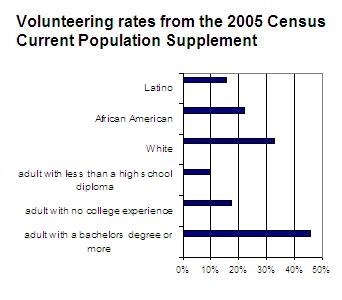
is volunteering an elite activity?

The Census data on volunteering show that there are big gaps by race/ethnicity and especially by educational background. Almost half of college graduates say they volunteer, compared to less than one in ten adults who dropped out of high school. I didn’t attempt any statistical analysis, but it appears that educational background is the important factor. African Americans might volunteer at higher rates than Whites if you controlled for educational background.

Volunteering has advantages for those who do it: it educates and connects people to their fellow human beings. That’s one reason to be concerned about the gap in volunteering. We might also worry that, if most volunteers are well-off and White, there will be inadequate volunteer services in disadvantaged communities. And privileged volunteers may misunderstand or patronize those they serve.

If we are concerned about this gap, we could try to close it by providing more service opportunities and support (including perhaps financial support) for less advantaged Americans.

On the other hand, there is a class-bias inherent in the concept of “volunteering.” If a person with a paid day-job helps other people’s kids at the local school, that’s volunteering. However, if a stay-at-home Mom carefully monitors the neighborhood kids, she is unlikely to describe herself as a volunteer. And if a person chooses to work as a public school teacher, she isn’t a “volunteer” unless she also helps after-hours at a soup kitchen or cleaning up a park.

Thus it’s possible that it’s not actual volunteering that’s mal-distributed, but only the way we define it.