We’re on our way to a family gathering, and I do not expect to post again until Nov. 27.
Category Archives: Uncategorized
starting from what?
I am attracted to two ideas that are in some tension:
1. We should prize very open-ended public deliberations (enriched by practical experiences) in which people try to set aside all ideological assumptions so that they can discover unrecognized needs, unimagined goals, and novel strategies. Open-ended deliberation would be less valuable if we had an array of persuasive ideologies to choose from; but today we do not. None of the major ideologies addresses the root causes of our problems, which I believe are largely cultural. In open-ended deliberations, young people have special potential because they have fresh perspectives, unconstrained by existing ideologies.
2. Good moral and political judgment is a matter of adopting and adjusting our store of accumulated beliefs. There are no fundamental reasons or self-evident truths that can justify our political choices. Our arguments and reasons always derive from a heritage or tradition, although we inherit divergent values and are thus able to make choices. To use Otto Neurath’s metaphor, we repair our boat while we are at sea.
These two ideas conflict because the actual traditions on which people depend are often ideological. Someone who grew up in a union hall and a Catholic congregation probably learned to apply a harmonious set of general principles to a wide range of political questions (which is my definition of an ideology). That’s a clear example, but somone who grows up around suburban soccer leagues and carpools also receives a big dose of ideology. My instinct in favor of open-ended, presupposition-free deliberation argues for putting such inherited principles aside (and trying not to indoctrinate young people with them). But I also have an instinct to prize our existing normative commitments, following Bernard Williams’ advice: “Theory typically uses the assumption that we probably have too many ethical ideas, some of which may well turn out to be mere prejudices. Our major problem now is actually that we have not too many but too few, and we need to cherish as many as we can.”
One way to combine these two ideas was proposed by Karl Mannheim, who suggested a generational division of labor. The young should provide a fresh perspective, while the old should offer principles derived from their experience that they crystallize into ideologies.
civic renewal in a state legislature
I’ve recently met several state legislators in basically social situations. It occurs to me that their job isn’t all that great nowadays. People strongly dislike politicians as a class, yet legislators must interact daily with strangers–and consistently treat everyone politely. As candidates, they are asked to complete questionnaires that will commit them to the specific legislative priorities of various interest groups. Once they are elected, the interest groups and parties closely track their votes and expect loyalty and consistency. Reporters generally ignore the legislature, but are ready to pounce at basically arbitrary moments.
Vote-counts, questionnaires, and investigative news articles provide accountability in politics in much the same way that multiple-choice exams promote accountability in schools: they are crude measures that overlook subtler but more important forms of excellence. For example, legislators get no points for changing their minds as a result of good arguments and evidence, for making especially thoughtful arguments in public settings, for wisely compromising to get “half a loaf,” for working across the aisle, for bringing new people into public life, or for focusing on neglected issues that lack attention from organized groups.
As Abraham Lincoln said when he heard about a man who had been tarred, feathered, and run out of town on a rail, “If it wasn’t for the honor of the thing, I’d rather walk.”
To restore the value of their own work, a bipartisan group of legislators in Minnesota has created a Civic Life Legislative Working Group. In some ways, they are following in the footsteps of the bipartisan “Congressional Retreats” of the 1990s, which were replicated in some state legislatures. (I attended one in Virginia.) But the Congressional Retreats attempted to improve bipartisan comity by addressing shared issues such as the quality of life within the legislature. The Minnesota Working Group has chosen a different approach–improving the civic culture of the state.
The Working Group has already met intensively, but they came out publicly last Sunday by publishing an op-ed in the St. Paul Pioneer Press:
We see the Civic Life Legislative Working Group taking a number of different approaches that will allow the Legislature to assume a variety of leadership roles in this effort, depending upon the issue.
For example, on issues where the dissemination of information is needed–such as senior issues–legislators could act as conveners, connecting constituents with information, helping them sort through the options available to them, sparking conversation among seniors about these options, not only with us as legislators. Think Medicare Part D or the myriad of options for home health care.
On issues where a comprehensive and statewide approach is necessary, the working group would take the role of architect, helping build consensus, mapping out a plan and tapping citizen and community energies to solve problems. The model for this would be the bipartisan Early Childhood Caucus, which since 2002 has helped to influence and shape public policies that impact Minnesota’s youngest children, their families and caregivers.
One of great things about the caucus–and one of the primary reasons it has been successful–is that it has not only helped educate legislators, but also created a dialogue within our communities and provided a vision of where we need to go when it comes to early childhood issues.
Finally, we also see the working group as a philosophical body, defining who we are and what we want to be as a state. There are numerous examples of the Legislature fulfilling this role. Think back to the Minnesota Miracle and the debate about the role the state should play in funding our public schools, or the creation of MinnesotaCare in the early 1990s, which established Minnesota has a leader in health-care innovation and access. Both of those accomplishments required genuine bipartisan cooperation and community involvement, as well as a view to the long term.
I’m told that the idea of being “philosophers” came from the legislators themselves and especially motivates them. They are brave to use a word that could sound corny or pretentious. Presumably, they see a “philosopher” as the opposite of a legislative infighter, a deal-maker, or an instrument of organized pressure groups. Good for them.
(As the Minnesota Daily reports (pdf), this project is part of a broader initiative called “Minnesota Works Together” that has beensupported by the W.K. Kellogg Foundation through the University of Minnesota’s Center for Democracy and Citizenship: www.publicwork.org.)
Murtha is completely unacceptable
Here is the full FBI surveillance tape from the Abscam investigation, dated January 7, 1980. That’s Representative Murtha on the couch. Scroll forward to about 12:00 on the tape and listen until about 18:35. (The most dramatic part is toward the end of that segment.)
The question is not whether the Congressman committed a felony; there’s some doubt about that. The questions are: What is Mr. Murtha doing in that townhouse? What’s his view of his job? What does he consider an appropriate “deal”? How does he comport himself as a Member of the United States Congress and a representative from Pennsylvania?
the long-term political trends
Here are trends for Democrats versus Republicans and liberals versus conservatives over several decades. The sources are National Election Studies for 1952-1992, and exit polls thereafter.
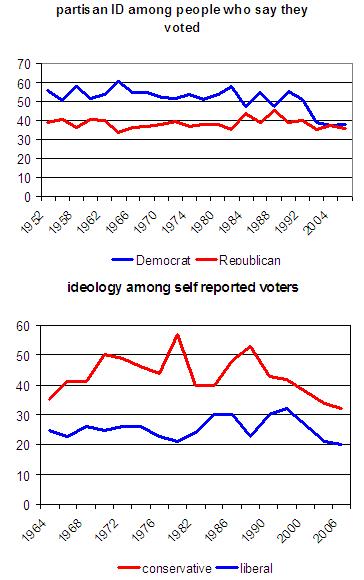
Democrats lost their advantage in registration during the 1990s, mainly because conservative Democrats quit. The party held a very slight (2-point) edge in 2006, but the score is basically tied. Independents have become much more numerous among actual voters than they were in earlier decades.
Self-described “conservatives” have substantially outnumbered self-described “liberals” for decades, although the definition of those terms has changed as the country has moved leftward on some social issues and rightward on some economic ones. (A typical liberal in 1960 believed in very high marginal tax rates but would probably have rejected gay marriage out of hand.) Both ideologies have lost favor lately, liberalism just as much as conservatism. The “good thumpin'” experienced by the GOP last Tuesday certainly creates an opportunity for Democrats to build support for a genuinely liberal (or call it “progressive”) agenda. After all, people voted Democratic despite being warned that Nancy Pelosi was a liberal. But her victory was a necessary, not a sufficient, condition for progressive revival. Now she and her party must lead both effectively and progressively, or else the blue lines will continue downward.