Category Archives: Uncategorized

my 1,000th post

This is post number one thousand, or so my blogging software (MovableType) tells me. Next Monday, January 8, this blog will turn four years old, which makes it–if I may say so myself–a hardy survivor.

I like to say that I have posted every working day since January 8, 2003. I think that claim was accurate until just last week. I returned to work last Wednesday but couldn’t write anything here because I was in the middle of upgrading the software to MovableType3.3 and I hit some snags (due to my own incompetence). It was a frustrating feeling to be able to see the blog online but not to change it in any way. As is so often the case, I upgraded not because I was dissatisfied with the existing software, and not because I wanted to do something new that was impossible with the old version, but only because my site was vulnerable to malicious behavior and I had to install some new security fixtures. I’m all for open networks that allow everyone to innovate; but they do have their drawbacks.
Rothenburg ob der Tauber

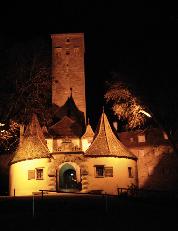
We had a wonderful pre-Christmas trip to the little Bavarian city of Rothenburg ob der Tauber. It is an old Free Imperial City of the Holy Roman Empire, a municipal republic like those of medieval Italy, very well preserved within its walls from the days of the meistersingers. In the weeks before Christmas, all decorated for the season, it is almost unbelievably quaint. We also drove up and down the “Romantic Road” (die Romantische Straße), which connects villages, castles, and walled cities, mostly in western Bavaria. I’ve made a movie to illustrate our visit. I don’t really anticipate regular readers of this blog watching it (it’s five minutes long), but I have posted it for people who are Googling “Rothenburg” to decide whether to visit.
to Germany for a week

We are leaving today for a family vacation in Germany. I won’t post again until shortly after Christmas.

We’re going to Rothenburg ob der Tauber, a little medieval town in northern Bavaria. It’s one of many German towns that have Christmas Markets. The streets are filled with stalls, decorations, lights, music, and outdoor food and drink for several weeks in December–or so we’re told.

We visited another Christmas Market accidentally in 2004. I was invited to a conference in the Netherlands, and while I was there, my family stayed in Bruges/Brugge (Belgium). The whole town was decorated for Christmas. There were jovial crowds of European tourists, and the streets were lined with shopping stalls. Our kids got a heavy dose of yuletide cheer and we all saw some art. It worked so well that we decided to try another Christmas Market this year. It turns out that there are scores, or perhaps hundreds, of them across Catholic Europe. So we are trying Rothenburg and will report back in the New Year. Meanwhile, happy holidays.

a model of anti-Black racism in the USA

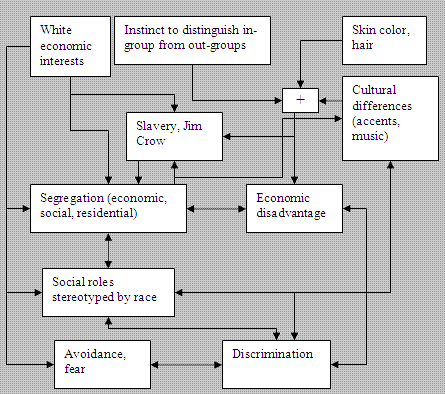
This is a very sketchy model, based on nothing more than personal observations and reflections. The arrows are supposed to be causal, although I can’t estimate the strength of these relationships. Thus, for example, the human instinct to distinguish in-groups from out-groups, plus skin color differences, yields economic disadvantage for African Americans.

The overall idea is that certain background factors predispose people (including some African Americans) to anti-Black prejudice. Actual prejudice is triggered by particular factors, such as skin color and accent. The results are harmful behaviors, some of which reinforce the background factors in a feedback loop or vicious circle.

Some things that are missing from this model: capital-accumulation, political participation and relations to government, minority status (in the sense of being outvoted by the more numerous group), and religion.

support for abortion rights: a generational story

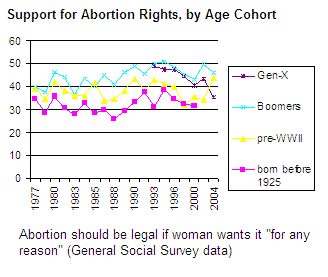
For a talk this afternoon, I quickly looked at attitudes toward abortion rights by age cohort. I think the story is interesting. In brief, each generation came of age with more favorable attitudes toward abortion than the cohorts that preceded it–until the Xers arrived. They were less favorable than the Boomers. At about the same time that Xers became a substantial part of the adult population, there was a decline in support for abortion rights within each generation. As a result, fewer people have favored abortion rights since 1994.

The Millennials are not numerous enough in the adult population to show a trend. Anna Greenberg found that 63% of Millennials supported a woman’s legal right to abortion, but her question didn’t specify the conditions under which abortions would be allowed. Surveys of college students typically find strong support for abortion rights, but most young people do not attend college.