Category Archives: Uncategorized

sunlight, the best disinfectant

In 2006, Senator Jon Tester (D-MT) and Rep. Kirsten Gillibrand (D-NY) defeated incumbents who were tied to Jack Abramoff–our latest exemplar of a corrupt lobbyist. In an effort to demonstrate their own commitment to “transparency,” Tester and Gillibrand pledged to disclose their daily schedules for all to see. See Tester’s schedule here and Gillibrand’s here.

Lindsey Layton (who met with Tester at 2:15 pm on January 30, according to the Senator’s public schedule) describes these online diaries in The Washington Post. Layton writes, “Richard A. Baker, the Senate historian, cannot find a precedent for what Tester and Gillibrand are doing.” But there is precedent for the underlying principle. In 1905, as governor of Wisconsin, Robert M. LaFollette signed a bill of which he was particularly proud:

The statute prohibits such lobby agents or counsel from having any private communication with members of the legislature upon any subject of legislation. The lobby is given the widest opportunity to present publicly to legislative committees, or to either branch of the legislature, any oral argument; or to present to legislative committees or to individual members of the legislature written or printed arguments in favor of or opposed to any proposed legislation; provided, however, that copies of such written or printed arguments shall be first filed in the office of the secretary of state. This law rests upon the principle that legislation is public business and that the public has a right to know what arguments are presented to members of the legislature to induce them to enact or defeat legislation, so that any citizen or body of citizens shall have opportunity, if they desire, to answer such arguments.

Since I came to the United States Senate I have steadfastly maintained the same position. Again and again I have protested against secret hearings before Congressional committees upon the public business. I have protested against the business of Congress being taken into a secret party caucus and there disposed of by party rule; I have asserted and maintained at all times my right as a public servant to discuss in open Senate, and everywhere publicly, all legislative proceedings, whether originating in the executive sessions of committees or behind closed doors of caucus conferences.

I can imagine two rebuttals to LaFollette’s argument. One is that people ought to be able to petition elected officials secretly, because disclosure can have a chilling effect. For example, in the present climate, Members of Congress might be less likely to meet with Muslim groups if they had to reveal every meeting. But Muslim groups, like all groups, have a constitutional right to petition the government for redress of grievances.

Tester’s schedule shows meetings with many mom-and-apple-pie associations, such as “parents of children with disabilities” and the “Inter-Tribal Bison Cooperative.” It is conceivable that he wouldn’t want to show contacts with more controversial organizations and would therefore refuse to see them at all.

The second argument is that secrecy actually protects elected officials from undue pressure from lobbyists. Senator William Packwood (R-OR) once said:

Common Cause simply has everything upside down when they advocate ‘sunshine’ laws. When we’re in the sunshine, as soon as we vote, every trade association in the country gets out their mailgrams and their phone calls in twelve hours, and complains about the members’ votes. But when we’re in the back room, the senators can vote their conscience. They vote for what they think is the good of the country. Then they can go out to the lobbyists and say: ‘God, I fought for you. I did everything I could. But Packwood just wouldn’t give in, you know. It’s so damn horrible’.” (Quoted in Birnbaum and Murray, p. 260)

Both rebuttals presume that politicians are well-intentioned and will behave better in secret than they do in public. In fact, that is occassionally true. But on balance, I think we’d be better off if Members of Congress felt they had to disclose all their meetings. Requiring such disclosure would probably violate the First Amendment. But making a habit of it would be a good thing. Tester and Gillibrand have, at the least, launched a worthy experiment.
campaign finance: defining deviancy down

It isn’t easy to regulate or control money in politics. There are practical problems: money tends to seep around legal limits. There are big political obstacles: everyone who holds elected office won the last race under the existing system and has an interest in preserving it. And there are constitutional objections. Even if one feels that the First Amendment allows the government to limit direct contributions to candidates, independent communications still constitute protected free speech.

Nevertheless, the government should not be for sale. We should feel at least some discomfort every time private funds flow into accounts that benefit candidates for public office. If politicians are a little embarrassed to rely on wealthy donors, there is at least a check on their behavior–a felt need to set limits or make amends. We can thereby retain a sense that the market and government are separate spheres of justice.

But shame now seems to be antiquated. According to Adam Nagourney in the New York Times (January 9):

Over 400 people, including corporate executives, governors, wealthy Republican donors and party operatives, gathered around telephones and computer screens stretched out over a huge convention center room for a day of public fund-raising on behalf of Mitt Romney, the former Massachusetts governor who created a presidential exploratory committee last week. Television camera crews and reporters circled the room as Mr. Romney’s aides provided a running tally of how much had been raised.

For Mr. Romney, this high-tech fund-raiser, with new fund-raising software rolled out to mark the occasion, amounted to a public declaration for the White House, as he marched out with his family for his first major event since leaving the Statehouse.

And as Mr. Romney announced at day’s end that he had drawn a $6.5 million one-day haul in cash and commitments, it was also a striking example of just how important fund-raising has become as a test for presidential viability, this year more than most, with the race dominated by high-profile candidates, most of whom are unlikely to participate in the public financing system.

”This has never been done before,” Mr. Romney said, standing in the middle of an elaborate set, a wireless microphone planted on his body. ”This is the most advanced technology ever employed as a fund-raising effort.”

Instead of announcing his presidential campaign in front of Bunker Hill or the USS Constitution, the former Massachussets governor deliberately chose a bank of fundraisers as a symbolic backdrop. In this presidential season, privately-funded campaign spending is expected to top $1 billion for the first time. The only hope is that such blatant, unashamed mixing of money and politics will provoke revulsion.

[p.s., I note that Senator Obama, who will certainly raise plenty of cash, has imposed a limit on himself. He won’t take money from registered federal lobbyists. That is hardly an adequate solution to the overall problem, but it reflects an old-fashioned sense that private money is problematic in politics.]

the hookup culture (II)

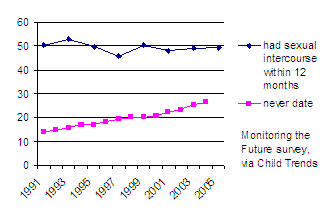
In a comment to yesterday’s post on the “hookup culture,” Mike Weiksner asks whether this is a new phenomenon. I don’t know for sure, but I find two trends interesting: the rate of sexual intercourse is basically flat, but the percentage of adolescents who “never date” has almost doubled. (Trends are shown for 12th graders.)

This graph is consistent with the idea that “hooking up” is replacing “dating.” But it raises several questions that I cannot answer without obtaining direct access to the data. (It would also be very useful to add other survey items.) What proportion of the young people who “never date” have sex? What would the trend look like for sexual behavior other than intercourse? What are the mean numbers of sexual partners for those who do and do not “date”?

the hookup culture

Those who are responsible for adolescents and college students are worried about the “hookup culture.” Quite a few young people have sex frequently with different partners within the same large social network. Their choice not to repeat sex with the same partner seems deliberate, probably a way to avoid commitment.

I think the hookup culture is new and troubling. It’s an example of treating other people merely as means, not as ends in themselves. Participants must constantly estimate their own desirability as sexual partners based on their success in the hookup market. That seems stressful and likely to cause pathologies, such as eating disorders. Because we have a natural proclivity to become emotionally connected to our sexual partners, people who “hook up” are likely to use drugs or alcohol to suppress those feelings. Finally, these young people are missing an opportunity to practice intimacy. I worry that when they actually try to settle down with a partner and start a household or a family, they won’t be good at it.

No doubt, this phenomenon has several causes. I suspect that one of them is economic. Young people are coming of age at a time of high risk and high opportunity, when they feel that they need lots of “human capital” to compete in the job market. They want as many experiences and awards as they can obtain to list on their resumes. Human entanglements don’t help, and an emotional relationship might hold someone back.

The deepest problem may be that successful students now do everything (studying, volunteering, exercise, and sex) for instrumental reasons: to prepare themselves for the moment when they graduate from their final level of college. I worry that they are going to find young adulthood very disappointing, and they will regret missing the chance to do things for their own sake.

I would guess that quite a few participants in the hookup culture (especially young women) are actually rather discontented with it. But it would take collective action and reflection to change that culture. Adults are poorly placed to take this on, because our questions are likely to be seen as censorious. (Or we may seem to be challenging freedom and sexual equality.) Although we should stand ready to help, the Millennials themselves will have to deal with this problem, much as previous generations changed gender roles and sexual mores.

[PS See the Washington Post’s excerpt from Laura Sessions Stepp’s new book Unhooked, which includes this quote from a young woman who is afraid to fall in love:

Her number-one goal, for as long as she could remember, was to excel in school so that she might someday land a great job that would make her financially independent. In high school, she maintained an A average, played volleyball and rowed crew, edited the digital yearbook and played on a church basketball team that won the state championship. Her pace in college was similarly brisk, and she didn’t see how, even in her senior year, she could afford to invest time, energy and emotion in a loving relationship.

At her 21st birthday party she talked about this with a girlfriend who understood. As the friend said, over the recorded sounds of rapper Jay-Z, “I don’t have time or energy to worry about a ‘we.’ “

This concern for financial independence (not affluence) seems symptomatic of a high-risk/ high-opportunity economy that provides weak social supports.]

lordy, lordy

(en route to Durham, NC). Yesterday, I turned forty. Since I happen to have a sick parent right now, “intimations of mortality” would be an understatement. Last time I noticed, my contemporaries were deciding what advanced degrees to pursue, looking for spouses and partners, and wondering whether our elders were paying any attention to us. Now we worry about our own kids, our parents, and our savings; and we are the elders in some of our institutions. All my Gen-X friends seem to live in grown-ups’ houses and understand grown-ups’ issues like 401(k)s, renovations, and dinner parties. We used to play at adult roles; now we inhabit them. Each day, the world seems exactly like yesterday, but a “heap” of days passes and life is completely different.