Category Archives: Uncategorized

trust and participation

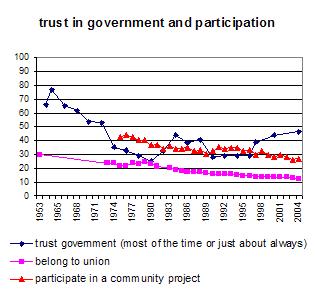
This is just to illustrate my argument from last Wednesday. I claimed that we cannot have massive new government programs without public trust, unless the programs are very simple and transparent–which is virtually impossible in the case of health care. The necessary trust has eroded, in part because people don’t belong to participatory groups that seek their voluntary support and that influence the state. Unions are a major example of such groups.

This graph cannot demonstrate a causal relationship among the three trends: falling trust, declining union membership, and declining participation at the local level. But I hypothesize a connection.

By the way, this graph is my belated response to a comment by David Moore, which I had missed.

stay tuned

Th Ad Council and the Federal Voting Assistance Program are launching public service announcements (also known as TV ads) “to promote youth civic engagement. … An extension of their ongoing campaign to encourage young adults to exercise their right to vote, the new PSAs urge young adults to become involved in their communities by voting, volunteering and becoming informed about current events.” The press release cites our 2006 survey:

According to FVAP, during the last twenty-five years there has been a dramatic decrease in voter turnout among 18-24 year-olds. In addition, a 2002 report conducted by The Center for Information & Research on Civic Learning & Engagement [CIRCLE] found that 57 percent of American youth aged 15-25 are completely disengaged from civic life and politics.

“take back our citizenship”

I love this new project created by students at “the U” (the University of Minnesota). They say: “Our goal isn’t to get you out to vote. It isn’t to support one candidate or another. Our goal is to get you to think about what it means to be a citizen in this country and to think about what role you would like to play. We’ve seen the power that citizens can have if they choose to take it, and we want you to take it.”

strategy, scholarship, and passion

Three meetings in the last four days have reminded me of our wonderful human diversity, even though the participants spoke the same language, gathered in similar settings in two cities along our East Coast, and addressed similar topics.

On Thursday, I spoke to a group of human rights activists from the developing world. Their host was the State Department; the setting was a private room in a Washington restaurant of the old, steak-and-bourbon style. I talked about civil society and the kind of politics that begins with citizens, not with governments. Much more interesting than I were the visitors who formed my small audience. There were West African politicians who delivered relatively long and formal comments, standing up to address the room. One man from Nigeria laced his remarks with classical allusions. An Egyptian and a Lebanese, speaking separately, criticized American foreign policy, particularly our inconsistent support for democracy. They were polite but passionate and angry. Afterwards, they asked to have their pictures taken with me, joking that my career as a politician would now be doomed. (It wasn’t going anywhere before then.) The Lebanese man complained that US funding agencies want more youth civic engagement in his country. He noted that every young Lebanese took to the streets in protest last summer. Youth engagement is not the problem; governments are.

On Friday and Saturday morning, I participated in a small academic conference on youth civic engagement. My colleagues were mostly psychologists. We sat around a seminar table in a slightly beat-up room high in a skyscraper that belongs to Fordham University. One of our characteristic ways of communicating was to respond favorably to the previous speaker’s remarks, adding: “So-and-so from Harvard–or Indiana, or Loyola–has done work on that.” Or: “There was a piece about that in ADS in the early nineties.” Or: “MTF data show that trend.” Because everyone was an empiricist, the norm was to ground claims in facts and statistics. Yet the participants shared strong, implicit moral commitments: to the dignity and value of political participation, the need for equality and justice, and the positive potential of young Americans. Therefore, much of the evidence came from evaluations of highly idealistic programs that were relatively small. The real message was how much young people could achieve if big institutions invested in them.

iThen, on Saturday evening, I joined the Newspaper Association of America (NAA) conference at Tavern on the Green in Central Park. This was a big institution with funds to invest. The participants were American media executives: prosperous, confident, good-humored and jocular. It was like an Ivy League alumni reunion, albeit with more women that you would see if the Princeton class of ’65 reconvened. I was served an enormous piece of beef while speakers stood to roast one another.

The next day, as a trustee of the NAA’s Foundation, I heard a presentation on youth. The speaker was a market researcher, and his objective was to help newspapers reach young consumers. This is a worthy goal, because we know that newspaper readers are much more active in politics and community affairs. Of course, the motives of the newspaper executives are pecuniary, but that is fine: they could achieve public benefits by investing in young readers

The presenter sounded like a motivational speaker. (“Folks, you’re going to have to reach them where they are.”) He had six main ideas about young Americans, and each one had its own, professionally designed logo that flashed on the screen. (For instance: “autono-ME” meant the strong desire of young consumers to customize their products.) These aspects of the presentation certainly put me off, but it was quite insightful and based on statistical evidence. It was also rather disturbing, since a picture emerged of young people who are tremendously skillful at finding entertainment that has little public or intellectual or spiritual value. My only doubt about the factual claims in the presentation concerned the future. Generations develop over time. The same people who wore dashikis and love beads in 1968 had been Eisenhower-era suburban kids in 1958. So there is always the possibility that today’s teens will rebel or shift dramatically–especially if they encounter passionate arguments like those I heard on Thursday or excellent programs like those discussed on Friday and Saturday.

It’s a facile conclusion, but I’ll write it anyway. We must somehow combine the political commitment and groundedness of the State Department’s visitors with the idealism and empirical rigor of the developmental psychologists and the economic muscle and realism of the media industry.
getting out the (French) youth vote

(traveling to New York City) The “Association Collectif Liberté, Egalité, Fraternité, Ensemble, Unis” is quite a mouthful, but its acronym means “enough of the fire” in French (ACLEFEU=”assez le feu”). Its List of Grievances (a phrase borrowed from the French Revolution of 1789) could be translated thus:

Our organization, ACLEFEU …, has seen the cold leftovers of the social revolts that shook the land during the month of November 2005 following the deaths of our children, Bouna and Zyad, at Clichy Sous Bois [where two alleged rioters, hiding from the police, were electrocuted in a power substation]. So that we can say they did not die for naught, we are committed to the mission of going to the people in all their diversity to get them to fill out ‘Lists of Grievances.’ … It seemed to us essential to work to stop the fires [of the riots], considering that the best weapon for making oneself heard still remains civic participation in democracy, yet the debate that must precede the choice at the moment of voting is still closed to one part of society, that which merely copes. All citizens must truly have the power of a voice and the ability to express their needs, their proposals, their hopes.

ACLEFEU claims to have collected “20,000 reports, grievances, and even more proposals.” It observes, “History seems to repeat itself; today as yesterday the central ideal of the Revolution is clearly evident in the Lists: equality.” It goes on to describe the people who submitted grievances:

Far from being unconcerned about politics, many of these people, among whom a majority are between the ages of 18 and 25, express the need to see the parties and elected officials become closer to the people and their real lives. For several years, all the parties have multiplied their forums, general meetings, etc. … But all this good will does not seem to have convinced the popular classes. The abstention in recent elections, as well as our List of Grievances, proves it. We hope that those who aspire to preside over the destiny of France will know how to take advantage of what we offer here, to build with the residents, with respect for their proposals, a just and courageous politics that attacks, above all, the causes of their insecurity and exclusion. For our part, we have faithfully synthesized the priorities, reports, and proposals from the Lists of Grievances. In the coming months, we will be vigilant regarding the use you make of these popular proposals. We expect to bring all our weight to bear so that the excluded register to vote and choose their [presidential] candidate as a function of his capacity to conduct politics in dialog with citizens.

The actual proposals, as far as I can see, appear rather retrograde. They include heavy regulations on the labor market that might worsen the exclusion of immigrant youth. However, the rhetoric of citizen voice and dialog is impressive, as is ACLEFEU’s organizing muscle.