Category Archives: Uncategorized

welcome, fundamentalists

We live in Cleveland Park, DC, an affluent, liberal, urban neighborhood of mostly single-family homes (median family income= $124,000; average family size=2.57; 84% white). I don’t think the US Census collects data on religion, but I would not be surprised if the biggest single group in our area consists of secular Jews. There is an impressive conservative synagogue on the main drag, while the (high-church) Episcopalian National Cathedral marks the western border. Both of those congregations draw from well outside the neighborhood.
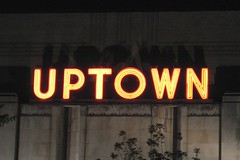
photo by KCIvey, creative commons license.

One of the main secular landmarks is the Uptown Theater, an art-deco building that shows premieres and popular movies. Recently, the McLean Bible Church, an evangelical congregation in Northern Virginia, announced plans to hold Sunday services in the Uptown, carrying a video feed from its large suburban church. This is part of “City Impact,” “a movement within McLean Bible Church designed to empower leaders and new ministries to carry out the vision of the church–to impact secular Washington with the message of Jesus Christ. The mission of City Impact is to inspire individuals and teams to share their passion for Christ with specific, targeted groups outside of the church.” Another part of City Impact is a “Jews for Jesus campaign” that was evident in our neighborhood earlier this month.

Cleveland Park has a very active email list with 5,498 members as of yesterday. The arrival of the McLean Bible Church has sparked a lively exchange, which I follow through the f2f intermediary of my wife Laura. Although there have been calls for tolerance, a lot of the comments have been angry.

Just to get an obvious point out of the way, the McLean Bible Church has the legal right to say anything they want about secular Washington on public streets or in any building they choose to rent. The only question is whether people should be angry about their arrival. This is my thought: It’s very uncomfortable when someone declares an intention to change your values and core commitments. Many people receive such declarations as attacks on their own identities.

The McLean Bible Church is “targeting” (their verb) secular Washington, along with “Russian Jews, Orthodox Jews, secular Jews, and Jews who are totally unaffiliated.” But before we get too upset, we should reflect that a desire to convert us represents a form of care and concern, from the perspective of the evangelicals themselves. Besides, by putting their bodies in our neighborhood, the missionaries risk encounters that could change them more than us. Such encounters are disturbingly rare in modern America, where we sort ourselves into neighborhoods by partisanship, religion, education, race, income, and aesthetic taste. I see the weekly arrival of evangelicals as a dose of welcome diversity, and I look forward to “us” rubbing off on “them.”

civic engagement in Britain

Centralized executive power is dangerous–but it provides great opportunities when the chief executive happens to have good ideas. The new British Prime Minister has committed to civic engagement. Since he has the votes to control Parliament, he should be able to implement his concrete policy proposals, which include (according to The Guardian):

  • grants for a new national youth community service program
  • endowments for new local foundations
  • grants for training and education in community work
  • a plan to let nonprofits take over unused public buildings
  • a social investment lending pool capitalized with funds held by private banks
  • Britain already has in place a well-regarded, ambitious civic education curriculum for all of its students.

    Gordon Brown’s rhetoric sounds maybe a little too communitarian to match my personal ideals. I would emphasize public work, deliberation, decentralization, and problem-solving rather than giving and belonging. But it’s an impressive set of concrete policy proposals, the likes of which would be hard to accomplish here (save for the youth service corps, which we got under Bill Clinton).

    public participation in grantmaking

    Led by Cindy Gibson, a group of us has helped the Case Foundation to develop an innovative grant competition that involves online voting about which proposals to fund. The Chronicle of Philanthropy ran a story about this competition that, as Cindy says, was “fairly balanced and thorough.” However, it put most of the focus on the voting part of the competition. A vote can be “gamed” or manipulated in various ways. It doesn’t necessarily reflect a group’s judgment, nor does it necessarily increase accountability to the public (since the whole public won’t vote).

    I like the Case Foundation’s experiment with voting because it’s part of a broader foray into public participation. There will not just be a vote, but also a structured discussion. Crucially, the proposals will be evaluated for how much they enhance public voice. As in the formal political system, granting people a vote is a gesture of respect; it says that power will not be monopolized at the center. But the vote is insufficient to achieve public judgment. If anything, the voting portion of the Case Foundation’s new program is valuable as a symbol of a deeper commitment. Case is experimenting with a new relationship between the foundation (whose funds are tax-exempt by law) and the public.

    Sekou Sundiata, 1948-2007

    I was very sorry to read in The New York Times that Sekou Sundiata has died. I once had the privilege to speak on a panel with him and have heard some of his performances. (Visit Salon for some sample audio.) Sundiata was a poet, performance artist, and organizer of community performances. His “the 51st (dream) state” is a remarkable portrait of the US after 9/11, full of hope and openness. He was a serious critic of White racism and he had an African aesthetic. Born in Harlem as Robert Franklin Feaster, he took an African name. But “the 51st (dream) state” is intensely patriotic about the USA. We all have complex and overlapping identities. Sundiata had the talent and the integrity to explore his own identities with eloquence and an open mind; and he was brilliant at helping other people to do the same.

    global warming and citizen participation

    I had an interesting conversation yesterday with a leading environmentalist. On the basis of that conversation, I’m wondering whether many of his colleagues might be willing to endorse a statement that said something like this:

    We believe that global warming is a profound challenge. Unless we reduce carbon emissions by two percent per year starting very soon, civilization is in danger. We trust scientists on this question, regardless of what democratically elected officials may say.

    Yet we also believe that civic engagement and participation are crucial. Civic participation is not a luxury, something that you can worry about when life is going well and you face no fundamental threats. On the contrary, it is when threats are profound that we especially need the ideas and energies of all our citizens and institutions.

    Despite our conviction that global warming is a serious problem caused by human action, we recognize that many aspects of the issue are unresolved and need public deliberation. In particular, the tools that should be used to mitigate the problem (such as cap-and-trade regulations) are by no means clear. A truly open, public discussion is needed.

    Furthermore, we doubt that the government could solve this problem through command-and-control regulations, although regulation may play an important role. Other sectors, beyond the government, also need to change and innovate. Just as one example, colleges and universities can cut their own carbon emissions.

    Not only big private institutions, but also individuals can and must address global warming. There are cultural and spiritual dimensions to the problem, which is profoundly connected to other social and human issues, such as poverty and over-consumption. Although we are confident about some facts (e.g., that human consumption of carbon causes global warming), no one has adequate solutions. Many perspectives are valid and useful; many people have the capacity to help.