Category Archives: Uncategorized

why are young people voting

Because we calculate the youth turnout rate, we at CIRCLE are getting many press calls every day. We have shown that youth turnout is up dramatically–by a factor of three or four in many states. The main question is: Why?

The answer is not simply Senator Obama, because Senator Clinton has won the youth vote in several states (California, Arizona, and Massachusetts), and about one third of young voters have participated in the Republican primaries. That means that Senator Obama has received less than half of all young votes.

I am boiling down my answer to two parts: the kids and the candidates. The “kids,” i.e., people now between 17 and 25 years of age, are somewhat different from their recent predecessors. If you want quantitative evidence of this change, the best single fact is the rapid rise in the volunteering rate. If you want qualitative context, I recommend our Millennials Talk Politics report. Either way, there is plenty of evidence that young people are concerned, idealistic, and aware of at least some social issues. If they volunteer at a homeless shelter, for instance, they recognize homelessness as a problem.

This does not mean that they are sold on voting and politics as solutions to social problems. One student told us in a focus group, “I have voted every time I’ve been given an opportunity, but I do it more as a symbolic gesture than an actual means of changing something.” This was a common view. Still, students are ready to hear a pitch that a given campaign or candidate might be worth supporting as a way of addressing problems.

Which brings me to the candidates. They are making the pitch–literally contacting young people through grassroots organizing and by making high-profile visits, and arguing that elections can affect social issues. Obama, Huckabee, and Chelsea Clinton have all personally appeared on our campus. It may seem obvious that politicians would campaign to get young votes. However, in the 1990s, there was such strong conventional wisdom that young people didn’t vote that often young citizens were literally deleted from contact lists.

When I mention the rising volunteering rate, sometimes reporters and others ask me whether this isn’t simply a function of mandates. Some schools require community service; many colleges seem to value it in applications. These are valid explanations for the increasing rate of volunteering, but they don’t negate its importance. For young people, experiences tend to cause attitudes, rather than the reverse. Providing incentives and opportunities for service is likely to change what young people value.
tertiary literature

I’ve previously confessed that I’m writing fiction about Elizabethan England. I have read some serious scholarly work for background. I’m also tempted to pick up relevant popular books when I see them for sale in places like airport bookstores. That is why I have recently read Stephen Budiansky, Her Majesty’s Spymaster: Elizabeth I, Sir Francis Walsingham, and the Birth of Modern Espionage; Benjamin Wooley, The Queen’s Conjuror: The Science and Magic of Dr. John Dee; Peter Marshall, The Magic Circle of Rudolf II: Alchemy and Astrology in Renaissance Prague; Antonia Fraser, Faith and Treason: The Story of the Gunpowder Plot; and Robert Lacey, Sir Walter Ralegh.

I find the demand for these books a little hard to understand. You could call them “tertiary literature” because they are basically summaries of the secondary literature, with maybe a few quotes from original sources and some journalistic writing about locations that the authors have visited for atmosphere. A tertiary book can be interesting if the author has a thesis. For instance Fraser has a view of the Gunpowder Plot that’s interesting. (She thinks that Guy Fawkes really did it, but in a context of terrible anti-Catholic persecution.) But for most of these books, the thesis is simply that the subject is important. Thus, for example, Peter Marshall’s point is that Emperor Rudolf was significant to history. I’m not sure why people would pay money to find this out. These books also tend to be very badly edited, with many misplaced modifiers and other errors. There seems to be a relative shortage of really compelling, literary narrative history for popular audiences.

the narrowing of the curriculum

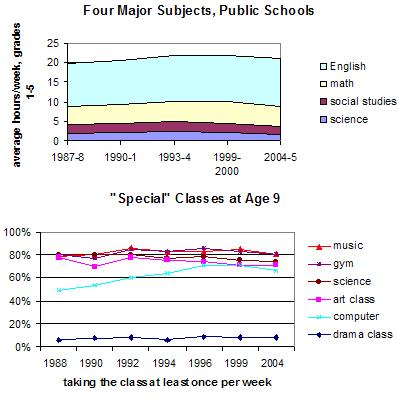
These two graphs indicate that the elementary school curriculum in the US has narrowed somewhat (not dramatically) in recent years. The first graph shows hours devoted to four major subjects throughout grades 1-5; the second tracks the percentage of kids who experience various “special” classes such as art and music. We see an increase in all the academic subjects and some of the “specials” in the 1980s and 1990s, as Americans became concerned about slackness in the whole education system. This was followed by a narrowing of the curriculum as the available time went into reading and math and away from social studies and arts after 1992-4.

Although these trends are not dramatic, I think they deserve public discussion. The cause is more than the No Child Left Behind Act, because the narrowing trend began before NCLB was enacted and is evident in private schools as well as public schools. I associate the narrowing with a whole set of decisions made by local, state, and federal authorities, teachers, schools of education, textbook publishers, and families.

Here are four perspectives that these stakeholders ought to consider and discuss.

1. Back to basics. Reading and math are fundamental. Performance in these subjects is inadequate for the whole population and very unequal. We need to focus our attention on these subjects until all kids can read, write, and calculate. The trends shown above are desirable.

2. The liberal arts. Education today is too instrumental. It’s all about outcomes, especially economic outcomes. It overlooks the intrinsic value of subjects like history, fine arts, natural sciences, foreign languages, and current events. Although such topics can be taught under the heading of “reading,” in fact reading instruction emphasizes skills, not content. Thus the trends shown above indicate a decline in the liberal arts.

3. Cultural literacy. The only way to be literate is to have a base of facts, concepts, and vocabulary. We obtain that base best by studying history, natural science, social science, and foreign cultures. The trends shown above mean that we are failing to emphasize cultural literacy and that is why reading scores are flat despite increased time devoted to reading/language arts.

4. Civic mission. The purpose of schools is not (only) to prepare workers, but also to create an active and egalitarian democracy. That mission requires widespread literacy and numeracy. But it also requires specific knowledge of history, government, social issues, and current events. Such knowledge also correlates empirically with using and enjoying the arts. We are losing those elements of the curriculum.

exit poll predictions

Early on Super Tuesday evening, I guiltily visited the Drudge Report to see the leaked exit poll results, which showed Senator Obama with a big lead in California. Of course, that lead evaporated. Why were the exit polls wrong? In short, because they are not designed to predict the outcomes of elections.

To give a more detailed answer: Commercial and academic pollsters never really try to draw a random sample of Americans from which they expect to be able to derive results directly. Instead, they always construct a sample using a source other than the poll itself to guide them. Most often, they try to fill quotas of interviewees from various categories (e.g., race, region, and gender). Even after they have done their best to fill their quotas using quasi-random methods, they almost always “weight” their data to reflect the demographic breakdown of the population, according to the US Census. For instance, if only seven percent of the sample is age 18-25, when the Census finds that 14 percent of adults are in that age range, then each interviewee of age 18-25 counts for two. (Doubling the weight of some respondents is not uncommon.)

In the case of exit polls, the results are not “weighted” to match Census demographics, because exit polls are intended to describe voters, not residents. Instead, results are weighted to reflect the actual election results, as reported by officials. Thus, if 51 percent of voters cast ballots for Senator Clinton, but 55 percent of people who were interviewed in the exit poll said that they preferred Senator Obama, then each Obama supporter in the poll counts for more than one in the results.

I’m sure that the early results leaked to Drudge were unweighted, because the ballots had not yet been counted. Once they were weighted, they showed a Clinton victory in California, because that’s what election officials reported. This is also why exit polls showed Bush behind in Ohio in 2004, yet he won the election.

This is a legitimate method, because any poll is designed to address only some questions, not all questions. An exit poll cannot predict who will win, but it can estimate (with various sources of error) what kinds of people voted for each candidate. That’s what it’s for.

Some of us are overly credulous about surveys. Others, having realized that surveys are imperfect, discount them all. I recommend carefully considering what questions any given poll can answer, and using it only for those purposes. (Remind me to stay off Drudge on November fourth.)