Category Archives: Uncategorized

Bernard Gill

Last Tuesday night–it is dark and rainy, and about thirty of stand beside a parking lot on what once was prairie, not far from the narrow, powerful Mississippi. We stand around a baby pine tree and a hole. Rudy Balles, director of an anti-gang program for Peace Jam, holds a piece of braided sweetgrass that he has set alight. He moves slowly around the circle, blowing the smoke onto each of us with an object–I wish I knew its name–made mainly of feathers. The smoke carries our prayers to the Creator. Rudy sings in his deep resonant voice a song from the American Indian Movement. He sings about us and about the land, about peace and justice, and about G. Bernard Gill.

Bernard was a preacher, a leader of the National Youth Leadership Council, a widowed father of four beautiful and successful children, a young African American man of enormous achievement and promise. Right in the middle of the last NYLC Conference, which he had helped to organize, Bernard suddenly died. He told Rudy that he needed to find a cup of water, but he never came back with it. His second child was headed to college; Bernard himself was starting on a PhD. He was a model of passion, compassion, commitment, and ethics. We planted the tree for him, and you can help his family. May his name be a blessing for all who knew him.
quote of the day

“If youth is the season of hope, it is often so only in the sense that our elders are hopeful about us; for no age is so apt as youth to think its emotions, partings, and resolves are the last of their kind. Each crisis seems final, simply because it is new. We are told that the oldest inhabitants of Peru do not cease to be agitated by the earthquakes, but they probably see beyond each shock, and reflect that there are plenty more still to come.” — George Eliot, Middlemarch.

the payoff of “diversity”

I’m at a retreat center in the rural Midwest, with representatives of about 40 other organizations. As part of the retreat, we heard from an excellent provider of diversity training. He noted that most such trainings are actually counterproductive. They just make people feel defensive and uncomfortable. The session today emphasized the positive effects of having a more racially and ethnically diverse workforce–as a path to better products, lower turnover, and more satisfied clients.

I agree that there’s much to be gained by demonstrating the economic advantages of diversity to businesses (and the educational advantages of diversity to universities). At the very least, it reduces their sense that diversity would hurt their bottom line. But we do need to keep our eyes on the issue of “distributional justice.” We must ask who gets valuable opportunities and–specifically–whether African Americans, Latinos, and Native Americans are getting fair shares. It’s an empirical question whether we can achieve distributional justice by emphasizing the benefits of racial and ethnic diversity to organizations. That strategy has the great advantage of being persuasive and appealing to powerful institutions. But it’s possible for firms and universities to buy “diverse” workforces without doing anything to address the disadvantages of being born in lower-income minority communities in the US. So I support arguing that diversity helps the bottom line, but only if that’s fully true and it advances our fundamental moral objective, which is equality of opportunity.

a widening gap

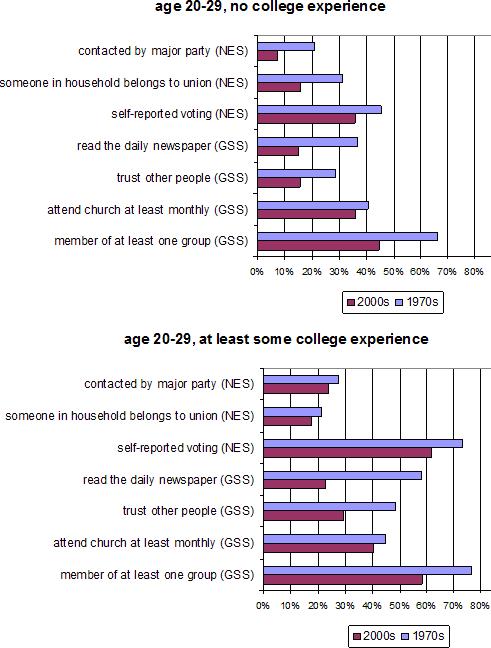
A wide gap has opened between the half of young Americans who attend college and the other half who do not. I am particularly concerned about the gap in political and civic participation. Those who express their views and cast their votes get more attention from government. Voting also correlates with other forms of civic engagement, such as following the news, joining organizations, and volunteering. When young people are not engaged in these ways, society misses their contributions: their ideas, energy, and social networks. And engaging in these ways is good for young people themselves: it provides information, networks, opportunities, motivation, and support. Those who volunteer are substantially better off than those who do not. A dramatic example is the finding that belonging to voluntary associations in Chicago is associated with lower death rates, especially for African American men.*

The following two graphs show the prevalence of civic engagement for young Americans during the 1970s and during the current decade. The first graph shows only young Americans without college experience; the second shows the ones who have attended at least some college.

Comparing the two graphs shows that youth on a college track are far more engaged. Engagement has declined in both groups over time; but proportionally, the change among non-college youth is much greater. While their voting rate has fallen significantly, their rates of union membership, newspaper readership, and contact by major political parties have been cut by more–at least by half. (I include trust in other people because it correlates with membership in groups and social networks.)

*See Kimberly A. Lochner, Ichiro Kawachia, Robert T. Brennan and Stephen L. Bukac, Social capital and neighborhood mortality rates in Chicago, Social Science & Medicine, vol. 56, issue 8 (April 2003), pp. 1797-1805

the effects of Obama’s organization

Senator Obama has 1.5 million donors, countless volunteers, a massive email list, and additional layers of organization, such as his trained “organizing fellows.” What does this mean for the future of politics and government?

Matt Stoller argues that Obama will have tremendous power within the Democratic Party. His supporters are even deliberately trying to de-fund alternative sources of power, such as America Votes.

Marc Ambinder reports that the Obama campaign is going to organize “more than a million donors and volunteers to directly persuade their neighbors through a variety of media” during the campaign, thereby bypassing the news media.

And Steve Teles and I argue that Obama has a chance to pass major legislation, such as health care reform, if he uses his organized base as a grassroots lobbying force after the election. We wrote this when the argument was Obama vs. Clinton. Our idea was that Obama would have a better chance to pass legislation because of his organizing campaign. Now the contrast with Clinton seems moot (to me), but the prospect of massive grassroots lobbying remains interesting. Power over the party, the media, and Congress–that is something to think about.