ServeNext is an organization started by young AmeriCorps alums who want to build support for national and community service. There is an entertaining article in the Chronicle of Philanthropy about their national road trip. That’s only one of their activities, and ServeNext is just one of several active and well-organized groups that are pressing for more and better federal support for service programs. The advocacy campaign as a whole is well organized and savvy and has the ear of policymakers, including leading Senators from both parties and both national presidential campaigns. I think Congress will pass significant new legislation to authorize many more service opportunities and will promote community service as a way to address important issues, such as the high school dropout crisis and our relationship with the Middle East. Whether Congress will appropriate sufficient funds seems more doubtful, given the awful federal budget situation.
Category Archives: Uncategorized
did the Supreme Court repeal the Supremacy Clause?
I was always under the impression that when the United States ratified a treaty, it became the law of our land. I got that idea from the U.S. Constitution, Article VI, section 2: “all treaties made, or which shall be made, under the authority of the United States, shall be the supreme law of the land; and the judges in every state shall be bound thereby, any thing in the Constitution or laws of any state to the contrary notwithstanding.”
Because this seems like strong language, I was actually open to the argument that the US should be careful about signing international human rights treaties. Famously, we and Somalia are the only two countries that have not signed the UN Convention on the Rights of the Child. I thought: That’s not good, but part of the reason is that we take treaties very seriously. To ratify the Convention would add a layer of law in our country and give individual children rights that courts could enforce. Courts might even order changes in state or federal budgets to comply with their reading of the Convention. Maybe there is a democratic argument against ratifying.
But then came the case of Medellin v. Texas, decided last year. Mr. Medellin was sentenced to death, but appealed on the ground that he had been denied the right to help from Mexico’s consulate, as provided by the Vienna Convention on Consular Relations (which we have ratified). The International Court of Justice (IJC) ruled that he had a right to review of his sentence. The Bush Administration actually took the IJC’s position and said that Texas should grant an appeal. But the majority of the US Supreme Court took Texas’ side and permitted an execution. As Justice Roberts wrote for the court, “In sum, while the ICJ’s judgment … creates an international law obligation on the part of the United States, it does not of its own force constitute binding federal law that pre-empts state restrictions on the filing of successive habeas petitions.”
In other words, because we signed the consular treaty, Congress should pass laws guaranteeing aliens the right to assistance by diplomats. But if Congress does not pass such laws, individuals have no enforceable rights under the treaty. And there is no sanction against Congress if it fails to pass laws.
I have friends who think the Medellin decision is an outrage. They say that the conservative justices ignored the plain text of the Constitution and 200 years of precedent. They offer two possible reasons: (1) The Court simply wanted Texas to execute Jose Ernesto Medellin (after all, Justice Roberts described his crimes in gory detail). Or (2) the Court dislikes international law so much that it will ignore a treaty that the Senate has ratified.
Whether these criticisms are fair depends–as such matters often do–on questions of precedent. If Medellin overturns 200 years of well-established law and makes the US an exception among nations, it is outrageous. If American precedents and the rules in other countries are more complex, then it is a more reasonable decision. I don’t know which interpretation is correct.
Leaving questions of legal interpretation aside, I think it is often (but not inevitably) good for the US to sign onto widely ratified treaties that grant individuals rights against governments. I would like such treaties to be enforceable, regardless of what Congress chooses to do. On the other hand, I also believe in the obligation of the US Congress to make all laws. When the US ratifies treaties, only the Senate and the president must agree, and they can agree to a very vague principle. Before the Medellin decision, courts would have to decide how precisely to implement a treaty. Thus I can see a fairly reasonable argument that Congress should always pass specific enabling legislation after a treaty is ratified.
why study service-learning?
I’m at Brandeis for a meeting of “emerging scholars” who study service-learning. They are paired with established mentors who advise them, and they enter a network of other new scholars in the field. This is a project (which we are helping to run) that is part of a larger effort to build the field of service-learning. I also participate in the “emerging leaders” part of the effort, which supports younger managers and organizers. Both aspects are funded by the Kellogg Foundation.
This seems an appropriate moment to ask why anyone should study service-learning (the combination of community service with academic study). I would say:
1. Because studying young people who are asked to work on a community problem or issue is a great opportunity to investigate large issues about human development, the reproduction or reform of institutions and cultures, learning, deliberation, racial conflict, and many other issues. In other words, service-learning is an opportunity for social science.
2. Because service-learning is common–present in about half of American high schools–yet the quality is very uneven. Research can identify what aspects of service-learning generate good results in various contexts. Once we know that makes service-learning succeed, we can inform future teachers in their education courses, explain the criteria in program guidelines, and so on.
3. Because there is an opening for new policies that involve service. Senators McCain and Obama both favor service-learning, and there is an effective nonpartisan advocacy campaign for national and community service programs. It is fairly straightforward to design new policies for Americorps. But it’s not so easy to say what a good service-learning policy should be for k-12 schools. Policies cannot automatically create high-quality educational experiences. They always operate through rather crude incentives or rules–for instance, grant opportunities, mandates, course requirements, standards, or state-sponsored exams. We need research about the likely impact of policies before we can tell friendly politicians which policies they should promote.
Note that even a friendly politician must make choices–must decide how much resources to put into service-learning compared to other activities, including other forms of experiential civic education. Responsible advice to policymakers thus depends upon careful and rigorous comparative research. It’s not enough to say that service-learning is good; we have to know whether each marginal dollar is better spent on it or something else.
4. Because a lot of adults are involved in a field called service-learning, and it’s a good group–diverse in goals and ideologies but idealistic and fairly coherent. To use an over-used term, it’s a “community.” Communities can deserve loyalty even if one doesn’t believe that they are objectively better or more important than other communities. I’m not sure that I believe service-learning is a better, or even a more promising, intervention than some others. I am sure that the community that supports it is a good one. According to the great work of Albert O. Hirschman, when one wants to change a group, the two choices are “exit” and “voice.” Exit is the main mechanism in a market, and it is a good one. We use “voice” when we cannot exit a group (e.g., a family or a nation), or when we are loyal. I think the service-learning world merits some loyalty, and that means using our voice to improve it. For those of us who are scholars, the best form of voice is research.
CIRCLE’s youth primary wrap-up
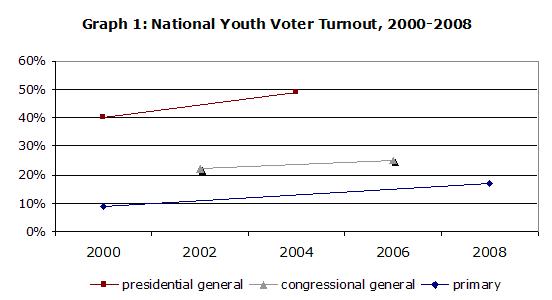
Today we released our analysis of youth turnout in the whole primary season. Youth voting almost doubled, compared to the best comparison year, 2000. That makes the primary the third straight federal election in which there has been a substantial increase.
For ages 18-29, these are the recent trends in national elections:
CIRCLE’s fact sheet and press release are here.
If the increase continues in the general, it will be interesting to see the impact on certain states where youth turnout was relatively low in 2004. Our interactive map allows you to explore these patterns. Especially interesting are Virginia (41% turnout of under-25s in 2008), New Mexico (42% turnout), and Florida (46% turnout). In each of these states, people between the ages of 18 and 25 represent 9% or 10% of the voting age population. For comparison, 69% of Minnesota’s youth voted 2004 (28 percentage-points more than in Virginia). Substantial increases this year in states like Virginia and Florida could shape the Electoral College.
the public and history
Here are two rival stories about the role of American history today:
1. American history used to be told in an elitist fashion. It was all about the intentions and actions of a few powerful individuals, almost all white men. Ordinary people (including ordinary white men) were marginal or invisible. Historical writing failed to give citizens a sense of agency, because all the power and influence seemed to belong to national elites. Then social historians began to democratize the past and bring it closer to students’ and readers’ experience by uncovering the daily world of farmers, soldiers, mothers, slaves, and others, in their specific circumstances. All kinds of people could find themselves in the past.
2. Many Americans are fascinated by great events and leaders. There is a huge audience for biographies, especially of presidents and generals. Millions visit battlefields and the historic homes of leaders; they want to know where Lincoln spoke or Stonewall stood. But historians write about minute details of social life, often using grand abstractions, like race and gender. They push schools and public facilities to emphasize traditionally oppressed people. For example, Chris Mackowski and Kristopher White noted at their talk on Tuesday that the Fredericksburg and Spotsylvania County Battlefield site has a sign about slave cabins even though there are no extant cabins or other remains to be seen there. Mackowski and White argued that this sort of display is alienating. People want to learn about Robert E. Lee, not about social history. Experts are responsible for the dominance of social history, which explains why students don’t major in history and why young people don’t know historical facts. (For instance, most 17-year-old Americans cannot place the Civil War in the period 1850-1900.)
I’m not sure what to think, myself. I will note that young people do study American history (it’s a requirement virtually everywhere), and they still recall a fairly traditional curriculum. We find that the three themes that young Americans remember studying most are: the Constitution and the American political system, “great American heroes and the virtues of the American system of government,” and wars and battles. Only 9 percent of young people recall any emphasis on “racism and other forms of injustice” in their social studies classes. Therefore, I can’t buy the argument that because young people are forced to study depressing facts about social life, they don’t know exciting facts about heroes. But that still leaves a deep question about what we ought to know.