Category Archives: Uncategorized

straight out of Dorchester

I was at U-Mass Boston today, watching videos produced by students in the Asian-American Studies Program. The videos were autobiographical and effectively raw: stories of child abuse, drug addiction, bullying. The students presented their work as a political act. They had made media instead of consuming it, thereby telling their own stories their own way.

I agree: although the personal doesn’t exhaust the political, to present yourself publicly is an important aspect of politics. As Hannah Arendt argued, to inhabit an identity fully and to have full individuality requires being able to display it for others in a public space–something that mass media culture frustrates. “In acting and speaking, men [and of course also women] show who they are, reveal actively their unique personal identities and thus make their appearance in the human world.”

The students whose videos I watched were self-conscious about defying ethnic and gender stereotypes, but one could say more generally that whenever human beings tell their personal stories–even briefly and simply–a challengingly complex reality emerges. I will give just one example of the complexity I learned about today. Several of the videos were made by Vietnamese-American men from the Boston area. They spoke in, I would say, a pervasive and credible version of an African-American urban youth dialect. They used the n-word to describe one another and said things like, “we all be gangbanging.” Vocabulary could be borrowed superficially or clumsily, but I noted subtler influences. For example, one young man was describing a fight that had led to a fatal shooting. On camera, he relived his own efforts to stop the violence. As he said, “Yo, calm down,” in a deep, serious voice, he partly raised one hand, palm outward; his eyebrows rose; and his eyes locked onto the viewer in a way that reminded me profoundly of an African-American man in a similar situation. But the murdered teenager was given a proper Vietnamese burial back in his birth country. Out of such mixtures and borrowings, parodies and homages, we make meaning, identity, and community.

Steve Teles’ The Rise of the Conservative Legal Movement

Steve Teles’ book The Rise of the Conservative Legal Movement was the subject of a recent symposium on Crooked Timber. It’s a fine book, specifically about the movement that pushed the federal judiciary rightward after the 1970s, and generally about why political movements succeed and fail. I think it’s especially valuable reading for liberals, who could learn many detailed lessons and at least three major points.

First, it’s a mistake to think that the conservative legal movement was successful because it was very well funded or especially canny and disciplined. Actually, funding for liberal legal scholarship, advocacy, and teaching far exceeds what conservative intellectuals ever had (especially if one counts the salaries available to liberal law professors); and the conservative movement made many tactical and strategic mistakes. They had diverse strategies and goals that were never very coherent. Some of their success came from what Teles calls “spread-betting.” They put money and effort into law-and-economics, into religious conservatism, into original-intent jurisprudence–mutually inconsistent ideologies–and every now and then they hit the jackpot.

Second, we on the outside of conservatism tend to associate it with powerful figures like Bush, Cheney, and Scalia; we argue that their views are favorable to the interests of the richest and most powerful tycoons and corporations; we observe them win on specific issues; and so we presume that we are dealing with a dominant, even hegemonic force. Whether conservatism actually has a privileged position is open to debate; it certainly loses many of its central causes. In any case, conservative thinkers do not feel dominant. On the contrary, they see the world much as other marginal movements do; they believe that the rules of evidence, the framing of questions, and such practical issues as who gets tenure and grants, are all stacked against them. Influenced by Steve Teles, I have previously made an analogy between conservative legal thought and feminism in the 1970s. Even if you are only trying to understand conservatism as an enemy, you should grasp its proponents’ psychology. Overall, I think they feel much more beleaguered and defensive than hegemonic.

Third, Teles makes some shrewd observations about how conservatives spend money. In the Crooked Timber symposium, he writes:

    Mark [Schmitt] starts his essay out by quoting Ben Barber, to the effect that, “When we care about something, we waste money on it.” Yes, absolutely, but as Mark knows better than anyone, there are better and worse ways of wasting money. In my experience, liberal-ish foundations often waste money precisely by trying to be too “responsible” with the funds under their control. They make grantees write huge proposals, go through complicated “evaluations” that are often inappropriate to the fields of advocacy or scholarship, give money for individual projects rather than general support (which makes building a strong organizational culture almost impossible) and just generally infantilize and get in the way of their grantees. Conservatives did not waste their money this way. Rather, their waste came from what I call “spread betting” (a term given to me by Mark Blyth)—throwing money at a bunch of different projects, letting the grantees run with their idea, and then seeing which worked and then doubling down. With a few exceptions, the conservative foundations were not the real agents of the story—they didn’t concoct a lot of “initiatives” or put out “requests for proposals.” They found people who seemed like they knew what they were doing, and then gave them the wherewithal to show what they could do with the resources.

My salary has been largely paid by “liberal-ish” foundations for nigh on twenty years, and I would certainly be glad if there could be simpler proposals, less evaluation, and more funds for core operating expenses as well as projects. In short, I would be glad if the liberal-ish foundations just bet on people–assuming I were one of the people they bet on. But that probably wouldn’t happen. My narrow self-interest may be better served by the current system of elaborate proposals, self-evaluation plans, and lots of little projects–because that’s the game I know how to play. Of course, liberal causes might do better using the conservatives’ investment strategy: my self-interest doesn’t necessarily coincide with the greater good. But it does strike me that grantmakers and successful grant-seekers have a mutual interest in the status quo, which partly explains why it doesn’t change.
setting a poor example

Many Americans believe that politicians are unprincipled and self-interested. Politicians, they assume, always try to maximize their chances of being reelected or promoted to higher office. That theory doesn’t make too much sense psychologically. Politics is a hard job, and there are easier ways to become rich and secure. I think that politicians are often pretty substantive. Their goals may be opposed to mine, or they may be too parochial. (Coming out of local communities, they sometimes just want to get stuff built and funded in their home towns.) They definitely want credit for what they achieve–or even what they touch. But it’s not fair to say they only want to be re-elected.

That’s why it’s unfortunate when a major politician acts blatantly opportunistically; it reduces respect for representative democracy to below what it deserves.

For instance, in explaining his shift to the Democratic Party, Senator Specter spoke briefly about “principle”; he claimed that his views were now more closely aligned with the Democrats than with the Republicans. But later in the same speech, he sounded like a professional athlete whose goal was to win and who had switched to a stronger team so that he’d have better odds. He said, “In the course of the last several months … I have traveled the state and surveyed the sentiments of the Republican Party in Pennsylvania and public opinion polls, observed other public opinion polls and have found that the prospects for winning a Republican primary are bleak.”

It seemed that nothing could be more nakedly self-interested; but then came the Senator’s interview with The New York Times Magazine:

    Q. With your departure from the Republican Party, there are no more Jewish Republicans in the Senate. Do you care about that?

    A. I sure do. There’s still time for the Minnesota courts to do justice and declare Norm Coleman the winner.

The evocation of “justice” made the Senator sound briefly principled, but he soon took it back, saying, “In the swirl of moving from one caucus to another, I have to get used to my new teammates. … I’m ordinarily pretty correct in what I say. I’ve made a career of being precise. I conclusively misspoke.”

I suppose one could give Specter credit for candor, but I think his motives are worse than average, and these glimpses into his soul hardly do him credit.

making the youth voting problem go away

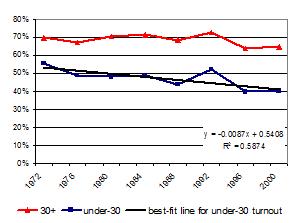
CIRCLE was founded in 2001 because of widespread concern that civic engagement was in decline, and a feeling that youth were the heart of the problem. Although everyone defined “civic engagement” as more than voting, the voting trend was a common symbol of the issue. The graph below shows turnout for young and older adults between 1972, when the voting age was lowered to 18, and 2000, just before CIRCLE was launched. Older adults’ turnout stayed pretty steady, but under-30s were in steady decline. A straight line would track the actual youth trend pretty closely and would decline by almost one point per year, or 3.58 points per election cycle. (If you discard 1992 as an outlier, the r-squared is .89.) We seemed to have a generational problem.

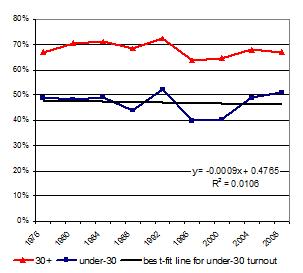
But 1972 could be considered an anomaly. Young people had just won the right to vote, with much hoopla. There was still a draft and the Vietnam War was deeply unpopular. So we might discard 1972 as a baseline year. Besides, we now have data from 2004 and 2008. This is how the trend looks if we chose to run it from 1976-2008.

Ipso presto, the youth voting decline has vanished! No straight line can track the youth trend very well, but the best-fit line hardly declines at all (one tenth of a point per year). It now looks as if the norm is a steady youth turnout rate of around 48%, and the late 1990s represented an unusually low period that could be attributed, perhaps, to the specific campaigns and politicians of that era.

Well, there are lies, damned lies, and statistics. We shouldn’t be allowed to make a problem appear or disappear by changing the parameters of a graph. But I would venture that declines and other changes over time are not nearly as striking as stability. We don’t seem to be able to get more than half of young people to vote. Just about half of young people attend college, and education and political activity correlate–not perfectly, but strongly. College attendance hasn’t risen; and within families, socioeconomic status tends to replicate itself. To me, the central issue is neither decline nor growth, but deep and persistent inequality.

(Another problem–harder to quantify but described in Harry Boyte’s editorial from yesterday–is a lack of civic opportunities other than voting.)

greening the city

My hometown of Syracuse, NY was disfigured when interstate highways were blasted right through its heart, between the university and downtown, flattening a neighborhood that had once been home to moderate-income African-Americans. Their strong web of churches, businesses, and other associations reached back to the time of the Underground Railroad, when Syracuse had been an important center of Abolitionism. In place of this old neighborhood, there appeared bleak expanses of tarmac and a modernist museum by I.M. Pei that showed no regard for its context. The city’s population has since fallen–more because of de-industrialization than urban “planning”–and now many of its fine old Victorian homes are abandoned and boarded up. There’s even a program under which the municipal government removes condemned houses and gives the property to the neighbors so that they can have suburban-sized yards.

Above is a major Syracuse cross-street, with Interstate 81 right through it. I know this is fanciful, but what if we put glass walls on either side of the space under the highways and filled it with plants? Syracuse is a very cold place–often the snowiest city in the whole country. Imagine warm, green, spaces for recreation under those highways. If the area became attractive, the neighborhoods on either side might fill again, taking advantage of scattered Victorian relics.

(With apologies for my poor perspective and draftsmanship.)