Category Archives: Uncategorized

state and local spending

(San Francisco) There is a lot of talk about deep cuts in state and local government spending, only partly offset by the federal stimulus. Here is a historical graph of total state and local expenditures, adjusted for inflation and for population growth:
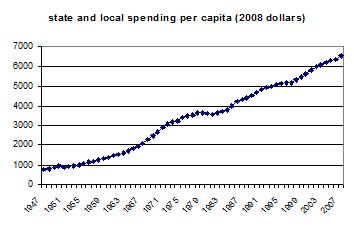
[revised, 10:30 am Eastern Time] The growth has been fairly continuous, apart from a dip in real spending in the Reagan years. Adjusted spending in 1982 was lower than in 1978, despite sharply increased need because of the recession. I don’t know for sure, but I suspect that at other times, the growth has been driven by: health entitlements, prison costs, and higher education (in descending order of magnitude). Spending for other purposes is probably close to flat.

Both the standard liberal and conservative narratives are a little off. Liberals are wrong to say that we’ve just lived through a period of conservative retrenchment in which local and state governments have shrunk. Expenditures are much bigger in real terms than they were in the liberal 60s. But conservatives are wrong to complain about a growing “welfare state.” If most expenditures cover prisons, education for relatively advantaged young adults who can attend college, and medical technology, this is hardly “welfare”–even broadly defined.

The data I could find ended in 2007. We’ll see what happens next.

people power in Iran

(Hartford, CT) I think the Iranian regime has doubled down, betting the very principle of clerical authority on the assumption that they can crush or outlast the protests. Ayatollah Khamenei denied that the election could have been rigged: “There is 11 million votes difference,” he said. “How can one rig 11 million votes?” He could have kept a low profile, called for negotiations, or tried to persuade one of the candidates to quit. Instead, he decided to force the issue. Evidently, either …

1. The election was rigged at a high level, not where the ballots were collected but where the results were announced. In that case, the whole regime is illegitimate on its own terms. Or …

2. President Mahmoud Ahmadinejad actually got the most votes, but there is still massive discontent, probably because the field of candidates and issues was sharply limited in the first place.

The two outcomes that I have seen discussed most are a victory for Khamenei, Ahmadinejad, and the militias, followed by further repression, or a victory for Mir Hossein Mousavi, whose policies would be incrementally less bellicose and more liberal. But I think there are several other possible outcomes, including a rapid drift in a more liberal direction (out of Mousavi’s control); a rapid drift in a different direction, such as toward some kind of left-populism; or a long period of conflict, including possibly a civil war. We should all wish the Iranian people the best in this critical, dangerous, hopeful moment.

Meanwhile, I continue to be moved by the self-discipline of their massive popular movement. According to a Mousavi supporter quoted by Juan Cole:

    … the dynamics of this movement are becoming more and more creative. From the moment everybody embraced silence as the best form of criticism, supporters from their cars switched from honking their horns to using their flasher. Last night, as I drove home, I noticed the blinkers in oncoming traffic (coming actually from the direction of Haft-e Tir Square). I didn’t take long to spread the message. Soon, everyone around was switching their flasher on, an act reflective of a truth that has been firmly established now after five consecutive days of protest: silence is speaking very loudly indeed. …

    The posters of Mousavi of day one have given way to posters expressing deeper themes, and the deeper problems that exist in this country. “Democracy does not equal Dead Student”, “Stop Killing Us”, “We are not rioters”, “Silence is not acceptance”, “The key to victory: Calmness, Hope and Patience”. …

    About the march: it was entirely silent and peaceful.

conference on the Obama civic agenda

Please save the date

The Obama Administration’s Civic Agenda After Six Months

A Public Discussion Convened by the

Jonathan M. Tisch College of Citizenship & Public Service

July 24, 12:00-2 pm, Tufts University

"I have no doubt that in the face of impossible odds people who love their country can change it. But I hold no illusions that one man or woman can do this alone. That’s why my campaign has called nearly 400,000 Americans to a common purpose. That’s why I’m reaching out to Democrats, and also to Independents and Republicans. And that is why I won’t just ask for your vote as a candidate; I will ask for your service and your active citizenship when I am President of the United =

States. This will not be a call issued in one speech or program; this will be a

central cause of my presidency."

    — Senator Barack Obama, December 5, 2007

What did Barack Obama mean when he named "service and active citizenship" a "central cause of his presidency"? What should that mean? What has the administration done so far to advance that goal? What should be done by the administration and others? How does Obama’s civic agenda look from historical and international perspectives?

To discuss these questions in a public forum:

Alan D. Solomont, Keynote Speaker

Chair, Corporation for National and Community Service

Harry Boyte

University of Minnesota

Archon Fung, Harvard University

Marshall Ganz, Harvard University

Peniel Joseph, Tufts University

Peniel Joseph, Tufts University

Carolyn J. Lukensmeyer,

AmericaSpeaks

Carmen Sirianni,

Brandeis University

And others to be named

This event is the capstone of the first annual Summer Institute of Civic Studies at the Jonathan M. Tisch College of Citizenship & Public Service. Participants in the Institute–an intensive, 2-week seminar at Tufts–are graduate students and faculty from many disciplines and universities. Each year the Institute will conclude with a public conference on a timely topic related to civic engagement.

Visit our website to sign up to receive updates about this event.


self-limiting popular politics

In this remarkable video from Italian TV, Iranian motorcycle police attack a group of peaceful protesters. The protesters respond with stones and manage to turn at least one motorcycle into a flaming wreck. You can then see them escort the lightly wounded police officer to safety and give him water. The informal rule that seems to have developed is: Hurt the machines, love the human beings.

This is a great example of what I wrote recently in connection to the Palestinian cause. Social movements must limit themselves or they are likely to spin out of control and destroy their own purposes and their own people. Perfect nonviolence is one example of self-limitation, but it is not the only one. Destroying motorcycles is violent (and could certainly harm the riders), but it can be done in a limited way. As Bhiku Parekh writes in his book Gandhi: A Very Short Introduction (p. 60), “Gandhi’s satyagraha has much to be said for it, but it cannot be a catholicon. Although Gandhi insisted otherwise, violence need not be accompanied by hatred to ill-will or be uncontrolled. Like non-violence it too can be restrained, measured, born out of love for both the victims and perpetrators of injustice, and used to arrest human degradation.” There couldn’t be a better illustration than this video.

a theory of familiarity

Let’s say that a place is perfectly familiar to you if you hardly notice you’re there. You can walk from one room of your house to another without using any mental resources to find your way, and if things haven’t changed, you hardly register the environment. I became so familiar with my Metro commute to College Park, MD–45 minutes each way for 15 years–that I often didn’t even notice changing trains at Fort Totten. I would have to look up to see if I had already shifted from the Green to the Red Line. Even accounting for some eccentricity on my part, I think this is a general phenomenon: We save our attention for what is new and requires thought.

I’m interested in when we reach a stage of familiarity. It doesn’t seem to take all that many hours. For instance, I would guess I spend an average of 2-3 hours per week on airplanes. Each plane is different. Yet that’s enough time to make the situation familiar once I settle into my seat. The context pretty much disappears and I can be fully absorbed in reading, thinking, or talking. So I think familiarity increases on a steep curve.

But then it matters how much time passes between experiences. My mother-in-law’s house in Georgia feels extremely familiar to me. I’ve spent no more than two percent of my time there since the mid-1990s, but our visits have been spaced fairly evenly over the years. Returning for a couple of days every 3-6 months seems to be sufficient to retain a sense of familiarity. In contrast, if we had spent three months there in 1996 and never returned, I’m pretty sure it would feel unfamiliar.

There is surely some individual variation in how we experience familiarity. I am not sure how I’d like to be in this respect. Attaining familiarity seems desirable, insofar as it reduces stress and distraction and lets us focus on our choice of tasks. At the same time, it seems bad when it makes us careless or inattentive to the world or when it makes time pass too quickly.