I’m at the University of New Hampshire for a conference entitled “No Better Time: Promising Opportunities in Deliberative Democracy for Educators and Practitioners.” By my unofficial count, more than 200 people [actually, 270] have convened here: college educators, grassroots community organizers, and scholars. The sponsors are the Deliberative Democracy Consortium and The Democracy Imperative, two organizations whose boards I serve on. We’re just starting but I am very excited by the group gathered here–its sheer size (considering that people had to pay their own way to get here) and its strength. Ten years ago, an open meeting with this framework would have drawn a much smaller and less experienced crowd.
Category Archives: Uncategorized
spectacles
I have been flying more days than not lately, and sometimes the process of checking in, lining up, boarding, riding, and waiting can take 13 hours or more–door to door. During that time, there is a constant background of trudging crowds, inane chatter on overhead TVs, music, repetitive warnings, commands, bellowed cell-phone conversations, mechanical welcomes, beeps, pings, shrieks. Sometimes it all seems like an intentional insult. They’re saying: You are so mindless that you’re better off with the stuff we broadcast than what might otherwise be inside your brains.
On Monday, CNN was covering a live car chase on the highways near Dallas. It had been going on for a long time, and the anchor had been joined by a Texan lawman as the color commentator. The two men occasionally remarked on the seriousness of the situation. “When you have a fugitive traveling at high speed, it’s never optimal.” “No, we never like to see this.” But the chase was entertainment gold. The whole AirTran lounge began to stare at the monitors, faces tipped upward, until the sudden end. I’m not sure exactly what happened, because I wasn’t watching the last moment, but I believe the fugitive left his car and was flattened by a truck. CNN showed instant replays with somber commentary and then switched to something else.
Tuesday, another lounge in another city. I’m on the floor with my laptop plugged into a rare socket. My flight is already three hours late, heading for five. Suddenly an offstage voice with maybe an Oklahoma accent barks out: “The remains of a serviceman are being transported. It would be appropriate to stand. Active service personnel and veterans, salute! Civilians, cover your hearts with your hands!” Soon everyone is standing in clusters around the concourse windows, staring at the tarmac. “Present arms!” Paunchy guys in shorts and flipflops salute the glass.
We go back to our air-traffic delays, with maybe a sense that frenetic noise is better than silence.
progressive reform requires trust in government
I’d be willing to bet that any climate change bill Congress passes this year will be an incremental improvement, but far from satisfactory. Likewise for health care. Not only will these bills have too little impact; they will also cost too much because corporate interests will have been bought off. Health and environmental reform could be accomplished more cheaply with more radical strategies, such as a single-payer health system and a straightforward carbon tax.
This situation is causing a lot of hand-wringing and calls for procedural reform, such as ending the Senate’s filibuster rule. I think I’m for that, but I have a somewhat different view of how progressive change may unfold.
For me, the basic issue is that Americans deeply distrust the federal government. Back in the 1940s and 1950s, when the top tax rate was over 90% and each new Democratic administration took on bold new domestic challenges, most Americans said they generally trusted the federal government to do the right thing. That has not been true since the 1970s, when the tide turned in a conservative direction. Campaign and lobbying money do frustrate clean reform efforts, but it’s also a big obstacle that Americans are fundamentally skeptical that the government can do a reasonable job. (This is the trend from American National Election Studies since they began in 1958:)
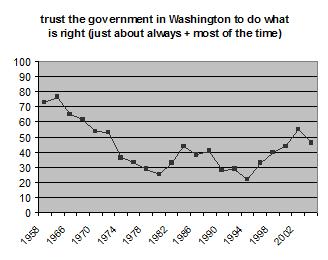
Some people (e.g., Thomas Frank, Paul Krugman) think that Americans distrust the government because of corporate and conservative propaganda. I tend to think, in contrast, that people know what their government is like from direct personal experience. Media coverage may be biased, but people aren’t so easily fooled. On the basis of their own experience, they have formed a negative view of government.
This wasn’t George W. Bush’s doing; in fact, one of the biggest temporary increases in trust occurred during his first couple of years in office (mainly thanks to Osama bin Laden). Bush didn’t deserve the trust he received from 2001-4, and Democrats were right to criticize his policies. But because Americans started with a very low baseline level of trust in the government as a whole, they didn’t attribute all of its problems to Bush or to his party. As trust fell, so did fundamental confidence that the federal government could handle any essential challenges.
It is certainly true that Americans deeply distrust corporations today and are open to government regulation–in the abstract. But whenever the issue becomes an ambitious government-run alternative to corporate markets, Americans get nervous. That is the context for policymaking in the early Obama years. There are powerful crosswinds.
If Congress could somehow pass bold, efficient legislation that really worked, that might restore trust. I think progressive members of Congress should continue to press for strategies like single-payer and a carbon tax. Procedural reforms should be on the table, too. But I wouldn’t depend on either of those approaches. Instead, I’d look for incremental steps that restore trust and that can build momentum. The more the Administration can involve Americans in both policymaking and actual public work, the better the chances for rebuilding trust.
“Where is the knowledge we have lost in information?”
(Washington, DC for a presentation) The ease with which we can analyze social statistics today is remarkable. There are huge, free data-sets all over the Internet. You can employ exploratory statistical techniques (such as probit models or factor analysis) to fish for relationships. Even easier is to find a column of numbers on a web page, copy and paste them into an Excel document along with a different column of numbers from a different source, and find out whether they correlate. It can take five minutes to accomplish a task that would have taken thousands of person-hours when my Mom was a young health statistician. Many statistical investigations that would have been completely impossible–such as a multivariate model of a Census data-set with tens of thousands of cases–are now quite simple.
Graduate students, faculty, think-tankers, bureaucrats, and even some bloggers are busy at this work every day. But I don’t think we understand society better than we did in 1960. At least, we don’t understand it in ways that help us to make the world better. We are richer as a nation, so we should expect life to have improved. In some respects, it has. Relative to our assets, however, I think our performance is considerably worse. How could rates of high school failure, violent crime, cancer, unemployment, depression, suicide, and poverty be stubbornly flat if we had developed better solutions through social science?
To be sure, bad policy doesn’t imply bad research; maybe there is a problem with implementation or with the motivations of the ruling classes. But figuring out how to address those obstacles should itself be a task for research. Besides, I am not overly impressed by the research-based proposals that are sitting around waiting for politicians and citizens to implement. At best, these ideas seem promising incremental steps, not game-changers.
What’s wrong? It could be that …
1) Correlational research provides limited understanding, because there are always unmeasured factors and influences. More powerful research is always experimental, and we don’t do enough of that. By the way, “experimental research” is not just a matter of randomly selecting treatment and control groups. It also requires bold and exciting new projects or institutions that can be evaluated in that way.
2) We don’t measure the important things. Test scores, yes; students’ wisdom and virtue, no. Voter turnout, yes; emerging political networks, not so much.
3) Our imaginations are too limited by our tendency to take actual facts (“data”) as necessary. Roberto Unger wants economics to be the scientific study of what might be possible. Instead, economics describes the present and recent past and infers from that description immutable laws. These laws may actually be subject to amendment, if we choose to change them.
4) Our attention is focused on the wrong levels or scales of analysis. Perhaps our scale is too modest. We ask whether interventions or programs affect outcomes, not which social philosophy is best. Or our perspective may be too broad and distant. We have tools for assessing whole populations, but few new techniques for understanding–let alone improving–specific neighborhoods, schools, or firms, let alone human beings. (There actually are techniques for those purposes, such as ethnography, asset-mapping, and appreciative inquiry, but they are vastly less influential than social statistics–and I am not sure they are satisfactory.)
the evasive passive
(In Providence, RI, for a Civic Education Institute) Tony Judt recently wrote a New York Times op-ed decrying the Israeli settlements in the West Bank. Abraham Foxman of the Anti-Defamation League played his customary role by providing an angry letter of rebuttal. The substance of his letter begins, “Isrealis settled in the West Bank because it was deemed part of the historic home of the Jewish people. …”
I love “it was deemed.” That must have taken a while to come up with. Consider the alternatives. “The settlers deemed that the land was theirs”? That sounds a little imperialistic, doesn’t it? “The Israeli government deemed the land useful to them”? Not a helpful message for the ADL director to publish in the Times. “God gave the land to Jews forever”? Some people believe that–some Jews and some fundamentalist Protestants. It’s not, however, a line that Mr. Foxman wants to take, nor does it have a lot of force in international law or diplomacy.
Thus the passive–the great, responsibility-ducking passive–followed by a few strong active sentences with Arabs as the subjects. (“They rejected opportunities for peace.” “[T]hey rejected the United Nations resolution …”) So they did (those few with the power to make decisions); but the Isreali government also made choices, and now the mess is theirs.