Category Archives: Uncategorized

politeness, protocol, military discipline

I personally found it offensive when Rep. Joe Wilson called the president a liar during a speech to Congress. That’s partly because the president was not, in fact, lying. (Even if some illegal immigrants might occasionally–and illegally–receive health coverage under the president’s plan, he was not “lying” when he said, “the reforms I’m proposing would not apply to those who are here illegally.”) The outburst also showed a lack of personal respect for Barack Obama. One of the reasons that I find such disrespect offensive is that Mr. Obama, as an individual, deserves a high degree of respect. Mr. Wilson and I evidently disagree on that matter, but I am confident he is wrong.

There is a separate question whether people in Mr. Wilson’s position are entitled to call any presidents of the United States “liars.” Many presidents have indeed lied, and some believe we should have less decorum in Washington and more “accountability moments.” The British House of Commons is a spectacle of abuse and recrimination that many find emblematic of democracy. I once watched a particular parliamentary exchange in England with graduate students from the developing world, who were stunned by the freedom it represented. The exchange went something like this:

    Front Bench Labour MP: “If the Prime Minister had spent eighteen years on Robben Island, like Nelson Mandela …”

    Labour backbencher: “As she should!”

    [General uproar, hooting, laughter, denunciations, etc.]

But successful organizations combine such frankness and openness with decorum. The British Prime Minister, for example, is enormously powerful and spends most of his or her time in venues that are completely decorous, controlled, and closed. Prime Minister’s Question Time relieves some pressure within this generally hierarchical system. That hierarchy–greater in some respects than ours–is helpful for obtaining progressive change when the Prime Minister happens to be progressive.

On our side of the ocean, there has been some decline in respect for official leaders. For instance, I’m pretty sure that thirty or fifty years ago, had a president chosen to address the nation’s schoolchildren, school administrators would not have thought it necessary to inform parents. And if they had sent a note home about the speech, most parents would have said, “Well, Johnny, you’d better pay attention in school tomorrow.” Now substantial numbers of parents are quick to attack both the schools and the president for indoctrinating their kids.

This trend is good, in part–reflecting an increase of freedom. It is also bad, in part, especially for progressives who expect the public to entrust more of their money to the federal government. That requires a degree of respect for high public offices and for those who legitimately hold them. Expecting people never to criticize the president would push “respect” much too far. But it seems a reasonable rule that Members of Congress should not blurt out personal attacks during formal speeches. George W. Bush deserved that level of decorum as well as Barack Obama.

Finally, Rep. Wilson is not only a Member of Congress but also a Colonel, US Army (ret.). I’m not sure what to make of Major General Paul D. Eaton’s comment that “Retired Colonel (Representative) Joe Wilson’s conduct last night is a breach of military protocol and represents a further departure from the historic good order and discipline I expected, in the past, to see from the GOP …” I appreciate that respect for democratically elected officials is an important ethic for uniformed military officers. But if military discipline is supposed to cover former officers who serve in Congress, I fear a militarization of this democratic space. Colonel Wilson was not allowed to disparage the Commander in Chief in any public venue. Surely Representative Wilson has a right to bitter attacks on the president, albeit not during a formal address to Congress. Barack Obama is not Mr. Wilson’s Commander in Chief (nor mine), although he is our president.
poor public knowledge does not mean we need more courses

It seems like every week Americans fail a survey about their knowledge of some important matter, and an expert or politician demands that we require students to study it. In my field, for example, American adults show poor knowledge of the Constitution (many more can name the Simpson family than the five freedoms in the First Amendment). Politicians seize upon such statistics to demand that we “teach the Constitution.”

But we do teach the Constitution. It is included in almost all state standards, and often tested on high-stakes exams. At least 80% of high school students take at least one semester of American Government or Civics, which typically revolves around the Constitution. Nevertheless, in an elaborate study that my colleagues and I conducted, we found that (a) studying the Constitution made only a modest impact on students’ ability to answer survey questions about the Constitution; and (b) state requirements made absolutely no difference in what students knew. Even if state requirements did boost students’ knowledge, it would be an open question whether such knowledge lasts.

Besides, we could play this game all day–citing important survey questions that Americans fail to answer correctly, and demanding that these subjects be mandated in our schools. For example:

1. According to the the National Environmental Education and Training Foundation, “45 million Americans think the ocean is a source of fresh water; 120 million think spray cans still have chlorofluorocarbons (CFCs) in them even though CFCs were banned in 1978; another 120 million people think disposable diapers are the leading problem with landfills when they actually represent about one percent of the problem; and 130 million believe that hydropower is America’s top energy source, when it accounts for just ten percent of the total.” Sounds like an argument for mandatory environmental education–which I would support in principle, but many states already have such mandates.

2. A plurality of Americans believe that “God created man pretty much in his present form at one time within the last 10,000 years,” even though almost every student has to study evolutionary biology.

3. According to the Kaiser Family Foundation, “In 2006, more than one-third of the public (37%) thinks HIV might be transmitted through kissing, 22% think it might be transmitted through sharing a drinking glass, and one in six (16%) think it might be transmitted through touching a toilet seat. More than four in ten adults (43%) hold at least one of these misconceptions.”

Before we jump to the conclusion that a curricular mandate would solve any of these problems, we need to ask: 1) Does a snap telephone survey of factual questions yield valid information? (Maybe people would do a lot better if they had a chance to prepare.) 2) Is educating kids the best way to reduce ignorance among adults? (That implies that factual information imparted in high school lasts for decades.) and 3) Do educational mandates cause good outcomes in classrooms? (I doubt it.)

The alternative is to work on improving the actual impact of instruction on important topics.

civic engagement in recessions

I am going to DC today very briefly for the release of the 2009 Civic Health Index by the National Conference on Citizenship. As in past years, we did most of the technical work for the NCoC’s Index. The title of their report is “Civic Health in Hard Times,” and the main finding is that engagement has really fallen this year.

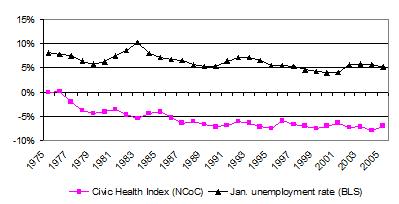
The following graph didn’t make the final report, for appropriate reasons–it seemed a bit ambiguous and not necessarily persuasive. But I think it’s interesting enough for a blog, if not for a shiny national report.

It graphs the NCoC’s Index of Civic Health–composed of our favorite 40 indicators, from volunteering to following the news–along with the unemployment rate. In general, the relationship is positive (a healthy .59 correlation). When unemployment gets worse, people engage more–perhaps to meet increased need, or possibly because some of them have time on their hands. But there was an exception. When unemployment reached and surpassed 10% in the 1980-82 recession, civic engagement fell pretty sharply, driven in large part by a decline in volunteering.

We think we’re seeing a similar dip in 2009. My best guess is that modern civic engagement depends on a funded infrastructure. You can’t tutor kids if the school lays off its literacy coordinator. You can’t read to kids if the library branch is closed. Thus, when the economy really gets bad, even though the need for engagement is high, opportunities suddenly dry up and civic health falls.

(I should note that the NCoC’s report makes this suggestion, but not by using the graph shown above.)

in the news

Mary Ann Zehr has a piece in EdWeek, unfortunately behind a firewall, that’s headlined, Celebrities Lend Weight to Promote Civics Education . She begins, “Actor Richard Dreyfuss, former U.S. Sen. Bob Graham, two retired U.S. Supreme Court justices, and several nonprofit organizations are each working on a piece of the puzzle of how to ensure that civics education gains a bigger foothold in the K-12 curriculum.” She quotes me about the trends in civic education. I say that it’s a myth we once taught civics and have since dropped it–but there are big disparities in the quality of civic experiences that different kids get.

Elia Powers has a piece on St. Louis Beacon entitled, “Engaging Young People’ (Part I)” It begins, “The Center for Information and Research on Civic Learning and Engagement (CIRCLE) is a regular stop on my morning web search. Based out of Tufts University near Boston, the nonpartisan research center puts out a lot of national reports on young voter trends and volunteering statistics – just the kind of snapshots that help convey an impression of how engaged (or not) young people are in civic life. Those snapshots are bound together in an album of sorts in a new book (have I given away the name already?), “Engaging Young People in Civic Life ,” out this month from Vanderbilt University Press. The book’s thesis is that young people are already largely engaged, and that too much attention has historically been paid to their shortcomings.” Powers then interviews the two editors, Jim Youniss and me.

Vernon Jordan as network hub

In his very accessible and enjoyable book Linked, Albert-László Barabási uses Vernon Jordan as an example of a “hub,” someone who collects an extraordinary number of links within a network. (It turns out that networks naturally develop such hubs if one node is added at a time and there are benefits to linking to already popular nodes.) At the time Linked was written (in 2002), Jordan served on a record-setting ten corporate boards of Fortune 1000 companies, meaning that “he regularly meets 106 other Fortune 1000 directors” and was within three degrees of separation from almost all the 6,724 directors of America’s largest companies. This centrality made him a useful person to know if you wanted to raise some cash or create a partnership, if you had a legislative or political problem, if you were thinking of a presidential run, if you had a scandal to hush up, or if you were interested in getting on a corporate board yourself.

Muckety (which is fun to play with, in case you haven’t already), shows Vernon Jordan’s current network as follows:

I find this map interesting for several idiosycratic reasons. I’m getting ready to teach a course on networks. I’m struck by Ward Just’s depiction of today’s Washington as a city of “fixers,” who profit from their network-centrality instead of their formal titles. I’m concerned about the history and strategy of the civil rights movement and wonder whether Vernon Jordan’s success is helpful. (It may be; I just don’t know.) I’d like to know who really runs today’s Democratic Party. Finally, I just spent a few days with my family near Oak Bluffs, MA–albeit without linking to Mr. Jordan in any way besides spatial propinquity.