Category Archives: Uncategorized

creating informed communities (part 1)

The Knight Commission on the Information Needs of Communities has issued a report entitled Informing Communities: Sustaining Democracy in the Digital Age. This report makes 15 recommendations, including the following that are related to my work:

  • Expand local media initiatives to reflect the entire reality of the communities they represent.
  • Engage young people in developing the digital information and communication capacities of local communities.
  • Empower all citizens to participate actively in community self-governance, including local “community summits” to address community affairs and pursue common goals.
  • Emphasize community information flow in the design and enhancement of a local community’s public spaces.
  • Ensure that every local community has at least one high-quality online hub.
  • (see also the list of “potential action items” in an appendix to the report)

I have been asked to recommend ways that we can meet these objectives. This week, I plan to write five consecutive blog posts about strategies. As always, critical feedback is welcome.

Strategy 1: A Civic Information Corps: Using the nation’s “service” infrastructure to generate knowledge

Community service and the combination of service with academic study (“service-learning”) have rapidly grown. Since the 1980s, civilian service has been institutionalized with funded programs, paid professionals, and rewards. In response to effective advocacy, the Federal Government founded the Points of Light Foundation in 1990, passed the National and Community Service Act of 1990, and launched AmeriCorps and the Corporation for National Service (later, the Corporation for National and Community Service) in 1993.

There is no single “corps” in AmeriCorps; instead, the Corporation funds intermediaries that include national nonprofits with diverse models and constituencies–City Year and Public Allies are two well-known examples–plus schools, universities, Native American nations, and local nonprofits. YouthBuild, the Peace Corps, and the Corps Network (a coalition of 143 Service and Conservation Corps) are additional components of the national service movement that happen not to receive AmeriCorps funds. Meanwhile, some large school districts and universities and one whole state (Maryland) have enacted service requirements for all their students. Several states and major cities also have official service commissions. Colleges and universities now look for prospective students with service experience.

Probably as a result of these incentives, opportunities, and requirements, three quarters of high school seniors reported volunteering at least “sometimes” by the year 2003, and 80 percent of incoming college freshmen reported having volunteered in high school. The Corporation for National and Community Service reports that about 8 million young adults (age 16-24) volunteered in 2008. These trends received an extra boost in 2009, when Congress passed the Edward M. Kennedy Serve America Act, which authorizes a tripling of AmeriCorps to 250,000 annual slots.

All these volunteers represent an important base for civic activity in the United States, at least potentially. “Service” activities range widely, and some have little connection to knowledge or information. It is not uncommon for young people involved in service to be bused to a park or an urban street and simply asked to pick up bottles or paint walls. AmeriCorps as a whole does not specify learning outcomes or require intellectually challenging opportunities for youth. Much emphasis is placed on the work performed, e.g., the number of homes weatherized. On the other hand, certain service projects generate public knowledge to an extraordinary extent. For example:

  • There are 1,500 Bonner Scholars at 24 colleges and universities, all involved in community service and other forms of civic engagement, such as community research. Using a grant from the Corporation for National and Community Service (the Learn and Serve America program), the Bonner Foundation promotes the use of social media tools–such as wikis and videos–by all of its Scholars. Methods involve social-media trainings at all of its meetings and conferences, an elaborate online platform for shared work at each campus and nationally, and ten competitive subgrants to Bonner campuses that do more intensive work with social media. At the heart of the online platform is a wiki site with hundreds of documents on social issues, student projects, tools, and best practices. After receiving the Learn & Serve America grant, Bonner began to plan PolicyOptions, an additional wiki platform for news and policy background information that will enable campuses to establish local, campus-based PolicyOptions Bureaus that are affiliated through a national network, sharing information and a common web platform.
  • With funds originally from the Cricket Island Foundation, we at CIRCLE funded young people in the Cabrini-Green Housing Projects in Chicago to document the full story of their community, which is nationally famous for its murder rate but has many other dimensions. Cabrini Connections today is rich with documentary videos, research reports, and photo essays.

Although independent evaluations are scarce, these programs (and many like them) are probably strong on two dimensions: they provide valuable community service in the form of knowledge, and they educate their participants by developing advanced skills.

The Knight Foundation report calls for a “Geek Corps for Local Democracy,” consisting of college graduates who would “help local government officials, librarians, police, teachers, and other community leaders leverage networked technology.” Corps members would educate local partners and also form a national learning network.

That sounds like a good idea, but I would relax two implied limitations. First, I would broaden eligibility well beyond college graduates. Just over half of adults between the ages of 20 and 29 have any college experience at all, and a majority of those do not hold four-year college degrees. A Greek Corps need not be limited to the quartile that is most successful (or privileged) in conventional ways. There are lots of talented individuals who have fallen off the college track, who would benefit from service, and who might contribute more than college graduates in terms of local knowledge and cultural savvy.

Second, I wouldn’t limit their role to merely providing technical support for the nonprofit IT infrastructure. I would involve them in creating knowledge and culture. The best format might be a new “corps” (although I wouldn’t call it a “Geek Corps,” because there would be an emphasis on creativity and cultural diversity that we don’t normally associate with geeks). Alternatively, the federal government might provide incentives for all kinds of service groups and organizations to focus on community knowledge. These groups would not have to focus narrowly in information or communications. If knowledge was an important byproduct of their work, they could join the national learning network, which would be separately funded and staffed.

In practical terms, if you organized after-school service activities for teenagers in, say, Chicago, and you emphasized community-based research, reporting, photo documentation, mapping, archiving local records online, or IT support for nonprofits, you could qualify as a “community knowledge producer.” You would then be able to send a designee to meetings, apply for training opportunities, log onto a virtual learning network, and apply for specialized grants.

my fellow readers

(Washington, DC) I have read almost every article in every issue of The New York Review of Books since about 1990. I enjoy it, and it’s my continuing education. But some of the articles make me uneasy, in a peculiar way. Ostensibly reviews of new books, they are really profiles of great thinkers from the past. These geniuses typically rubbed shoulders with others who were equally worthy of caricatures by the late David Levine. Reading about these impressive cliques begins to make you feel that you’ve missed out. The reviewer, too, is formidably bright and learned, and he or she may drop the names of personal acquaintances who are just as famously smart and creative. One in-crowd is reviewing another.

More often than not, the essay suggests that the great mind in question did not quite pan out, had a flaw or a weakness, somehow disappointed. That can make you feel even more inadequate by comparison. Or we may read that the great writer depicted an ordinary or mediocre person with a sharply satirical or a wisely sympathetic eye: think Emma Bovary, Leopold Bloom, or Rabbit Angstrom. In such cases, an intellectually glamorous reviewer is describing a superstar writer whose subject stands far beneath them both. But where do we stand?

It all makes me want to address my fellow readers. (This is the age of peer-to-peer communication, after all.) So I say to my peers: Very few of us are destined for the pages of The New York Review, neither as writers nor as subjects. But we pay for the thing. We too have thoughts and hopes, even if they are not worthy of a review. Also, those geniuses?–they wasted some of their time. They cut corners and doubted themselves and wrote a fair amount of schlock. There’s nothing like a five-page digest of a life to make the whole thing seem Olympian, even with its itemized flaws. Devote that much space to any of us, let an Elizabeth Hardwick or a Tony Judt summarize our work and a David Levine turn our face into art, and we wouldn’t look so shabby, either.

YUM: a taste of immigrant city

Project PERIS (Partnering for Economic Recovery Impact through Service) is an ambitious and rather complicated initiative of Tufts and our partners in Somerville, MA–funded by the Corporation for National and Community Service. The idea is to go beyond episodic and uncoordinated “community service” to achieve substantial impact. The project combines research, consultation, planning, and hands-on service as a real partnership between a university and community agencies and nonprofits.

In concrete terms, the main elements of the project are a set of courses (3-4 per semester) that are co-taught by Tufts faculty and community leaders. Each course undertakes some combination of research and service. The “connective tissue” among the courses is a series of planning and reflection meetings that include participants from across Tufts and Somerville.

In one class that I’ve been tangentially involved with, Professor Jennifer Burtner and her students helped plan and launch a project that supports 13 immigrant-owned restaurants in Somerville. Their major service is the Yum! discount card. They have also studied and documented the participating restaurants, producing graphic art, ethnographic essays, professional-quality photographs, videos, posters, and A-frame billboards. Some of their material is collected on their class blog.

The ethnographic essays are particularly interesting because they look–superficially–like restaurant reviews. But the perspective is different. These are not assessments meant for consumers; they are descriptions of small institutions in their social context.

Overall, PERIS is producing a mass of high-quality information and culture, which may turn out to be its biggest contribution–especially if we can find ways to pull that material together.

will the White House go all in?

At a book party for Robert Kuttner’s A Presidency in Peril, guests debated whether the White House will actively and forcefully support Democratic congressional candidates this November.

The argument against: Democrats are going to lose seats compared to 2008, even if they manage to draw a majority of the popular vote. A loss of seats will be depicted as a loss, period. If pundits and politicians assert that the president tried to help his party but failed, he will be depicted as weak and unpopular. That perception will deplete his political capital for the 2010-2012 legislative sessions.

The argument in favor: Perceptions of the president matter, but they will be shaped by more fundamental factors than whether he is perceived to have campaigned for Democrats in congressional elections. (The unemployment rate will be far more important, for one thing.) By campaigning, he may be able to boost turnout and save some seats. Even if he doesn’t, he can gain political capital by taking a risk for his party. And he can energize the Democratic side by showing that he is moved by principle and policy, not by short-term political considerations. Finally, by making principled arguments for progressive policies in 2010, he can lay the groundwork for majority support when (or if) the economy finally recovers.

young people and trust in government

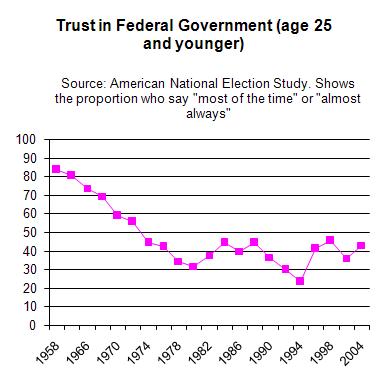
I was quoted on NPR’s Morning Edition earlier this week, commenting on a new Pew survey that finds 32 percent of young adults trust the federal government. That’s not exactly a resounding vote of confidence, but it’s much higher than the level of trust observed in older people today. For instance, just one in five of the 65-and-older group trusts the feds. In my quotes, I attribute some of the difference to generational traits. We know from many other surveys–and from comparisons to surveys in past decades–that Americans born after 1985 tend to be more trusting toward government and other institutions (including corporations) than other recent generations were at the same age. They are also more likely to favor government action to promote equality and social welfare. See Peter Levine, Constance Flanagan, and Les Gallay, The Millennial Pendulum (pdf).

But three important caveats are in order. First, even though young people have more favorable views of big, adult-led institutions than their predecessors had since the 1960s, they continue to set records for lack of trust in fellow citizens. This is the “social trust” that is thought to promote all kinds of good outcomes, from democratic participation to health and well-being. It remains in deep decline.

Second, young people are surely still forming their opinions. They are not dyed in the wool. Pew finds that the whole population has some of the lowest levels of trust ever recorded in the government. Public anger comes on the heels of a deep recession and a series of bailouts. The research on Millennials’ attitudes mostly predates the recession. By the time the dust settles, young people may conclude that the Obama Administration (which they played a major role in electing) helped them and the country, in which case their levels of confidence will rise. Or the Millennials may conclude that the feds fiddled while Rome burned, in which case their formative experiences will be sharply negative. The story is far from over, and it’s way too early to make predictions about a whole generation (the youngest members of which are now turning five years old).

Third, we tend to compare Boomers, Xers, and Millennials with great interest, focusing on fairly small changes. That’s because we have lots of comparable data on them. But if you take a longer view, it’s clear that the big changes occurred four and five decades ago. At the height of the New Deal, the Fair Deal, and the New Frontier, vast majorities of Americans–young and old–trusted the federal government to do the right thing. After Watergate and Vietnam, trust has bounced up and down depending on the economy and other news, but it has remained in a whole new band. Where once trust was the norm, now distrust prevails. This change explains a great deal about the direction of national policy since 1970.