Category Archives: Uncategorized

a bull market in youth civic engagement

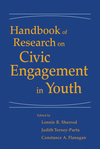
Today I received my copy of the Handbook of Research on Civic Engagement in Youth, edited by the star team of Lonnie R. Sherrod, Judith Torney-Purta, and Constance A. Flanagan. It provides 706 large pages–24 chapters by 53 authors–about how, why, and when young people participate in politics and civic life.

In 1985, Timothy Cook wrote an American Political Science Review piece entitled “The Bear Market in Political Socialization.” As he noted, the body of research on how people become citizens was then strikingly small, considering that the future of our democracy depends on that question. A few fine scholars wrote on this topic, but they were scattered among political science, developmental psychology, and education research, with little interdisciplinary dialogue and few inroads into other relevant disciplines, such as sociology and communications.

Further, the current scholarship had virtually no impact on practice. Educational policies, classroom strategies at all levels (from kindergarten to graduate school), community service programs, and the efforts of political campaigns and the news media to reach young audiences were some of the areas of practice that were conspicuously uninfluenced by theory or research about young people as citizens.

The new Handbook illustrates that we are now in a bull market, with scores of active scholars turning out heaps of research on youth civic engagement and interacting constantly with practitioners.

My own chapter, by the way–co-written with Ann Higgins-D’Alessandro–considers some of the crucial philosophical questions that arise when we ask how young people should be educated for citizenship. A not-so-hidden agenda is to persuade readers that education is not a matter for positivist social science alone. It is intrinsically about values; and good research is defined in part by having good values.

states versus markets (a somewhat different take)

On a major blog some months ago (unfortunately, I can’t find the link), the blogger complained about his Internet-service provider, and a debate ensued in the comments section about whether corporations or governments are worse. One writer remarked, in effect: Companies can be as bad as government agencies, but when a company mistreats you, you can just walk away. It’s irrational to get all worked up about that. When the government wastes your money or time or gives you bad service, it’s an outrage. The author concluded that markets are better than governments.

I have a somewhat more complicated view. I think it is smart to minimize your emotional reaction when a company performs poorly; just take your business elsewhere, if you can. It is more appropriate to be angry at government because:

  • It usually offers less choice or none at all, which is frustrating.
  • We have a legitimate sense of ownership and identity with our government. It is “ours.” Its bad performance is a matter of deeper significance for us.
  • The mechanism of reform in government is “voice,” not “exit.”* Government services improve when some citizens (perhaps including state employees) take it upon themselves to complain and advocate for change. That can also happen in a marketplace, but the main mechanism for improvement in a market is Darwinian. Customers are supposed to move their money to the best-performing companies and not provide free advice. So we should hope for frictionless, unemotional decisions in a market and periodic expressions of anger in the public sector.

The question is whether, when, and for what purposes we want to rely on voice versus exit as the mechanism of improvement. I see the advantages of exit and competition and am therefore biased in favor of markets as the means for delivering ordinary services. But there can be at least three powerful rationales for state involvement:

  • To promote equity. Markets don’t deliver services to everyone. For example, there is virtual consensus in the US that governments should fund universal k-12 education, a view shared even by market-enthusiasts who believe that education should be delivered by private schools. Unless the government funds education, being born poor will be a life sentence to poverty. That means that we hold the state accountable for education even if it chooses to outsource the work of educating. Voice is inescapable.
  • To promote security. Governments are in the security business when they guard our borders, arrest criminals, prevent pollution, regulate markets, or provide fundamental services to people in need. We can debate which forms of security are appropriate and whether the government should directly provide them or else fund private entities to do so. But again, when we believe in some form of society-wide security, we hold the government accountable for results and use voice to express dissatisfaction.
  • When we feel a sense of ownership in an object. For example, Americans think of the national parks as theirs. If they don’t like the services at Yellowstone, they are not going to be happy switching over to some private resort. It doesn’t matter whether the National Park Service does the work at Yellowstone or outsources it; as long as people feel they own the park, they will hold the federal government accountable for it. This feeling is socially constructed, not inevitable. We could feel ownership over different acres instead of Yellowstone–or none at all. But the initial creation of the National Parks was popular and has been validated by decades of public opinion.

To complicate matters, all markets are (at best) imperfectly competitive, and there can be choice and competition among governments (because individuals and companies can move). Thus voice is sometimes appropriate in the private sector; and exit sometimes matters in the public sector. Also, communities as well as governments can own public resources. Finally, some private corporations own resources that people identify as theirs–for instance, fans identify with their local professional sports teams. In such cases, whether to honor voice is the company’s choice, but it is often a wise one.

* Albert O. Hirschman, Exit, Voice, and Loyalty: Responses to Decline in Firms, Organizations, and States (Harvard, 1970)

talking about this generation

I am paid to write about the civic and political engagement of young Americans. Many people who are interested in this topic believe that today’s younger adults, often called the Millennials (born 1985-2004), have distinctive and admirable attributes that will help to remedy the deep problems that we older people have created for them. Chief among their distinctive characteristics are a propensity to serve (marked by record-high volunteering levels), appreciation of diversity, creativity and entrepreneurship, and resistance to the dead-end ideological debates and culture wars of the previous decades.

The portrait is controversial and subject to much debate. For example, I keep on my shelf the following pair of books. Generation We by Eric Greenberg and Karl Weber is subtitled, How American Youth are Taking Over America and Changing Our World Forever. Norman Lear provides one of many enthusiastic endorsements on the back cover: “The Bible tells us, ‘a little child shall lead them.’ … Greenberg and Weber chronicle today’s wonderful young people as they push, pull, and propel us toward global salvation.” But I also own The Dumbest Generation by Mark Bauerlein, subtitled How the Digital Age Stupefies Young Americans and Jeopardizes Our Future, or Don’t Trust Anyone Under 30. The back cover warns: “If they don’t change, they will be remembered as fortunate ones who were unworthy of the privileges they inherited. They may even be the generation that lost that great American heritage, forever.”

If these books are witnesses for the defense and the prosecution, I would give my ultimate vote to the defense. I think the positive trends (rising volunteering rates, strong turnout in 2004 and 2008, and tolerant attitudes) outweigh the negative ones (record-low interpersonal trust and news media use)–while other measures of civic engagement (such as students’ knowledge of politics) are remarkably flat. Although there is nothing inevitably good about youth movements–European fascism was an important example–this generation inspires somewhat more hope than fear in me.

On the other hand, the whole business of making a case for or against a generation should be viewed with suspicion, for four reasons. First, generations are arbitrary constructs: babies are born every second, and all the important trends in civic engagement are smoothly continuous, not broken suddenly at twenty-year intervals. Second, there are many aspects of civic engagement, and some rise while others fall. Third, people born around the same time can have totally different formative experiences. For example, about one third of young Americans are not graduating from high school today, and they come of age in very different circumstances from their contemporaries who attend four-year colleges. The gaps in volunteering and voting rates by educational experience are vastly larger than any differences among generations. (Almost three quarters of young college graduates voted in 2008, compared to 26% of young high school dropouts.)

Finally, we do not know how the current generation of younger adults will turn out over their life course. The children of post-War suburbs who bought Davey Crocket hats and acted like Charlie Brown and Lucy were wearing dashikis and love beads a decade later. Today’s generation had early experiences with peace and prosperity, but more recently have faced the longest war in American history and the deepest recession since the Great Depression. To the extent that they have typical formative experiences, we cannot yet say what those experiences will be.

Notwithstanding all those caveats, there is something to the idea of social reform through generational mobilization. In the 1920s, Karl Mannheim argued that younger adults have valuable roles as critics, reformers, and renewers of society, even as elders contribute experience, and people in their middle years hold most of the managerial responsibility. Furthermore, when one is born affects one’s development as a citizen, even though other factors also matter. It is important that today’s youth grew up with Facebook and two wars in the Middle East, instead of Walter Cronkite and war in South East Asia.

Thus one does not need a strongly positive evaluation of the Millennials to motivate a commitment to youth civic engagement. It is always valuable to get younger adults constructively involved, and to do so effectively requires careful attention to their particular traits. Each cohort has distinctive assets and challenges which one must understand to develop strategies for civic renewal. With regard to the current generation of young adults, the most salient characteristics appear to be a fondness for online social networking, experience with volunteer service, comfort with diversity, unprecedentedly high levels of support for the winning presidential candidate (in 2008), low interpersonal trust, and low levels of formal group membership. This is the mixture of which something valuable can and must be made.

we need more branches of government

Two very different authors whom we assigned in our summer institute both advocate adding branches to the traditional troika (legislative, executive, and judicial).* In general, a “branch” is a part of government with distinctive guiding principles and forms and functions appropriate to those principles. It has autonomous powers, checked by other branches. These checks are not only designed to prevent tyranny but also to promote various kinds of inter-branch collaboration for the public good.

The principle of division into branches could be carried further than it was in the US in 1788. Bruce Ackerman writes, “The separation of powers is a good idea, but there is no reason to suppose that the classical writers have exhausted its goodness. To the contrary.” He favors a powerful elected legislature, “checked and balanced by a host of special-purpose branches, each motivated by one or more of the three basic concerns of separationist theory.”

Here are my own top three ideas for new branches.

1. A regulatory branch. We pretty much have one of those already. Even though the US Constitution explicitly vests “all legislative powers” in the elected Congress, everyone knows that laws are also made by regulatory and administrative agencies. Ackerman advocates thinking of these agencies as their own branch.

I have written critically about the delegation of democratic responsibilities to appointed agencies and also against over-estimating the value of expertise, which is the trump card of bureaucracy. But it seems unrealistic and unwise to imagine that we can dispense with lawmaking administrative agencies in a modern economy. So perhaps the best course is to think of administrative agencies as part of a separate branch with its own virtues and principles but also with strict limitations.

The elected branches should not be able to interfere with administrative agencies in illegitimate and corrupting ways, e.g., with rampant earmarks, miscellaneous mandates, and patronage appointments. But they should be able–or even compelled–to review important value judgments and choices that the agencies make. Agencies should embody principles of professionalism and rule-of-law. That means, for example, that they should be required to codify their own decisions in consistent, transparent, and stable law rather than miscellaneous, ad hoc decisions. Courts should be able to review their procedures for adherence to these professional principles.

Note that some of this “reform” program is already embodied in the Administrative Procedures Act and case law, so all we need is to to think of administrative agencies as a branch and to tinker with the law accordingly.

2. An integrity branch. This is another suggestion of Ackerman’s. It is scandalous that we permit incumbent politicians to draw the legislative districts in which they will run for reelection; that we hold partisan votes for the secretaries of state who administer elections and decide where to locate voting machines (etc.), and that we allow private interests with financial stakes to fund campaigns. Many other countries have rigorously independent electoral commissions or agencies. The US version could be empowered to draw electoral districts, administer the vote, and subsidize qualified candidates with public funding (guaranteed by the Constitution or by a durable statute).

3. A reconstructive branch. This idea comes from Unger. It is aimed at the problems of sclerosis, corruption, entrenchment, and inertia–in the private and public sectors, local and national. Unger’s proposal is to let this new branch seize troubled entities temporarily, reconstruct them, and then let them go back about their business. Clear candidates for such reconstruction lately would include bankrupt Wall Street banks, bankrupt auto manufacturers, the state of California, and (due mainly to events beyond its own control), the city of New Orleans.

The obvious objection to this third proposal is the lack of democracy–a bunch of “suits” from Washington would be able to seize anything they wanted and revise it according to their pet theories. But that problem could be overcome with two provisions. 1) The reconstructive branch would itself be chosen in regular, competitive, popular elections for term-limited positions. 2) When reconstructing public institutions, the branch would be required to create fully democratic processes, not impose its own ideas. So both California and New Orleans would use popular constitutional conventions (or charter reviews) to design their new systems of governance. The process would be managed by the reconstructive branch, but the outcomes would be up to citizens.

*Bruce Ackerman, “The New Separation of Powers”, Harvard Law Review, 113 (2000): 642-729 and Roberto Unger, “Democracy Realized: A Manifesto” (pp. 263-77).