Category Archives: Uncategorized

what is corruption?

I’m about to write a chapter that hinges on the thesis that American politics is corrupt. Most Americans would agree, although their reasons and solutions vary (and, as shown by Transparency International’s map, people feel worse about corruption in most other parts of the world). But what does “corruption” mean?

It cannot mean that the political system generates results you abhor, because that’s the nature of politics (collective-decision making) on a large scale. Other people are going to choose to do things that you consider wasteful, murderous, immoral, treasonous. That doesn’t mean the system is corrupt.

It cannot mean that the political system favors the wealthy. I am an economic populist, but I agree with Charles Lindblom‘s theory of the “privileged position of business.” Prosperity is a popular public good. In order to promote prosperity, we have to make discretionary investors happy. Discretionary investors are rich. So governments try to make rich people and governments happy. That by itself is not corrupt.

It cannot mean that political institutions do not live up to their express or original principles, because sometimes those principles are abhorrent and we welcome their abrogation. And sometimes institutions try to honor good principles but simply fail.

It cannot mean that leaders act on bad motives. Yes, there are good and bad motives, and we can recognize them in others–or else the whole idea of proving intent in a law court is a farce. But the intent of political leaders is a problematic issue. It’s hard to discern their true motives because we observe them at a distance, mediated by various untrustworthy sources. Besides, politicians can do great things for selfish motives (such as their own re-election) and horrible things with good motives.

It cannot mean simply the exchange of official decisions for illegal payments, because people have used the concept of corruption more broadly for at least 25 centuries. Bribes are corrupt because they are examples of something more general.

So I don’t think corruption is any of these things at once, but it might be some combination of them. Unfortunately, a combination is what we observe every day.

where is the wisdom we have lost in information?

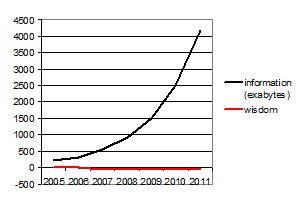
(Aspen, CO) Thanks to a reference by Richard Adler, I see that all the words ever spoken by human beings took 5 exabytes of data. In 2010 alone, we will produce about 750 exabytes. In 2011, we will produce about 1,750 exabytes, and rapidly rising. So in one year, we will communicate 350 times more data than we have spoken in the past hundreds of thousands of years.

But the rate of growth in aggregate wisdom seems modest, at best. I’d sum it up like this:

I thought it was Winston Churchill who said, “The population of the earth rises exponentially, but the sum total of human intelligence is finite constant.” I can’t find that quote online, so maybe I garbled it. But if you substitute “exabytes of data” for “population,” it seems about right.

the unbundling of everything

(Aspen, CO) There has been much talk at the FOCAS conference about the “un-bundling” of news products. You used to get one newspaper that “bundled” together international and local news, serious issues and fluff, editorials, letters, comics, sports scores, want ads and classifieds. Now those products can be obtained separately, and most people are not choosing to purchase any serious journalism.

It strikes me that much more than the newspaper has been unbundled over the last century. We’ve unbundled political parties into collections of entrepreneurial politicians and discrete ballot initiatives. We’ve unbundled careers by losing most of the unionized jobs and secure, lifelong positions. We’ve unbundled religion by creating a proliferation of “faith-based” networks, organizations, and self-help groups that are separate from congregations. We’ve unbundled civil society by moving from demanding membership organizations to a la carte networks. And we’ve unbundled families.

The result is a lot more freedom. But people will use that freedom to choose not to discuss and address public problems, unless they have skill and motivation for civic engagement. Skill and civic motivation are scarce and very unequally distributed. The cognitive demands of citizenship have risen: you need to know a lot more to navigate the complexities of modern, unbundled institutions. Meanwhile the motivational hurdles have risen, because no one can make you engage with public issues or obtain the skills and knowledge you would need to do so effectively. Public education can help by getting youth on the right track, but the effects of even the most engaging and inspiring educational experiences are likely to fade in later years. As a result, too few people are engaged in addressing our public and community problems, and the public discourse is dominated by those who remain highly motivated–strong ideologues and wealthy interest groups.

forum on communications and society

(Aspen, CO) I am here for a conference called FOCAS: Forum on Communications and Society. The topic is how to implement the recommendations of the Knight Commission on the Information Needs of Communities. The Knight Foundation was originally endowed by newspaper magnates and retains a concern with professional journalism, which is now in dire condition. (At least one quarter of America’s paid journalists have been laid off already in the past decade.) But the Commission wisely decided to focus on the fundamental “information needs” of communities instead of the state of the news media and journalistic profession. And it adopted a hopeful tone, optimistic about fundamental innovations.

Present at FOCAS are some interesting folks. To name just a few: Julius Genachowski is chairman of the FCC; Marcus Brauchli is executive editor of The Washington Post; Alberto Ibarguen is president of the Knight Foundation; and Craig Newmark started craigslist. The heads of the Corporation for Public Broadcasting, National Public Radio, and the Public Broadcasting Corporation are all on the agenda, along with executives from News Corporation, Microsoft, E.W. Scripps Company, and NIKE, among other companies. I will be listening for ideas about how to make public broadcasting more effective, replace the traditional functions of the metropolitan daily newspaper, and help disadvantaged Americans use and create knowledge.

The meeting will stream online, with a chat function, here.

you know you’re in Germany because the roofs are all covered with solar panels

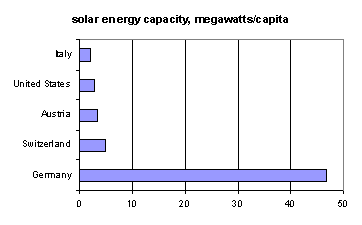
Last week, driving around Alpine Europe, we crossed the borders of Germany, Austria, Liechtenstein, Switzerland, and Italy, sometimes more than once. Nowadays, the border guards are gone, and even the roadside signs marking borders are very modest, but you can tell you’re in Germany by one simple clue: everything is covered by solar panels. There are fields of photovoltaic cells, like crops, and they cover every other roof. That’s not just my impression, but a significant national phenomenon, driven (natürlich!) by policy:

.

Data come from here. Interesting explanatory report here. (Liechtenstein, with just 35,000 people, doesn’t count.)