Category Archives: Uncategorized

graph of the day: paying attention to public affairs

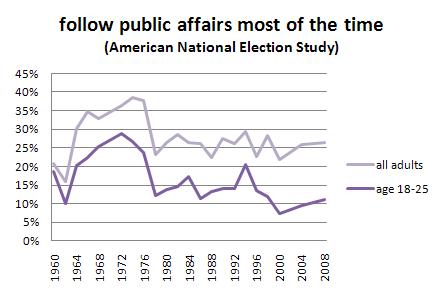
Here is the trend for the proportion of people who say they pay attention to public affairs. The lower line shows the trend separately for younger adults, ages 18-25.
I notice a few points:

  • It seems that “the Sixties” grabbed people’s attention–older people’s more than young adults’.
  • The interest of the whole population has been pretty stable since the 1970s, despite momentous changes in the news media, which morphed from three TV channels and metropolitan daily newspapers to cable, the Internet, and cell phone apps. Even as the supply shifted, demand was steady.
  • Younger people have been less engaged in recent years than in the 1970s, 1980s, and early 1990s.
  • The past decade saw an upward trend for both age groups, albeit from low baselines.
  • Young adults are not too far below their 1960-2008 average (about five points below), but the gap by age was larger from 1998 to 2008 than it was earlier.

All of this matters because people who pay attention have the most impact, and because habits of news consumption that form in early adulthood tend to stick.

new CIRCLE website

We just launched our new website at www.civicyouth.org. That’s the same address we’ve used since 2001, and it’s mostly the same content, but there’s a whole new look and organization. I see some items that need to be moved around, missing legends on graphs, etc. But please check it out: it’s the best source of research, data, evaluation tools, maps, policy analysis, and other geeky stuff related to young people’s civic engagement.

students as part of the accountability puzzle

Yesterday, I suggested alternatives to holding teachers accountable on the basis of test scores. Just a few hours later (by coincidence), I was shown an interesting initiative from the Boston Public Schools. All Boston high school students will soon begin completing “Constructive Feedback Forms” about their teachers each semester. These very carefully constructed surveys do not ask the students to rate their teachers as good, bad, nice, smart, or by any overall measure. Instead, they ask a whole series of very specific questions about teaching practices. How soon after the bell does the class get down to work? How many students participate in discussions? In what ways does the teacher provide feedback on homework?

The union and school system endorsed the policy, which is pretty modest because only the teacher receives the anonymous results. It would be interesting to consider sharing the results in some form with administrators, mentors, or other colleagues. I see the disadvantages of those ideas, but they are worthy of experiment.

Another fascinating aspect of this policy is its origin. Students on the Boston Student Advisory Council developed it–both the outline and the details–and succeeded in persuading the Boston School Committee to approve it. Those students are supported by Youth on Board (a nationally recognized nonprofit) and by the school system’s Office of High School Renewal, so they perform excellent, well-informed, and effective work as.public leaders.

Where Harvard Meets the Homeless

Scott Seider has published a new book entitled Shelter: Where Harvard Meets the Homeless. It’s about a homeless shelter that is entirely managed and staffed by Harvard students.

Most of our work at CIRCLE concerns the civic engagement of people far different from those young leaders. We focus on the half of the population that does not attend college at all, let alone highly selective, private, four-year universities. But Seider’s topic is an important one because the kinds of people who gravitate to ambitious civic or political organizations at institutions like Harvard will soon run strategically important parts of our civil society and politics.

This generation is certainly different than their predecessors who would have flocked to Students for a Democratic Society and tried to block Robert McNamara from leaving campus. Today’s Ivy League undergraduates are more entrepreneurial, probably better organized, possibly more thoughtful, but lacking a comprehensive theory of how to change society.

As I wrote in my blurb, “Scott Seider’s rich and insightful study of Harvard students who run a homeless shelter provides an informative portrait of today’s young leaders and their struggle to understand and confront injustice.”