Category Archives: Uncategorized

making our own mosque

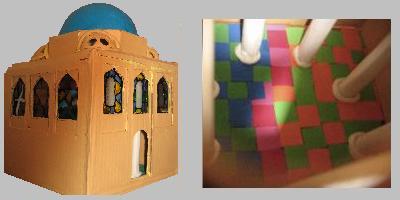
With all the controversy about building a mosque in Lower Manhattan (not to mention various bills and laws against erecting minarets in Europe), I thought this might be a good time to recycle a photo of the little “mosque” that my daughter and I built when she was seven.

Height: 14 inches. Construction materials: cardboard, plastic freezer baggies, papier-mâché over a popped plastic balloon. Current location: our attic. It is not really a mosque because it lacks a mihrab (to orient people for prayer) or a minbar (the Islamic equivalent of a pulpit). Our motivations in making it were not doctrinal, nor ecumenical, nor political. Rather, this is our amateur homage to one of the world’s finest architectural traditions, the heritage of Islamic religious architecture.

the righteousness that is the special entitlement of homogeneous groups

I am always torn when I hear discussions about the “fragmentation” of American culture or politics, because fragmentation also means diversity and freedom. Yet there are real disadvantages to losing a common dialog. Bill Bishop has written a brilliant book, The Big Sort, about how we have chosen to live in more culturally and politically homogeneous communities than a generation ago. I think he gets the issue just right:

    It would be a dull country, of course, if every place were like every other. It’s a joy that I can go to the Elks lodge pool in Austin to see the H2Hos, a feminist synchronized swimming troupe accompanied by a punkish band, or that I can visit the Zapalac Arena outside my old hometown of Smithville, Texas, to watch a team calf roping. Those sorts of differences are not only vital for the nation’s democratic health, but they are also essential for economic growth. Monocultures die.

    What’s happened, however, is that ways of life now have a distinct politics and a distinct geography. Feminist synchronized swimmers belong to one political party and live over here, and calf ropers belong to another party and live over there. As people seek out the social settings they prefer–as they choose the group that makes them feel the most comfortable–the nation grows more politically segregated–and the benefit that ought to come with having a variety of opinions is lost to the righteousness that is the special entitlement of homogeneous groups. We all live with the results: balkanized communities whose inhabitants find other Americans to be culturally incomprehensible; a growing intolerance for political differences that has made national consensus impossible; and politics so polarized that Congress is stymied and elections are no longer just contests over policies, but bitter choices between ways of life.

Bill Bishop (whom I know just a little) and his wife sorted themselves into a progressive neighborhood in Austin, where they are comfortable–as I would be. He begins his book with truly troubling quotes from the neighborhood’s listserve about how specific conservative neighbors ought to leave the area. It’s an important reminder that such “righteousness” is by no means a monopoly of the right.

the Project Vote survey

Today, Project Vote released a survey of the current opinions of people who voted in 2008. (They randomly sampled from a list of actual voters, which is available from official rolls, so no one in their sample inaccurately reported that he voted.) As I’ve written before, we ought to understand the views of the majority in the last election, rather than speculating about who will vote next time–especially since such predictions can become self-fulfilling prophesies.

Project Vote finds the following results for 2008 voters:

Approve of President Obama’s job performance: 48.1% (all 2008 voters); 91.8% (African Americans); 60.8% (youth); 61.8% (low income); 10.9% (people who identify today with the Tea Party).

First-time voter? 51.5% (youth); 8.5% (all); 0.6% (Tea Partier)

More important to spend money to stimulate the economy or to reduce the budget deficit 44.8% spend v. 48.5% reduce the deficit (all); 55.5% v. 39.6% (youth); 18.8% v. 78.6% (Tea Partiers).

There are 67 items in all, most of them quite interesting. Overall, a picture emerges of the Tea Partiers as outliers in the 2008 electorate. The average voter’s opinion will probably move in their direction in November, 2010. But that hasn’t happened yet, and the degree to which most voters will agree with them on substantive issues remains very much to be seen.

Justice Ginsburg at the National Conference on Citizenship

Justice Ruth Bader Ginsburg (following the example of justices O’Connor, Souter, Breyer, and Scalia) is speaking at the National Conference on Citizenship. It’s helpful for the Supreme Court–and the judicial branch in general–to endorse civic engagement and civic education. Judge Learned Hand was right: “Liberty lies in the hearts of men and women; when it dies there, no constitution, no law, no court can save it. While it lies there, it needs no constitution, no law, no court to save it.”

Justices O’Connor and Souter have made civic engagement a special priority in their retirements–more than speaking, they also organize and lead practical efforts–and Justice Breyer has written substantively about civic education. (Apparently, he addresses it in his new book.)

Today, Justice Ginsburg took a turn to address the topic. She used the “Impeach Earl Warren” campaign as an example of a time when people paid attention to the law and engaged, but in an ignorant way. Asked whether she was disturbed by public “ignorance” (the questioner’s term, not hers), she said she was. She cited her own work litigating for equal rights. She said that the litigants who won important court victories for civil rights were ordinary people who understood their rights and the courts.

“The courts are reactive institutions. Why was Sally Reed‘s case before the Court in 1971? Because there was a women’s movement. Why was there activity in the 50s and 60s? Because there was a burgeoning Civil Rights movement. The courts will react …, not to the weather of the day, but to the climate of the era.” I think her point was the importance of active citizenship in the process of reinterpreting and strengthening the law.

Justice Ginsburg argued that case law regarding gender is now quite fair and equitable. In that sense, an Equal Rights Amendment would not change our laws. But our Constitution, she noted, is older than other countries’ and does not contain an explicit statement about gender equality that would be found in almost all other constitutions. “My granddaughters will not find that statement,” she said, and “for that reason, I remain a partisan of the Equal Rights Amendment.”

“If I could design an affirmative action program, it would be for men. It would give men every incentive to be an equal partner in raising the next generation.”

Justice Ginsburg praised the Campaign for the Civic Mission of Schools, which is now co-chaired by Justice O’Connor, and materials supported by the Annenberg Foundation. “There is an important job to be done to persuade school administrators to request these materials and use them in their classrooms.”
at the National Conference on Citizenship

I am in DC for the National Conference on Citizenship’s annual meeting and some related events. It has been a long day and I cannot reflect adequately on all that has happened, but here are some highlights.

In partnership with the Corporation for National and Community Service and the Census, the NCoC is releasing the first annual National Civic Health Assessment. This is the lineal descendant of the Index of National Civic Health (INCH) and the the Civic Health Index, both of which I worked on with many colleagues. But the CHA is based on a national Census survey and is therefore the best data yet.

Today’s pre-conference was a series of panels and speeches: very rich and interesting. The Twitter feed (#ncoc) gives a flavor.

Splashlife was publicly launched. That’s an impressive new social network the provides incentives for volunteering, organizing, and activism. The young people who built it announced it at NCoC in a creative way. Dressed as waiters and other characters who had infiltrated the audience, they pretended to interrupt a speaker (their colleague) who was giving a PowerPoint presentation about the Millennials. It was all theater and very nicely done.?