Category Archives: Uncategorized

youth volunteering rate much higher than in the 1970s and ’80s

At CIRCLE, we often receive questions about the youth volunteering rate today compared to past generations. The following graph, based on Census data, shows that young people are considerably more likely to volunteer than they were in 1974 or 1989, two years when the Census Current Population Survey included a volunteering question that has also been asked annually since 2002. There have been ups and downs in recent years, but the growth compared to 1989 is striking.

volunteering rate for ages 16-19

Data points from 1974 and 1989 were calculated by Grimm, Dietz, Foster-Bey, Reingold, and Nesbit (PDF). Data points since 2002 were calculated by CIRCLE. See more detail on recent years here.

the case for civic renewal

Below are the first paragraphs of a new article by me in the centennial issue of the National Civic Review.* They are also the first paragraphs of a book that is just about complete. I argue that certain types of citizen participation are the only plausible solutions to our deepest and most intractable problems, at this particular stage in our political history. In the book, I then present political strategies for renewing civic engagement against the powerful forces that would rather hold it down.

    We Americans are in a bad mood about our nation and our public life. By two to one, we think that we are heading in the “wrong direction” rather than the “right track.” Unemployment, bankruptcies, bailouts, and other repercussions of the Great Recession are surely on our minds, but our pessimistic mood started well before that. A majority of Americans said they were satisfied with the nation’s course briefly at the conclusion of the First Gulf War and shortly after the terrorist attacks of September 11, 2001. At all other times during the last 20 years, most Americans have been dissatisfied.

    Perhaps this is because we face an accumulation of profound problems. They have been called “wicked problems” because better policies alone could not fix them (although our bad policies surely make matters worse). Our problems interlock, so that each one can be seen as a symptom of another. They are entangled with cultural norms and personal behavior as well as conflicting rights and limited resources. Any of the purported solutions could do more damage than good. How to define and diagnose our problems is fundamentally controversial, inseparable from our diverse religious and philosophical commitments. Advancing some of our interests and values would set other Americans back. For those who identify with particular interests and ideologies, watching our opponents express themselves in public can be deeply frustrating. For those who feel little stake in national debates, the bitter controversy itself is alienating.

    I do not claim that our condition is worse than it usually is. On the contrary, we are richer, safer, and more respectful of rights than we were half a century ago—and far more so than when Abraham Lincoln took the oath of office. A consistent theme in American politics is the Jeremiad, a lament that we have suddenly lost our way and face imminent destruction. James Fallows notes that “only six years after the Arbella brought John Winthrop to Massachusetts, a Congregationalist minister was lamenting the lost golden age of the colony, asking parishioners, ‘Are all [God’s] kindnesses forgotten? all your promises forgotten?” After four centuries of such Jeremiads, we should doubt that our current problems are unprecedented. The end is not nigh.

    But I do claim that the obligation to address our problems falls on us—American citizens—more profoundly than in the past. Our political institutions are inadequate to address our accumulated problems; and the prevailing ideologies offer no plausible solutions.

*Peter Levine, “The Public and Our Problems,” National Civic Review, Volume 100, Issue 1, pages 42–50, Spring 2011

Not Quite Adults

Richard Settersten and Barbara E. Ray have published Not Quite Adults: Why 20-Somethings Are Choosing a Slower Path to Adulthood and Why It’s Good for Everyone (Bantam 2010). Their book is a product of the MacArthur Research Network on Transitions to Adulthood and Public Policy, an ambitious collaborative project that also yielded, among many other works, an article by Constance Flanagan and me on “Civic Engagement and the Transition to Adulthood.”

Not Quite Adults is admirably broad, accessible, and well-written, enriched by the stories and voices of real people. (The Network conducted 500 interviews). It begins with a vignette of a typical young person of 30 or 50 years ago, who left home and started life immediately after high school graduation. Today, in contrast, half of 18-24-year-olds still live in the bedrooms where they were children. The ages at which people become financially independent, move out of their parents’ homes, marry, vote, and finish their final degree have all risen rapidly.

One response is to view all these young people as slackers or immature. But that overlooks the profound difficulties young Americans face today in becoming independent. It also overlooks the many ways in which the third decade of life can be a valuable time for learning, developing skills and networks, and contributing to society. Finally, it overlooks serious gaps in the experience of different groups of young people. Some–Settersten and Ray call them “swimmers”–are using their young adult years to strengthen their positions, racking up advanced degrees and social networks before they settle into careers and families. This is all to the good (as long as their expectations of success aren’t excessive, leading to disappointment). Others–whom the authors call “treaders”–struggle to move through the cross-currents of economic insecurity. For them, the third decade of life is increasingly difficult, and they need social investment. Settersten and Ray point to Youth Build, Youth Corps, and Civic Justice Corps as examples of programs that need more support.

The book has its own interactive website, including a blog on which Rick Settersten asks most recently, “Why do so many Americans have it out for young people?” At a time when many of the basic indicators of young people’s well-being (crime, violence, teen pregnancy, and drug use) have been improving, older Americans seem convinced that the new generation is a threat. Asked to discuss “youth,” working class Americans immediately identify behavioral problems–violence, crime, lack of respect for adults and for themselves–while elites are just as concerned about low test scores and dropout rates. Meanwhile, the data on young people suggest substantial improvement.

the Campaign for Stronger Democracy

The Campaign for Stronger Democracy pulls together activists for campaign and election reform, deliberative democracy, transparency, collaborative governance, civic education, national and community service, and community organizing. It is an unprecedented coalition, the need for which I tried to demonstrate rigorously through an exercise in network mapping. The Campaign’s monthly newsletter is turning into my favorite compendium of relevant articles. You can register for the free newsletter here.

the Eight Americas

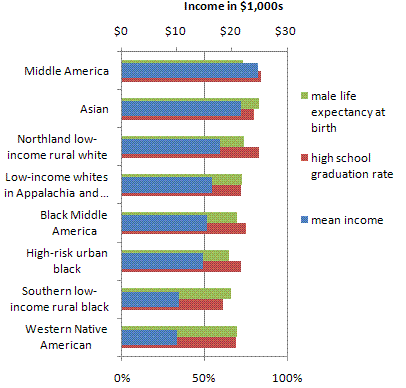
Christopher Murray and six colleagues have published an article entitled “Eight Americas: Investigating Mortality Disparities across Races, Counties, and Race-Counties in the United States.” They divide the entire US population into the following categories:

    1. Asian: Asians living in counties where Pacific Islanders make up less than 40% of total Asian population

    2. Northland low-income rural white: Whites in northern plains and Dakotas with 1990 county-level per capita income below $11,775 and population density less than 100 persons/km2

    3. Middle America: All other whites not included in Americas 2 and 4, Asians not

    in America 1, and Native Americans not in America 5

    4. Low-income whites in Appalachia and the Mississippi Valley (with 1990 county-level per capita income below $11,775)

    5. Western Native American: Native American populations in the mountain and plains areas,

    predominantly on reservations

    6. Black Middle America: All other black populations living in countries not included in

    Americas 7 and 8

    7. Southern low-income rural black: Blacks living in counties in the Mississippi Valley and the Deep South with population density below 100 persons/km2, 1990 county-level per capita income below $7,500, and total population size above 1,000 persons (to avoid small numbers)

    8 High-risk urban black: Urban populations of more than 150,000 blacks living in counties with cumulative probability of homicide death between 15 and 74 [years] greater than 1.0%

Disparities in life expectancy are enormous–for example, women in America 1 outlive men in America 8 by 20 years. It is illuminating to view these empirically-derived categories instead of the usual baskets (such as White versus African American). Below is my chart of selected disparities from the article: