Author Archives: Peter Levine

“Where is the knowledge we have lost in information?”

(Washington, DC for a presentation) The ease with which we can analyze social statistics today is remarkable. There are huge, free data-sets all over the Internet. You can employ exploratory statistical techniques (such as probit models or factor analysis) to fish for relationships. Even easier is to find a column of numbers on a web page, copy and paste them into an Excel document along with a different column of numbers from a different source, and find out whether they correlate. It can take five minutes to accomplish a task that would have taken thousands of person-hours when my Mom was a young health statistician. Many statistical investigations that would have been completely impossible–such as a multivariate model of a Census data-set with tens of thousands of cases–are now quite simple.

Graduate students, faculty, think-tankers, bureaucrats, and even some bloggers are busy at this work every day. But I don’t think we understand society better than we did in 1960. At least, we don’t understand it in ways that help us to make the world better. We are richer as a nation, so we should expect life to have improved. In some respects, it has. Relative to our assets, however, I think our performance is considerably worse. How could rates of high school failure, violent crime, cancer, unemployment, depression, suicide, and poverty be stubbornly flat if we had developed better solutions through social science?

To be sure, bad policy doesn’t imply bad research; maybe there is a problem with implementation or with the motivations of the ruling classes. But figuring out how to address those obstacles should itself be a task for research. Besides, I am not overly impressed by the research-based proposals that are sitting around waiting for politicians and citizens to implement. At best, these ideas seem promising incremental steps, not game-changers.

What’s wrong? It could be that …

1) Correlational research provides limited understanding, because there are always unmeasured factors and influences. More powerful research is always experimental, and we don’t do enough of that. By the way, “experimental research” is not just a matter of randomly selecting treatment and control groups. It also requires bold and exciting new projects or institutions that can be evaluated in that way.

2) We don’t measure the important things. Test scores, yes; students’ wisdom and virtue, no. Voter turnout, yes; emerging political networks, not so much.

3) Our imaginations are too limited by our tendency to take actual facts (“data”) as necessary. Roberto Unger wants economics to be the scientific study of what might be possible. Instead, economics describes the present and recent past and infers from that description immutable laws. These laws may actually be subject to amendment, if we choose to change them.

4) Our attention is focused on the wrong levels or scales of analysis. Perhaps our scale is too modest. We ask whether interventions or programs affect outcomes, not which social philosophy is best. Or our perspective may be too broad and distant. We have tools for assessing whole populations, but few new techniques for understanding–let alone improving–specific neighborhoods, schools, or firms, let alone human beings. (There actually are techniques for those purposes, such as ethnography, asset-mapping, and appreciative inquiry, but they are vastly less influential than social statistics–and I am not sure they are satisfactory.)
the evasive passive

(In Providence, RI, for a Civic Education Institute) Tony Judt recently wrote a New York Times op-ed decrying the Israeli settlements in the West Bank. Abraham Foxman of the Anti-Defamation League played his customary role by providing an angry letter of rebuttal. The substance of his letter begins, “Isrealis settled in the West Bank because it was deemed part of the historic home of the Jewish people. …”

I love “it was deemed.” That must have taken a while to come up with. Consider the alternatives. “The settlers deemed that the land was theirs”? That sounds a little imperialistic, doesn’t it? “The Israeli government deemed the land useful to them”? Not a helpful message for the ADL director to publish in the Times. “God gave the land to Jews forever”? Some people believe that–some Jews and some fundamentalist Protestants. It’s not, however, a line that Mr. Foxman wants to take, nor does it have a lot of force in international law or diplomacy.

Thus the passive–the great, responsibility-ducking passive–followed by a few strong active sentences with Arabs as the subjects. (“They rejected opportunities for peace.” “[T]hey rejected the United Nations resolution …”) So they did (those few with the power to make decisions); but the Isreali government also made choices, and now the mess is theirs.

service as a path to educational success

(San Francisco) I gave a presentation and moderated a session at the National Conference on Volunteering & Service yesterday. The topic was equity. But I’d rather describe a different panel, one that I attended as a member of the audience. The topic was service as a key to enhance student achievement. Angela Glover Blackwell was the moderator, and she started with an eloquent statement in favor of tapping students’ energies to address social problems and thereby give them skills and motivations for learning. She said that all the excellent social programs she knows include a dimension of civic engagement, because programs work best when people “own” them. She cited Harlem Children’s Zone as a model and referred to a new federal program, Promise Neighborhoods, that intends to replicate that model. Unfortunately, James Shelton III from the US Department of Education had to miss the panel at the last moment and so could not address that initiative.

Lisa Spinali, a friend of mine, talked about a large program that matches volunteers to schools in San Francisco (it is called San Francisco Volunteers, and she’s the executive director). There has been a gradual shift from placing anyone with an interest in a school to identifying real needs and finding the right skills. Early on, San Franciscans might offer to teach macrame and guitar and would be sent to a classroom. Today, a corps of bilingual volunteers translates at parent/teacher conferences.

Anthony Salcito works for Microsoft. He used the formula that I associate with the Gates Foundation: rigor, relevance, and relationships. These “three-r’s” are too often lacking in our schools. Salcito took the line that “service-learning” (combinations of academic study with community service) would help with rigor, relevance, and relationships.

Eric Schwartz from Citizen Schools made the case that the school day and school year are too short; there should be more learning opportunities for all kids during an expanded learning day. Citizen Schools creates a “second shift” of learning, with lots of interactive and fun projects. Volunteering comes into play in two ways. The “second shift” is substantially provided by unpaid volunteer adults and by AmeriCorps members. And the kids do, among many other activities, some service-learning.

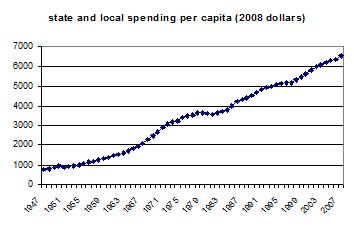
state and local spending

(San Francisco) There is a lot of talk about deep cuts in state and local government spending, only partly offset by the federal stimulus. Here is a historical graph of total state and local expenditures, adjusted for inflation and for population growth:

[revised, 10:30 am Eastern Time] The growth has been fairly continuous, apart from a dip in real spending in the Reagan years. Adjusted spending in 1982 was lower than in 1978, despite sharply increased need because of the recession. I don’t know for sure, but I suspect that at other times, the growth has been driven by: health entitlements, prison costs, and higher education (in descending order of magnitude). Spending for other purposes is probably close to flat.

Both the standard liberal and conservative narratives are a little off. Liberals are wrong to say that we’ve just lived through a period of conservative retrenchment in which local and state governments have shrunk. Expenditures are much bigger in real terms than they were in the liberal 60s. But conservatives are wrong to complain about a growing “welfare state.” If most expenditures cover prisons, education for relatively advantaged young adults who can attend college, and medical technology, this is hardly “welfare”–even broadly defined.

The data I could find ended in 2007. We’ll see what happens next.

in-flight nostalgia

(On a plane from Boston to San Francisco) I spent every childhood summer in England–in a different home almost each year–and have returned there repeatedly in adulthood. Whenever a long time passes without a visit, I feel subtle nostalgia growing. Here’s the kind of thing I miss:

A summer morning, cool enough to require a sweater and jacket outside. The sky has been light since 4 am. The bathroom window is almost always a frosted pane of glass on a hinge, set in a thick stone wall. There’s no screen, because there are hardly any mosquitoes. Open the hinge and damp air flows in, carrying strong smells of pollen, rich soil, and new growth–even in the heart of London, although there you can detect engine exhaust as well.

The hot and cold water flow from separate taps, the hot coming directly from a gas heater overhead. It steams in the sink. There’s never a shower, just an elaborate coil of metal pipes that hangs on the side of the tub along with a steel basket for the soap. Because of the high voltage, the electrical outlets are big plastic boxes with on/off switches. Layers of paint cover old wallpaper; wires are tacked to the baseboards. Cleansers give the room an ineffably British smell.

The staircase is long and narrow. Bacon is thick and intensely salty. Tea is strong. The insides of the mugs are tea-stained. The grass is luxuriously thick and green. Cumin wafts from restaurant doors, and the glittering cement pavements are sticky from last night’s spilled beer. An unmarked white delivery van rushes past, pinning you against a bowed stucco wall. Tattered music billboards, surveillance cameras, Oxfam and Barclay’s Bank on the High Street, black fences topped with spears, zebra crossings, beds of lavender and rosemary bushes.