Author Archives: Peter Levine

Ward Just, City of Fear

I’ve taken a break recently from War and Peace (which is heavy to carry on planes), to read the much slimmer war novel City of Fear by Ward Just. This was my third Just novel, the others being Echo House and Forgetfulness. These three excellent books share some common themes. Just’s big story is the evolution of official Washington from Kennedy’s Camelot to the Reagan Era. The capital changes from a Cold War city–whose leaders were morally troubling but tough, ideological men on the federal payroll as soldiers, politicians, and spies–into a city of fixers: corporate lawyers who instead of litigating make phone calls and pull strings on behalf of clients. The main decline takes place during the Vietnam War, which Just covered and which is clearly a moral linchpin for him. Often the shift occurs within families, creating tensions between Cold-Warrior fathers and fixer sons. The fathers have Midwestern roots, usually in industrial Wisconsin or Downstate Illinois. The Midwest stands for America, in contrast to the “federal city”–which, however, Just evidently loves. Certain parts of DC receive particularly affectionate attention in his pages, especially a corner of Georgetown north of Q and east of Wisconsin that becomes a lofty refuge for several of his characters. Vietnam and France, where the author lives today, also figure repeatedly.

I have emphasized the commonalities, but these are wonderfully diverse novels, each intricately constructed even though a plot summary would retell a lot less action than you’d expect in a fictional book about spies and wars. (Marriages and father/son relations are central.) The narration involves frequent flashbacks, stories within stories, and ruminations told with implied indirect discourse. Sometimes I think the structure is contrived as well as simply complex, as when a character in City of Fear looks up from a conversation to see a relevant event playing on the TV. Then again, coincidences happen–especially to people near the center of power in media-saturated environments. Events really do revolve around them.
our dog can read (update)

As previously discussed on this blog, our dog Barkley can read. Here he is with my wife Laura, a certified reading specialist. Barkley’s fluency and comprehension have improved since my last post about him, although his vocabulary seems to have hit a plateau at 10 months (similar, perhaps, to the fourth-grade slump found in national reading statistics). One possible explanation is the lack of cultural relevance in his home literacy resources. The first frame of the video shows that he has been looking at a stack of books. But many of the volumes in his home environment emphasize the dominant culture of middle-class humans. Barkley is a dog from very low-SES background. (He was a homeless stray in Alabama less than one year ago.) Perhaps his motivation will improve if he can find more culturally appropriate role-models in both the fictional and informational texts available in his home milieu.

spectacles

I have been flying more days than not lately, and sometimes the process of checking in, lining up, boarding, riding, and waiting can take 13 hours or more–door to door. During that time, there is a constant background of trudging crowds, inane chatter on overhead TVs, music, repetitive warnings, commands, bellowed cell-phone conversations, mechanical welcomes, beeps, pings, shrieks. Sometimes it all seems like an intentional insult. They’re saying: You are so mindless that you’re better off with the stuff we broadcast than what might otherwise be inside your brains.

On Monday, CNN was covering a live car chase on the highways near Dallas. It had been going on for a long time, and the anchor had been joined by a Texan lawman as the color commentator. The two men occasionally remarked on the seriousness of the situation. “When you have a fugitive traveling at high speed, it’s never optimal.” “No, we never like to see this.” But the chase was entertainment gold. The whole AirTran lounge began to stare at the monitors, faces tipped upward, until the sudden end. I’m not sure exactly what happened, because I wasn’t watching the last moment, but I believe the fugitive left his car and was flattened by a truck. CNN showed instant replays with somber commentary and then switched to something else.

Tuesday, another lounge in another city. I’m on the floor with my laptop plugged into a rare socket. My flight is already three hours late, heading for five. Suddenly an offstage voice with maybe an Oklahoma accent barks out: “The remains of a serviceman are being transported. It would be appropriate to stand. Active service personnel and veterans, salute! Civilians, cover your hearts with your hands!” Soon everyone is standing in clusters around the concourse windows, staring at the tarmac. “Present arms!” Paunchy guys in shorts and flipflops salute the glass.

We go back to our air-traffic delays, with maybe a sense that frenetic noise is better than silence.

reforming civic education

[11/25/09: Please also see my statement on the Center’s federal audit.]

In Tampa, meeting with social studies teachers) For quite a few years, almost all of the federal government’s investments in civic education have been earmarked for the Center for Civic Education (CCE). In 2009, the Center’s earmark from the US Department of Education was $31.9 million. CCE spent most of those funds on “We the People,” a high school government curriculum, and “Project Citizen,” a curriculum for middle school students who study policy issues of their choice and develop responses. CCE provides free texts and materials and offers training for teachers.

The available evaluations suggest that students in CCE’s programs learn the material. We don’t know some other interesting facts about these programs, such as how many students they serve, the students’ demographic profile, or how much the programs cost per student. We cannot compare CCE’s impact or its cost-effectiveness against alternatives. Still, in the absence of public data on those matters, I will stipulate that CCE probably benefits the kids who experience its programs.

However, it is not the role of the federal government to finance curricula or materials that serve a small number of American kids, year after year. The federal government generally doesn’t select particular textbooks that seem beneficial and then provide them free of charge to limited numbers of schools where the teachers happen to request them. Nor should it provide programs like “We the People” or “Project Citizen” on those terms. Thirty-two million dollars is not nearly enough money to make a significant difference for the national student population, if it is spent that way.

Instead, a minimum of $32 million should be spent on innovation and growth. Competitive grants should be given to school districts, schools, other local government agencies, nonprofits, colleges, publishing companies, software developers, and other firms that propose to develop and test new approaches to civic education or to increase the scale or quality of their efforts. Thirty-two million dollars would be useful seed money, and over time it could benefit most American kids.

The Administration is asking Congress to end CCE’s earmark. That seems like the right thing to do, but the next step must be to create a competitive alternative run by the United States Department of Education. Congress and the Administration should fund civic education–the original purpose of American schooling–at a minimum of $32 million for the whole country. Criteria for competitive grants should include: innovation, rigorous evaluation, a potential to grow and survive without further federal funding, and a focus on engaging disadvantaged kids.

progressive reform requires trust in government

I’d be willing to bet that any climate change bill Congress passes this year will be an incremental improvement, but far from satisfactory. Likewise for health care. Not only will these bills have too little impact; they will also cost too much because corporate interests will have been bought off. Health and environmental reform could be accomplished more cheaply with more radical strategies, such as a single-payer health system and a straightforward carbon tax.

This situation is causing a lot of hand-wringing and calls for procedural reform, such as ending the Senate’s filibuster rule. I think I’m for that, but I have a somewhat different view of how progressive change may unfold.

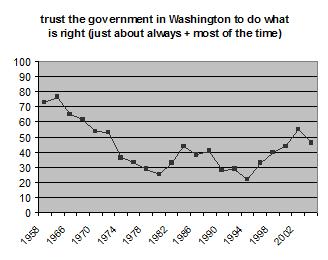
For me, the basic issue is that Americans deeply distrust the federal government. Back in the 1940s and 1950s, when the top tax rate was over 90% and each new Democratic administration took on bold new domestic challenges, most Americans said they generally trusted the federal government to do the right thing. That has not been true since the 1970s, when the tide turned in a conservative direction. Campaign and lobbying money do frustrate clean reform efforts, but it’s also a big obstacle that Americans are fundamentally skeptical that the government can do a reasonable job. (This is the trend from American National Election Studies since they began in 1958:)

Some people (e.g., Thomas Frank, Paul Krugman) think that Americans distrust the government because of corporate and conservative propaganda. I tend to think, in contrast, that people know what their government is like from direct personal experience. Media coverage may be biased, but people aren’t so easily fooled. On the basis of their own experience, they have formed a negative view of government.

This wasn’t George W. Bush’s doing; in fact, one of the biggest temporary increases in trust occurred during his first couple of years in office (mainly thanks to Osama bin Laden). Bush didn’t deserve the trust he received from 2001-4, and Democrats were right to criticize his policies. But because Americans started with a very low baseline level of trust in the government as a whole, they didn’t attribute all of its problems to Bush or to his party. As trust fell, so did fundamental confidence that the federal government could handle any essential challenges.

It is certainly true that Americans deeply distrust corporations today and are open to government regulation–in the abstract. But whenever the issue becomes an ambitious government-run alternative to corporate markets, Americans get nervous. That is the context for policymaking in the early Obama years. There are powerful crosswinds.

If Congress could somehow pass bold, efficient legislation that really worked, that might restore trust. I think progressive members of Congress should continue to press for strategies like single-payer and a carbon tax. Procedural reforms should be on the table, too. But I wouldn’t depend on either of those approaches. Instead, I’d look for incremental steps that restore trust and that can build momentum. The more the Administration can involve Americans in both policymaking and actual public work, the better the chances for rebuilding trust.