Author Archives: Peter Levine

Havel on the “spiritual or moral dimensions of politics”

(Durham, NH) I think that Vaclav Havel’s 1992 speech in Poland is famous, but I am focusing on it for the first time because we have assigned it for our summer institute of civic studies, which starts on Monday.

Not long after the fall of communism, Havel argued that the special ethos of the democratic dissident movements was being lost, and he wanted to “breathe something of the dissident experience into practical politics.” He explained:

    The dissident movement was not typically ideological. Of course, some of us tended more to the right, others to the left, some were close to one trend in opinion or politics, others to another. Nevertheless, I don’t think this was the most important thing. What was essential was something different: the courage to confront evil together and in solidarity, the will to come to an agreement and to cooperate, the willingness to place the common and general interest over any personal or group interests, the feeling of common responsibility for the world and the willingness personally to stand behind one’s own deeds. Truth and certain elementary values such as respect for human rights, civil society, the indivisibility of freedom, the rule of law these were notions that bound us together and made it worth our while to enter again and again into an unequal struggle with the powers that be.

    By politics with a spiritual dimension, I do not understand politics that is merely technological competition for power, limited to that which can be practically achieved and seeking primarily to satisfy this or that particular interest. Nor do I understand by it a politics that is concerned merely to promote a given ideological or political conception.

I am moved by the idea of politics that’s not “technological”–which means, I think, that it’s not about trying to get the goal you want (even an altruistic or idealistic goal) in efficient ways. Efficient politics leads to manipulation and social engineering. Havel later adds that the “aim of an ideology … can be achieved.” Ideologies have end-states, such as socialized medicine or a free market. Havel prefers something that can never be achieved, a “never-ending effort” to make the world better by acting well. Each good act leaves a benign “trace.”

I am also moved by his understanding that “to follow this path demands infinite tenacity, infinite patience, much ingenuity, iron nerves, great dedication, and last but not least, great courage.” That is even more evident 17 years later than it was in 1992, shortly after the great democratic revolutions in Europe and South Africa.

But I am not sure what I think about Havel’s main claim–which I haven’t quoted so far–that the heart of a better politics is achieving a personal “moral stance.” Three possible responses occur to me:

1. The dissidents could be revolutionary by being personally moral in a courageous way, without risking controversy about what was moral. Communism in its later stages was so bankrupt (literally and otherwise) that by simply telling the truth, refusing government jobs, signing manifestos, and so on, one rebuked the system and helped to bring the whole rotten edifice down. Under those circumstances, Catholic conservatives, free-market libertarians, and even Frank Zappa fans could unite without controversy. But that moment ended when they inherited a complex, flawed, but not easily fixed democratic society. Then groups inevitably disagreed about what should be done, and simply being moral on a personal level could no longer repair the world. The dissident experience became basically irrelevant. Havel is nostalgic but not strategic.

2. Havel is right that all we need is to be moral, but the question is: What does morality demand? If you’re comfortable answering that question with a phrase like “classical utilitarianism,” or “Catholic social doctrine,” then you have an adequate political theory. But obviously, it will be controversial, because everything really depends on your moral views. So there will be no consensus or harmony, just a conventional debate about moral positions.

3. Havel is onto something about the need to avoid ideological and technocratic politics, but his emphasis on personal morality is misleading–especially when he talks about “thousands of tiny, inconspicuous, everyday decisions” that are moral. That’s not the path to an alternative politics. The right path involves carefully developing and then fighting to protect venues in which people can discuss and address common issues without pursuing pre-determined goals or following pre-determined scripts. It requires specific moral commitments: to equal respect, openness, and “negative capability.” As Havel says, “all of this is easy to say but difficult to do.”
no better time

I’m at the University of New Hampshire for a conference entitled “No Better Time: Promising Opportunities in Deliberative Democracy for Educators and Practitioners.” By my unofficial count, more than 200 people [actually, 270] have convened here: college educators, grassroots community organizers, and scholars. The sponsors are the Deliberative Democracy Consortium and The Democracy Imperative, two organizations whose boards I serve on. We’re just starting but I am very excited by the group gathered here–its sheer size (considering that people had to pay their own way to get here) and its strength. Ten years ago, an open meeting with this framework would have drawn a much smaller and less experienced crowd.

a tendency to generic thinking

When we try to think seriously about what should be done, we have a tendency or temptation to think in generic terms–about categories rather than cases.

  • In social science, quantitative research evidently requires categorization; it is the search for relationships among classes of things.
  • In applied philosophy/ethics, most of the discussion is about categories that can be defined by necessary and sufficient conditions, e.g., abortion, war, marriage. Thinking about categories allows what Jonathan Dancy calls “switching arguments.” For instance, you decide what is good about heterosexual marriages, and if the same reasons apply to gay marriages, you should favor them as well. By thinking categorically, you can switch from one case to another.
  • In policy analysis, lots of research is about generic policies: vouchers, foreign aid payments, prison sentences. I should, however, note the important exception that some scholars study major individual policies, such as the decision to invade Iraq or the No Child Left Behind Act.
  • In ideological politics, the underlying values are strong general principles, e.g., “markets are good” or “there should be more equality.” Categories of policies are then used as wedges for advancing an ideology. For example, libertarians promote school choice in order to demonstrate that markets work better (in general) than governments.

I have a gut-level preference for particularism: the idea that, in each situation, general categories are “marinaded with others to give some holistic moral gestalt” (Simon Blackburn’s phrase). That implies that applying general categories will distort one’s judgment, which should rather be based on close attention to the case as a whole.

I will back off claims that I made early in my career that we should all be thorough-going particularists, concerned mainly with individual cases and reluctant to generalize at all. My view nowadays is that there are almost always several valid levels of analysis. You can think about choice in general, about choice in schooling, about charters as a form of choice, or about whether an individual school should become a charter. All are reasonable topics. But the links among them are complex and often loose. For instance, your views about “choice” (in general) may have very limited relevance to the question of whether your neighborhood school should become a charter. Maybe the key issue there is how best to retain a fine incumbent principal. Would she leave if the school turned into a charter? That might be a more important question than whether “choice” is good.

The tendency to generalize is enhanced by certain organizational imperatives. For instance, if you work for a national political party, you need to have generic policy ideas that reinforce even more generic ideological ideas. The situation is different if you are active in a PTA. Likewise, if you are paid to do professional policy research, you are likely to have more impact if your findings can generalize–even if your theory explains only a small proportion of the variance in the world–than if you concentrate on some idiosyncratic case. On the other hand, if you are paid to write nonfictional narratives (for instance, as a historian or reporter), you can focus on a particular case.

I’m inclined to think that we devote too much attention (research money, training efforts, press coverage) to generic thinking, and not enough to particular reasoning about complex situations and institutions in their immediate contexts. There is a populist undercurrent to my complaint, since generic reasoning seems to come with expertise and power, whereas lay citizens tend to think about concrete situations. But that’s not always true. Martha Nussbaum once noted that folk morality is composed of general rules, which academic philosophers love to complicate. Some humanists and ethnographers are experts who think in concrete, particularistic terms. Nevertheless, I think we should do more to celebrate, support, and enhance laypeople’s reasoning about particular situations as a counterweight to experts’ thinking about generic issues.

the new media literacies

The old “media literacy” meant being able to understand a news broadcast or a commercial; having some idea how it was constructed and how it might manipulate you; being able to choose reliable and relevant broadcasts and avoid junk. Those are still good skills to have. But the new “media literacies” include things like “digital storytelling”–being able to tell a story using words, images, and sound on a website–designing a digital game, or writing a text document online with lots of collaborators.

These are active skills, befitting a more active media environment. They are also highly challenging, and it is definitely not true that “young people today” know how to use them effectively. Quite the contrary–teenagers are less likely than some older groups to spend time doing these things, and I have often found them intimidated by the combination of tech skills and civic/political skills that you need to be effective.

But here are two amazing toolkits people of all ages can use to learn the new media literacies.

1. Puget Sound Off, a great social network for youth in the Seattle area, now has a set of “interactive videos to help you master blogging, digital storytelling, and other multimedia skills.”

2. The New Media Literacies Project at MIT has a large library of training videos and games that are designed to be combined, augmented, and amended by a community of users.

I think this field is in its infancy and we are just learning what skills are important and how to teach them. The best learning is experiential, and I’ve gained a lot from interactions with both of the projects listed above.

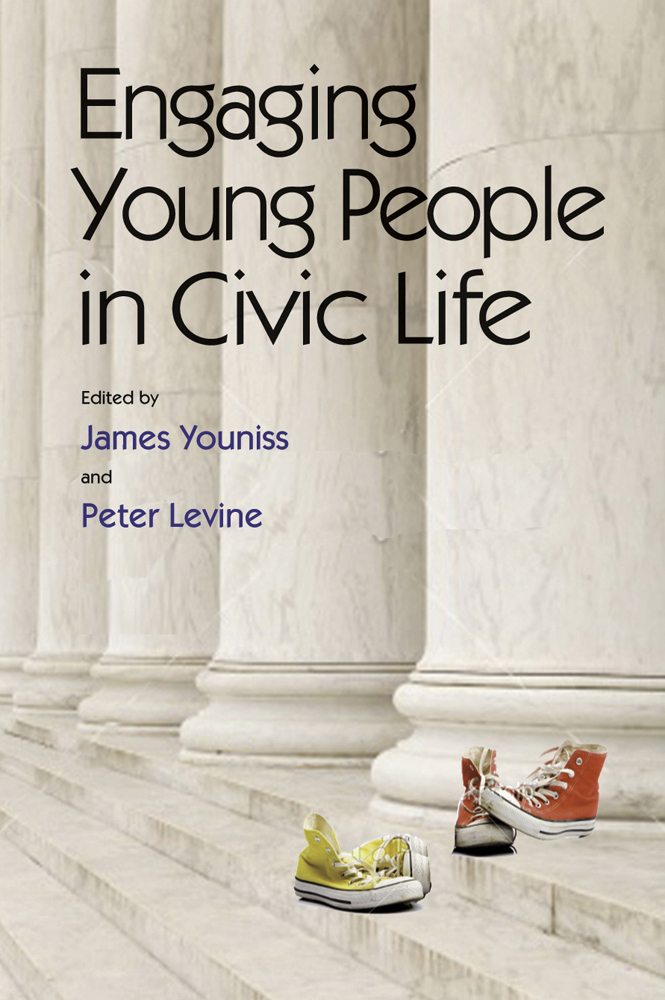
New Book: Engaging Young People in Civic Life

Youniss and Levine book cover

Vanderbilt University Press has published Engaging Young People in Civic Life, edited by James Youniss and me, with a forward by former United States Representative Lee Hamilton.

In the forward, Hamilton writes, “I can think of no task more important for the future of American democracy than teaching young people about our system of government and encouraging them to get involved in politics and community service. … Engaging Young People in Civic Life is tough-minded, data-driven, and unsentimental. It is full of concrete policy proposals for schools, municipalities, service programs, and political parties. It offers all the appropriate scholarly caveats and qualifications. But at its heart, it is a plea to revive American democracy by offering all our young people the civic opportunities they want and so richly deserve.”

Table of Contents

Foreword – Lee Hamilton

Introduction. Policy for Youth Civic Engagement – Peter Levine and James Youniss

Part I. Youth and Schools

Chapter 1. A “Younger Americans Act”: An Old Idea for a New Era – James Youniss and Peter Levine

Chapter 2. Democracy for Some: The Civic Opportunity Gap in High School – Joseph Kahne and Ellen Middaugh

Chapter 3. Principles That Promote Discussion of Controversial Political Issues – Diana Hess

Part II. Political Environments: Neighborhoods and Cities

Chapter 4. Policies for Civic Engagement Beyond the Schoolyard – James G. Gimpel and Shanna Pearson-Merkowitz

Chapter 5. Civic Participation and Development in Urban Adolescents – Daniel Hart and Ben Kirshner

Chapter 6. City Government As Enabler of Youth Civic Engagement: Policy Design and Implications – Carmen Sirianni and Diana Marginean Schor

Chapter 7. Local Political Parties and Young Voters: Context, Resources, and Policy Innovation – Daniel M. Shea

Part III. Policy Models from Other Nations

Chapter 8. Youth Electoral Participation in Canada and Scandinavia – Henry Milner

Chapter 9. Civic Education in Europe: Perspectives from the Netherlands, Belgium, and France – Marc Hooghe and Ellen Claes

Chapter 10. Strengthening Education for Citizenship and Democracy in the UK – David Kerr and Elizabeth Cleaver

Conclusion. The Way Forward – Peter Levine and James Youniss