Author Archives: Peter Levine

the shame of our prisons

I’ve been reading the report of the Commission on Safety and Abuse in America’s Prisons (PDF). It tells basically a tragic and horrifying story, although it also cites some individual prisons and even whole states that have achieved dramatically better outcomes than others in terms of reducing prison violence and rape as well as recidivism.

One premise is the gigantic scale of our prison industry. “The daily count of prisoners in the United States has surpassed 2.2 million. Over the course of a year, 13.5 million people spend time in jail or prison, and 95 percent of them eventually return to our communities. Approximately 750,000 men and women work in U.S. correctional facilities as line officers or other staff.” (p. 11) These numbers have increased steadily even when crime rates have fallen.

The incarcerated population is highly needy. To mention just one challenge, “At least 300,000 to 400,000 prisoners have a serious mental illness–a number three times the population of state mental hospitals nationwide” (p. 38).

All prisoners are somewhat isolated from society; that is the point. But policies sharpen their isolation in ways that prevent prisoners from successfully re-entering their families and communities later. For example, they are discouraged from talking to family members. The “average cost of a 15-minute in-state long-distance collect call placed from a correctional facility” is high almost everywhere. In Washington State, it is $17.77. “In Texas … the very ability to make calls is severely restricted: ‘Offenders who demonstrate good behavior can earn one five minute call every 90 days’” (p. 36).

Within prisons, a large subclass of inmates is isolated from the rest, indeed, deprived of all human contact by being placed in solitary confinement. On one day in 2000, “approximately 80,000 people were reported to be confined in segregation units.”

Some use of solitary confinement is inevitable, but it is growing much faster than the prison population (p. 52-3). Some prisoners are held without human contact for many months or as long as nine years, and often as disproportionate punishments. “For example, a young prisoner caught with 17 packs of Newport cigarettes–contraband in the nonsmoking jail–was given 15 days in solitary confinement for each pack of cigarettes, more than eight months altogether” (p. 54).

Many prisoners are held in solitary confinement because they are regarded as too dangerous to be managed within a prison–and then released into society. “People who were released directly from segregation had a much higher rate of recidivism than individuals who spent some time in the normal prison setting before returning to the community: 64 percent compared with 41 percent.” (p 55).
fictional stories about collective agency

(In DC briefly, for a class at Georgetown Law School) Are there fictional stories–novels, movies, long poems, or works in other formats–that depict networks or other large groups of people who improve the world?

There are fictions about individuals improving the world: heroic teachers making their inner-city kids into academic stars, whistle-blowers overthrowing evil corporations, and good cops achieving justice in bad cities.

There are true stories about networks and associations that improve the world, like the excellent historical narratives of the abolitionist movement, the American Civil Rights Movement, and the Indian independence struggle. (The scholarly studies do not attribute excessive importance or originality to individual leaders, Martin Luther King or Gandhi. When the good side wins, it is always because of the whole network.)

There are fictions about groups of people in difficult and unjust circumstances. For example, The Wire is a brilliant depiction of a whole network of people trapped in a heartless system. It is realistic, but it is not a story of agency. Characters in The Wire who try to improve the world fail.

There could be realistic fictions about groups of people who succeed in changing institutions and systems. But are there any? Does the failure to envision such success tell us anything about our art, or our society?

classroom practice from an ethical perspective

(Madison, WI) I am here for one of a series of meetings organized by University of Wisconsin Professor Diana Hess and funded by the Spencer Foundation. Diana and her colleagues have assembled remarkable empirical data about high school students and their social studies classes. From their longitudinal surveys–which follow the students into their twenties–they can draw inferences about the effects of various school experiences. Their elaborate interviews of students and teachers and their classroom observation notes help to explain the quantitative data and also provide numerous interesting anecdotes. The interviews, in particular, draw attention to dilemmas. Should you deliberate issues in a classroom that may be offensive to some students? Should you allow students to deliberate issues that should be settled? Should a teacher disclose his or her personal views?

The empirical data are relevant to these questions. For instance, it might turn out that teachers’ disclosing their opinions affects students’ opinions. But the data cannot settle these questions, which also involve value judgments about both means and ends. The appropriate ends, in particular, are by no means clear.

Therefore, Diana and her colleagues have assembled professional philosophers to discuss the empirical data with the researchers. There are actually three kinds of background in the room. Almost all the participants have personal experience as teachers. The quantitative data is more general and systematic but less rich than personal experience. And everyone has some level of philosophical training or interest. This seems to me a model for how to think about thorny issues.

graphs of the day: health spending, health outcomes

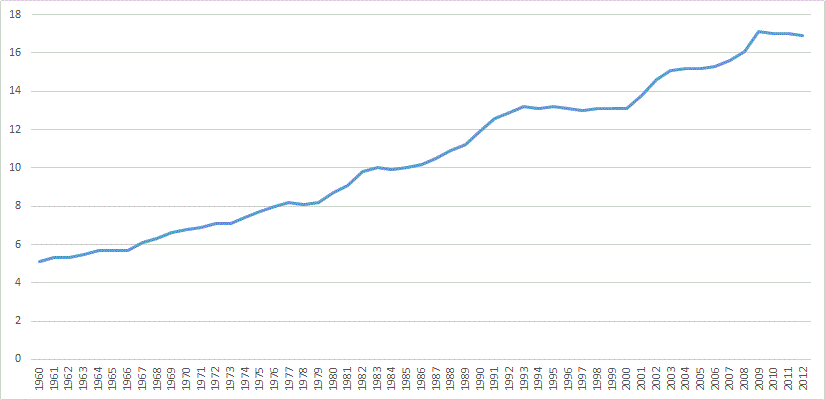
The total proportion of our economy devoted to health care has increased from 7 percent in 1972 to 16 percent in 2006:

Yet the proportion of Americans who consider their own health to be “excellent” is slightly lower than it was in 1972:

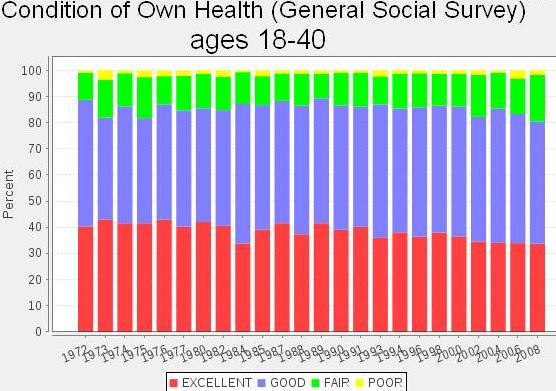
You’d think the reason might be an aging population, but no dice. When you look at only people between the ages of 18 and 40, their self-reported health situation actually declines:

participatory budgeting in Chicago

Participatory budgeting started in Brazil, when residents of poor urban neighborhoods were given control over capital budgets. They now meet in large groups and decide how to spend government funds deliberatively. The outcomes of participatory budgeting in Brazil include better priorities, greater public trust in government, and much less corruption. The last benefit might seem surprising, but it appears that when people allocate public money, they will not tolerate its being wasted.

Participatory budgeting is one of many important innovations in governance that have originated overseas and that should be imported to the US. Now is a time of great creativity in democratic governance, with the US generally lagging behind. We suffer from too limited a sense of the options and possibilities.

I believe there has been some participatory budgeting in California cities. And now Chicago Alderman Joe Moore announces:

    As a Chicago alderman, I have embarked on an innovative alternative to the old style of decision-making. In an experiment in democracy, transparent governance and economic reform, I’m letting the residents of the 49th Ward in the Rogers Park and Edgewater communities decide how to spend my entire discretionary capital budget of more than $1.3 million.

    Known as “participatory budgeting,” this form of democracy is being used worldwide, from Brazil to the United Kingdom and Canada. It lets the community decide how to spend part of a government budget, through a series of meetings and ultimately a final, binding vote.

    Though I’m the first elected official in the U.S. to implement participatory budgeting, it’s not a whole lot different than the old New England town meetings in which residents would gather to vote directly on the spending decisions of their town.

    Residents in my ward have met for the past year — developing a rule book for the process, gathering project ideas from their neighbors and researching and budgeting project ideas. These range from public art to street resurfacing and police cameras to bike paths. The residents then pitched their proposals to their neighbors at a series of neighborhood “assemblies” held throughout the ward.

    The process will culminate in an election on April 10, in which all 49th Ward residents 16 and older, regardless of citizenship or voter registration status, are invited to gather at a local high school to vote for up to eight projects, one vote per project. This process is binding. The projects that win the most votes will be funded up to $1.3 million.

I am strongly opposed to discretionary budgets for legislators. That’s just a way for them to buy reelection with public funds. But the fact that Alderman Moore has such a budget is not his fault, and he is using it for an excellent experiment.