Author Archives: Peter Levine

YUM: a taste of immigrant city

Project PERIS (Partnering for Economic Recovery Impact through Service) is an ambitious and rather complicated initiative of Tufts and our partners in Somerville, MA–funded by the Corporation for National and Community Service. The idea is to go beyond episodic and uncoordinated “community service” to achieve substantial impact. The project combines research, consultation, planning, and hands-on service as a real partnership between a university and community agencies and nonprofits.

In concrete terms, the main elements of the project are a set of courses (3-4 per semester) that are co-taught by Tufts faculty and community leaders. Each course undertakes some combination of research and service. The “connective tissue” among the courses is a series of planning and reflection meetings that include participants from across Tufts and Somerville.

In one class that I’ve been tangentially involved with, Professor Jennifer Burtner and her students helped plan and launch a project that supports 13 immigrant-owned restaurants in Somerville. Their major service is the Yum! discount card. They have also studied and documented the participating restaurants, producing graphic art, ethnographic essays, professional-quality photographs, videos, posters, and A-frame billboards. Some of their material is collected on their class blog.

The ethnographic essays are particularly interesting because they look–superficially–like restaurant reviews. But the perspective is different. These are not assessments meant for consumers; they are descriptions of small institutions in their social context.

Overall, PERIS is producing a mass of high-quality information and culture, which may turn out to be its biggest contribution–especially if we can find ways to pull that material together.

will the White House go all in?

At a book party for Robert Kuttner’s A Presidency in Peril, guests debated whether the White House will actively and forcefully support Democratic congressional candidates this November.

The argument against: Democrats are going to lose seats compared to 2008, even if they manage to draw a majority of the popular vote. A loss of seats will be depicted as a loss, period. If pundits and politicians assert that the president tried to help his party but failed, he will be depicted as weak and unpopular. That perception will deplete his political capital for the 2010-2012 legislative sessions.

The argument in favor: Perceptions of the president matter, but they will be shaped by more fundamental factors than whether he is perceived to have campaigned for Democrats in congressional elections. (The unemployment rate will be far more important, for one thing.) By campaigning, he may be able to boost turnout and save some seats. Even if he doesn’t, he can gain political capital by taking a risk for his party. And he can energize the Democratic side by showing that he is moved by principle and policy, not by short-term political considerations. Finally, by making principled arguments for progressive policies in 2010, he can lay the groundwork for majority support when (or if) the economy finally recovers.

young people and trust in government

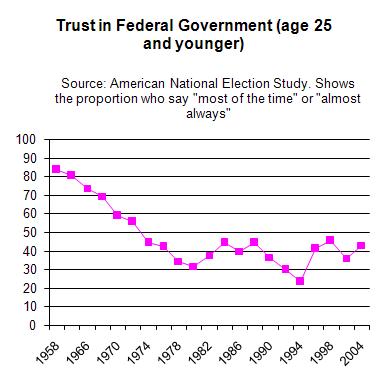
I was quoted on NPR’s Morning Edition earlier this week, commenting on a new Pew survey that finds 32 percent of young adults trust the federal government. That’s not exactly a resounding vote of confidence, but it’s much higher than the level of trust observed in older people today. For instance, just one in five of the 65-and-older group trusts the feds. In my quotes, I attribute some of the difference to generational traits. We know from many other surveys–and from comparisons to surveys in past decades–that Americans born after 1985 tend to be more trusting toward government and other institutions (including corporations) than other recent generations were at the same age. They are also more likely to favor government action to promote equality and social welfare. See Peter Levine, Constance Flanagan, and Les Gallay, The Millennial Pendulum (pdf).

But three important caveats are in order. First, even though young people have more favorable views of big, adult-led institutions than their predecessors had since the 1960s, they continue to set records for lack of trust in fellow citizens. This is the “social trust” that is thought to promote all kinds of good outcomes, from democratic participation to health and well-being. It remains in deep decline.

Second, young people are surely still forming their opinions. They are not dyed in the wool. Pew finds that the whole population has some of the lowest levels of trust ever recorded in the government. Public anger comes on the heels of a deep recession and a series of bailouts. The research on Millennials’ attitudes mostly predates the recession. By the time the dust settles, young people may conclude that the Obama Administration (which they played a major role in electing) helped them and the country, in which case their levels of confidence will rise. Or the Millennials may conclude that the feds fiddled while Rome burned, in which case their formative experiences will be sharply negative. The story is far from over, and it’s way too early to make predictions about a whole generation (the youngest members of which are now turning five years old).

Third, we tend to compare Boomers, Xers, and Millennials with great interest, focusing on fairly small changes. That’s because we have lots of comparable data on them. But if you take a longer view, it’s clear that the big changes occurred four and five decades ago. At the height of the New Deal, the Fair Deal, and the New Frontier, vast majorities of Americans–young and old–trusted the federal government to do the right thing. After Watergate and Vietnam, trust has bounced up and down depending on the economy and other news, but it has remained in a whole new band. Where once trust was the norm, now distrust prevails. This change explains a great deal about the direction of national policy since 1970.

Hirsh on how to save the schools

E.D. Hirsh’s review of Diane Ravitch’s The Death and Life of the Great American School System: How Testing and Choice Are Undermining Education is not very good–as a review. Ravitch’s book is important, and Hirsch doesn’t really analyze it. Instead, he uses the opportunity to argue for his own view. But his position is worth considering: it is orthogonal to the main debates in education.

The main debates concern incentives or pedagogy. That is, the two main strategies for improving schools are to change the rewards and punishments, or else to convince/educate teachers to act differently.

Strategies that involve incentives appeal to several types of reformers. Some want to test students and allocate resources according to the test scores (the NCLB approach). Some want parents to be able to choose schools for their own children and let the public money follow the kids. Some want to raise teachers’ pay in order to motivate qualified people to enter and remain in the profession. All share the assumption that the government can’t or shouldn’t improve our 120,000 public schools by directly influencing the content of education in each one. We improve other sectors by shaping external incentives for innovation and impact, and the idea is to do the same with schools.

Strategies that involve pedagogy are equally controversial. The two main poles of this controversy are Deweyan progressivism versus traditionalism. Progressives are “child-centered” or “constructivist” (see my summary here). They want kids to shape their own learning according to their diverse interests and motivations–to be active participants in interpreting and creating knowledge and culture. Traditionalists worry that leaving children to make such decisions short-changes them. They think that students benefit from being told and explained things. Both sides want to influence our 120,000 schools by training or persuading our 3.5 million teachers.

Hirsch is a traditionalist on the question of pedagogy, but he has an alternative strategy for reforming schools. He focuses on the curriculum. This is his lever of change. For him, the curriculum is a set of things students should know: facts, concepts, names, dates, and places on the world map. Put another way, it is a set of texts that students should read and understand (texts that competently present the things that students should know). The curriculum as a whole should be:

  • Transparent, a literal list, so that students from marginalized and disadvantaged backgrounds and the teachers who serve them can know what the kids need to learn.
  • Uniform, because Hirsch argues that success in life requires knowing what everyone else is also expected to know. If that varies, mastery is impossible.
  • Finite, because students can only absorb so much material, and they ought to have time left in the day for other activities.

Unlike proponents of vouchers and charters, Hirsch is perfectly willing to say that all schools should change the content of the education they provide. Unlike the proponents of various pedagogies, he doesn’t trust in a strategy of changing what teachers do. He wants to redefine what they teach.

I have not made a study of the independent research on Hirsch’s approach. In theory, it could work. The question seems strictly empirical to me. As an advocate for civic or democratic education, I care most about civic outcomes. I want to see students prepared to play active and effective roles in our public life. I do not take it for granted that the path to that outcome must itself be democratic or participatory. Maybe all kids should read The Federalist Papers and Letter from Birmingham Jail (and other texts), and that is all they need. I sort of doubt it, but I respect Hirsh for putting an alternative on the table.

community organizing and public deliberation

Matt Leighninger, director of the Deliberative Democracy Consortium, has written a wise and inspiring paper called Creating Spaces for Change for the Kellogg Foundation. It is the product of several meetings in which community organizers interacted with people who define their roles as promoting public deliberation. The tensions between these two conceptions of “democracy”–and the potential for melding them–have interested me for many years. I’ve addressed the topic in published writings, e.g., here. But Matt’s report breaks new ground.

Deliberative democracy first arose as a response to a blinkered notion of politics as mere power. The dominant view of political scientists during the 1950s and 1960s was that individuals and organizations want things. They have options, such as to vote, to contribute money, to run for office, to strike, to sue, or to threaten violence, and they make their choices in order to get as much of what they want as possible. Political outcomes are the result of many simultaneous choices.

Deliberative democrats criticized that theory from a moral perspective, saying that we should not be satisfied with policies that arise because individuals and groups try to get what they want. They may not want good things; their power is starkly unequal; and some of their tactics are unethical. Besides, people don’t know what they want until they have communicated with others. So we should talk and listen before we try to get things.

But talk can be very harmful, as when evil dictators talk their followers into murderous action. Thus a crucial second step for deliberative democrats is to define some kinds of communication as better than others and to name the better kinds “deliberation.” Typically, the hallmarks of deliberation include the diversity of the participants, their equality of influence, freedom of speech, openness and transparency, reasonableness, and civility.

There is now a field devoted to organizing tangible public deliberations at a human scale: meetings, summits, “citizens’ juries,” community dialogues, moderated online forums, and various hybrids of these. They all involve convening diverse groups of citizens and asking them to talk, without any expectation or hope that they will reach one conclusion rather than another. The population that is convened, the format, and the informational materials are all supposed to be neutral or balanced. There is an ethic of deference to whatever views may emerge from democratic discussion. Efforts are made to insulate the process from deliberate attempts to manipulate it.

In contrast, activism or advocacy implies an effort to enlist or mobilize citizens toward some end. At their best, advocates are candid about their goals and open to critical suggestions. But they are advocating for something. Many advocates for disadvantaged populations explicitly say that deliberation is a waste of their limited resources. They note that just because people are invited to talk as equals, the discussion will not necessarily be fair. Participants who have more education, social status, and allies may wield disproportionate power. Individuals and groups who are satisfied with the status quo have an advantage over those who want change, because they can use the discussion to delay decisions. (They can “filibuster.”)

Talking with people who hold different views can cause us to temper or censor our sincere views in order to avoid confrontation; and such self-editing reduces our passion and our motivation to act. Social movements that oppose injustice seem to arise when “homogeneous people … are in intense regular contact with each other.” (Doug McAdam, John D. McCarthy, and Mayer N. Zald, 1996).

For their part, proponents of deliberation often see organized advocacy as a threat to fair and unbiased discussion; hence they struggle to protect deliberative forums from being “manipulated” by groups with an agenda. One tactic for this purpose is to select potential participants randomly (like a jury), so that it is impossible for an interest group to mobilize its members to attend. Overall, deliberation seems cool, cerebral, slow, and middle-class. Activism seems urgent, passionate, effective, and available to all.

Community organizing is a type of activism. It is concerned with just social outcomes (not just processes). But many community organizers have deep concerns about respecting all voices, including ideologically diverse ones, building trust and networks among fellow citizens, and developing civic skills that include skills of listening and collaborating. Thus the gap between deliberation and community organizing can be very small. After one meeting that Matt describes, Eduardo Martinez of the New Mexico Forum for Youth and Community (a community organizer) remarked, “We may use different terminology and have different local issues, but most of the discussion was about how similar our work is.”

Another organizer, Jah’Shams Abdul-Mumin, nicely articulated the limitations of both fields in making a case for combining them: “The organizing community often treats people in a pejorative manner. Meanwhile, the deliberative democracy crowd includes a lot of extremely intellectual types. Neither group owns up to the things they can do better to relate to people.”

There were, evidently, tough discussions about the value (if any) of neutrality and whether concern for social equality needs to be built into deliberative processes. There were also debates about what to call the whole field that includes both deliberation and community organizing. “Civic engagement” seems too dry; “citizenship” can be understood as exclusive and merely legal. Nobody knows what “deliberation” is, and “community organizing” has perhaps “been stretched so far over the last forty years that it has lost much of its meaning.” But overall, there seems to have been much enthusiasm for the idea that issue advocacy, community organizing, deliberative democracy, and racial equity may be parts of one larger cycle or ecosystem–a “wheel of engagement,” as some called it.