Author Archives: Peter Levine

the old order passes

When Tocqueville visited America in the 1830s, civil society was predominantly composed of local, voluntary groups. They held regular face-to-face meetings. Their most important means for distributing information and opinions were newspapers (which were carried by the US Mail). Associations needed newspapers to communicate and they arose in response to the news. Thus, Tocqueville wrote, “There is a necessary connection between public associations and newspapers: newspapers make associations and associations make newspapers.”

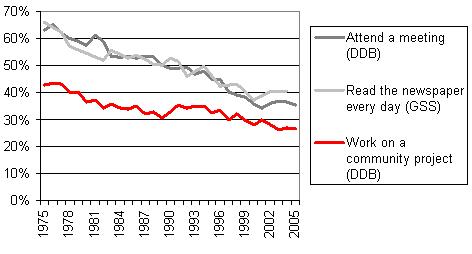
Tocqueville’s civic ecosystem evolved but remained fundamentally similar for more than a century. It is now in steep decline, as shown by these trends:

(GSS is General Social Survey. DDB is DDB Needham Life Style Survey. Analysis by the author.)

The correlation between the trends in newspaper readership and attendance at face-to-face meetings is especially striking. The reason to be concerned by this graph is a core commitment to public deliberation, which has traditionally occurred within associations, at meetings, informed by newspapers.

But we should not mourn the passing of 19th- and 20th-century associations and media. We should organize. We can rebuild the public sphere from new building blocks, as our predecessors have done several times in the American past. The new materials include digital technologies and networks, as well as new forms of face-to-face association.

AmericaSpeaks: Our Budget, Our Economy

My post for the day is over at usabudgetdiscussion.org, the blog for the National Town Meeting on Our Budget, Our Economy that AmericaSpeaks is organizing for June 26, 2010. This national deliberation will occur simultaneously in about 20 large venues “across the country, in many Community Conversations, and online.”

I conclude my post by saying, “I am confident [that citizens] will address this difficult, divisive, and complex topic just as they handle equally challenging questions at the local level–with maturity, civility, and collective wisdom. They will model a whole new form of politics that we desperately need.”

the myth of Israeli competence

Even if you think that Israel has the right and a decent reason to blockade Gaza, it’s pretty clear that dropping heavily armed commandos at night onto the decks of Turkish [!] ships loaded with peace activists and humanitarian assistance was stupendously dumb–especially since there was evidently no contingency plan in case of resistance.

This is an opportune moment to note that Israel’s government is quite capable of self-destructive and foolish policy. That would be self-evident in most countries, but the State of Israel has a pervasive reputation for competence. Anti-Semites and committed Zionists agree on that, if nothing else. Stereotypes of Jews as smart people feed into it, as do all those military victories from the War of Independence to the Raid on Entebbe.

But Israel has a Jewish population of only about 5.6 million, just a bit more than the population of the Atlanta-Sandy Springs-Marietta, GA metropolitan statistical area. With that population, they have to run all the institutions of a modern nation, from a stock market to a nuclear weapons program, from a parliament to a navy. There is no reason to think they have the brainpower to do it all well under pressure.

The myth of Israeli super-competence causes anti-Semites to overestimate Israel’s deliberate impact on world politics. If anything important happens, Mossad must have caused it, because those Israelis are diabolically brilliant. Meanwhile, the myth causes some Israelis and would-be friends of Israel to put far too much stock in military or technological strategies. In theory, a country could run a blockade (whether they should or not) and avoid humanitarian disasters, p.r. fiascoes, effective smuggling, and other failures. In reality, success would take an enormous amount of talent in the civilian government and the Defense Forces. I simply don’t think Israel has what it takes, and that limitation should strongly influence their strategic thinking.

Memorial Day, Belmont

Shaw’s father wanted no monument
except the ditch,
where his son’s body was thrown
and lost with his “niggers.”
–Robert Lowell, For the Union Dead

The VFW Commander in his flat Boston voice
intones the names of the dead:
DeStefano, Haratoonian, Donnelly, O’Neil.
Sweating, Buddha-fat babies watch; their
shrunken grandmas sag into low lawn chairs.
The high school band follows the route we have
marked for them. They play like experts, but they can joke,
knowing they have a few years before they sink
into the chairs along the way.
In this town, Lowell checked himself in
to the loony bin
and glimpsed his future in the faces
of the other mental cases.
(Plath too, and Ray Charles.)
Once John Birch HQ, it knows fear.
Cambridge public housing blocks stand in sight: warnings.
The lady selling cones from the ice cream truck
wears a hijab. Belmont’s Finest march to the tune
of Valley Forge, Custer’s ranks,
San Juan Hill and Patton’s tanks.
And the ditch, it comes closer each year.
Blank shots over the town’s war graves.
The bones hear nothing, but the shots and smoke
are for the grandmas, the band, the babies,
for the ravaged veterans of the one war
we all fight alone to the last breath.

debating civic environmentalism

Yesterday, I helped to lead a kind of seminar for Tufts faculty at TELI, the Tufts Environmental Literacy Institute. We assigned chapter 9 of Mark Sagoff’s Price, Principle, and the Environment, which is entitled “The View from Quincy Library or Civic Engagement in Environmental Problem Solving.” Mark Sagoff tells a great story about a group of citizens–environmentalists, loggers, and others–in a small California forest town who met in the library because people are not allowed to shout there, worked out a management plan for the surrounding National Forest, got it passed as an act of Congress, and were criticized by the national environmental groups (see a collection of documents, here). The legislation was never implemented because of litigation.

We divided the Tufts faculty into two groups to debate–literally–the pros and cons of civic environmentalism as represented by Quincy Library. The debate focused mostly on scale, and whether it is better to set policy at the local or national level. Expertise also came up, because experts tend to work at the national level and laypeople dominate at the local level. Each side cited this difference in its own favor.

I see some other important issues in the Quincy Library Case. Above all, the national policy debate involves corporations and nonprofit groups, each of which has a fiduciary obligation to seek certain kinds of outcomes. Because they have opposing goals, they are drawn to litigation or constant lobbying over legislative amendments. They are better off with unresolved issues than with compromises, because they can keep on fighting as long as there is no resolution. And they use science strategically, commissioning and highlighting scientific findings that benefit their cause.

In contrast, people came together in Quincy Library as citizens with a problem–the forest was liable to go up in flames any day. Although they differed in values and interests, their differences did not define them. After all, they had overlapping as well as contrasting interests. Thus they had incentives to deliberate, i.e., to discuss values and goals, including aesthetic and moral ones as well as the purely means/ends reasoning that science can handle. They reached consensus. That was not inevitable, but they had a motive to try, which is not the case in the national debate.

I could take the critical side in the debate. I would note that the Quincy Library plan was only acceptable because national environmental laws had stymied loggers and forced them to the negotiating table. I might assert the right of American citizens who live elsewhere to influence their National Forest in California. And I might observe that certain issues–such as climate change–are of overwhelming importance and need to be settled by adversarial politics, command-and-control regulation, and science. Yet I think we are unlikely to see good policies at the national and international level until people can do their own civic work to defend the local environment, as they tried to do in Quincy.