Author Archives: Peter Levine

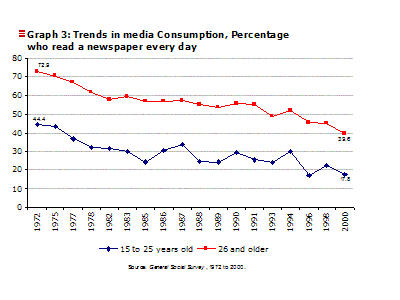
the young don’t read newspapers

According to CIRCLE’s new fact

sheet on media use, this is the trend in newspaper readership since 1972:

We know that newspaper reading correlates with many forms of civic engagement,

so this trend is worrisome. (It is also very bad news for the newspaper industry.

Why don’t they do something aggressive to reverse the decline, like giving millions

of free newspapers to schools?) I think one piece of the problem is that young

people don’t learn how to read a newspaper. My own experience as a volunteer

high school teacher has taught me that the "inverted pyramid" style

of journalistic writing assumes a lot of background knowledge, and thus makes

news stories baffling to inexperienced teenagers. They can learn to read newspapers,

but they don’t pick up this skill by osmosis.

aid to Africa

I

believe in asset-based development, which means

that I am loath to itemize deficits and problems without putting at least as much

emphasis on the assets that any human community or nation possesses as

the basis for its own development. I am certain that Africa has tremendous assets:

cultural, social, and natural. Unfortunately, I lack the detailed knowledge necessary

to list the main ones. In lieu of an asset inventory, we ought to pay attention

to the following gaps or problems on the occasion of President Bush’s African

tour:

  • life expectancy at birth: Sierra Leone = 34.5 years; USA = 77.1

    years

  • adult literacy rate: Niger = 16.5%; Estonia = 98.8%
  • population

    earning less than $1/day: Ethiopia = 81.9%; USA = 0% (reported)

  • probability

    at birth of not surviving to age 40: Mozambique, 56%; Japan = 7.5%

  • population

    without access to improved water source: Ethiopia, 76%; USA = 0%

  • physicians/100,000

    people: Mali = 1; Italy = 567

  • health spending/capita: Guinea-Bissau =

    $12; USA = $4,499

  • undernourished people: Burundi = 69% of population;

    USA = 0% (reported)

  • percent of adults with HIV/AIDS: Zambia = 21.52%;

    USA 0.16%

  • official development aid received, per capita: Dem. Rep. of

    Congo = $5; Israel = $172.4 (The new European Union members get more aid than

    Israel, but their assistance comes with club membership in the EU.)

All

these statistics come from the "Human

Development Indicators" section of the United Nations Development Programme’s

Human Development Report 2003.

honesty means having to say you’re wrong

President Bush said

in his January State of the Union Address that Iraq was trying to buy uranium

in Africa—an extraordinarily important charge that could justify a preemptive

war (on the assumption that Iraq would only need uranium for nuclear weapons).

According to today’s Washington

Post, national security adviser Condoleezza Rice "said Secretary

of State Colin L. Powell did not include the uranium allegation in the speech

he gave to the United Nations on Feb. 5, eight days after the president spoke.

She said that was because [the State Department] had questioned the matter."

This suggests to me that top Administration officials realized before Feb. 5 that

the State of the Union speech had included a dubious, but extremely significant,

assertion. Why then did they not issue a statement casting at least partial doubt

on the uranium story? Failure to withdraw a false claim of such enormous magnitude

seems to me deeply unethical. It was not nearly enough to refrain from repeating

the charge.

the place of ideology

I have been approached

by a publisher about the idea of writing a popular guide to politics for new voters,

in time for the 2004 campaign season. I don’t know if this idea will come to pass,

but it’s interesting.

Perhaps the "ideal citizen" would make an

independent and informed judgment about each issue and also each candidate, and

then vote accordingly. But none of us has the time or energy to do this. Instead,

we use shortcuts to make our voting choices. The most common shortcut, I believe,

is to choose a political identity for oneself: for example, "liberal"

or "conservative," or something somewhat more complicated, like "pro-choice

conservative" or "social liberal/fiscal conservative." We then

learn how to identify the candidates who fit this label, based on clues in their

rhetoric and a few issues that serve as proxies. If we are better-than-average

citizens, then we choose an ideology in a provisional way, trying to stay open-minded

and to understand the merits of alternative views. But we still use ideology as

a cue. CIRCLE surveys show that people

who cannot place themselves on an ideological scale or identify the differences

between Democrats and Republicans also do not vote.

Thus I may propose

to write a book that begins with a quiz, designed to identify the reader’s starting

ideology or political identity. If a reader chooses "don’t know" as

an answer to any question, he or she will be sent to pages in the book that introduce

the relevant issue. Once the reader has completed the quiz and identified a provisional

ideology, the rest of the book will help him or her to (a) think critically about

the pros and cons of this ideology and (b) learn how to identify candidates who

espouse it.
working with power

I’m reading all the back issues

of the Higher

Education Exchange, in order to write a mini-report for the editors about

their future strategy for the journal. One generally excellent article is Edward

Royce’s "The Practice of the Public Intellectual" (1999). In passing,

Royce makes a point that I consider very important. He writes: "public intellectuals

can work with those subject to power as well as against those who

exercise power." Working with ordinary people (or with especially

oppressed people) is an entirely different form of engagement from "speaking

truth to power." It requires more listening, more quiet work within institutions

and communities, more development of personal relationships and trust, more building

on local assets—and less dramatic rhetoric. Working against the powerful

is an important role for intellectuals to play. But working "with those

subject to power" seems equally valuable (and interesting).