Author Archives: Peter Levine

Miles Horton on improvisation

I came across a quote today by Myles

Horton, the great founder of the Highlander Folk School in Tennessee,

which trained Rosa Parks and so many other heroes of the labor and civil

rights movements. Horton said that he had learned from decades of nonviolent

struggle against injustice that "the way to do something

was to start doing it and learn from it."

I recognize the limitations to this approach. It’s good to have a "strategic

plan" with goals and methods all arranged in proper order. Yet

often in civic work, improvisation is both a necessity and an inspiration.

As long as you keep your mind open, listen to others, and try to learn

from everything you do, it’s sometimes wise to start working even before

you know exactly what you are doing.

I write this as I continue to read articles about local geography and

its effects on nutrition—all because I want to obtain a grant

that can support our local work with kids.

I don’t know where that work will take us, but it seems important to

sustain a nascent institution by grasping the opportunities that come

along. (I don’t mean to compare myself and my colleagues to Miles Horton,

because we’re not struggling against injustice as he did. But we do

have a similarly cavalier attitude toward planning.)

Dean vs. Gephardt

I was interviewed on New Hampshire Public Radio last Friday about the

different styles of the Gephardt, Edwards, and Dean presidential

campaigns (see an imperfect

and incomplete text transcript or listen to the audio here.) Actually,

the reporter, David Darman, asked a very interesting set of questions

(which didn’t come across clearly in the broadcast radio segment) about

what conception of the role of citizens is implicit in each campaign.

My quotes suggest that I’m biased in favor of Rep. Gephardt, which

is not really true. I do believe that if he fails, it will be symptomatic

of the collapse of mass mobilizing institutions, such as unions and

political parties, that used to multiply the power of ordinary people

and connect them to Washington. I do not believe that the Gov. Dean

style of campaigning, which is very “21st century,” offers

an entree to people near the bottom of the socio-economic heap. They

won’t be mobilized by listservs, blogs, and Meetup.com. This is

not only because they lack Internet access and interest in politics.

It’s also because of the basic logic of collective action, which tell

us that people won’t take costly action in the public interest unless

they are assured that others will also contribute. Voting is always

partly an altruistic act, because even if one votes in one’s own self-interest,

it’s more “rational” (meaning self-interest-maximizing) not

to expend the energy. Disciplined organizations such as unions overcome

this problem by guaranteeing that not only you will vote; so will many

like-minded people. Meanwhile, they lower the “cost” of voting

by providing free information. Wealthy and well-educated citizens find

that the cost of voting is relatively low, because they already have

much of the necessary information. Thus they don’t need unions and parties;

and they are adept at using voluntary resources such as listservs or

blogs. Poor and poorly education people are at a disadvantage in this

environment, and their disadvantage is worse than it was fifty years

ago.

civic renewal in NYC

I was supposed to go to New York City today for a meeting at the Social

Science Research Council, but I found when I reached the airport at

6 am that no flights were leaving because of the huge blackout.

According to the New

York Times, the 1965 power failure "was largely characterized

by cooperation and good cheer," whereas the one in 1977 was "defined

by widespread looting and arson."

In 2003, we seem to be back to civility. Jeff

Greenfield of CNN says he "saw tourists pouring off those double-decker

buses looking dazed and confused. People were offering them free glasses

of water and restaurants were putting out food that was spoiled for

free. I saw police officers politely asking New Yorkers, ‘Would you

mind please getting out of the street.’"

When I was deputy director of the National

Commission on Civic Renewal, I developed an Index

of National Civic Health. INCH, as we called it, declined sharply

in the early 1970s and then rebounded in the 1990s. I have to

wonder whether the three great NYC blackouts are evidence of the same

trend. Three scattered events do not really make a trend. Besides, I

have no specific data for New York City, and no INCH data at all for

2000-3. Still, it’s interesting that New York has fared so much better

in emergencies when the national civic health is higher. More than 1,037

fires burned while the lights were out in 1977. In 1965, and again in

2003, people took care of each other instead.

(Incidentally, we couldn’t run INCH back through the 1960s, because

we didn’t have enough data from those early years. But if you make an

index out of the variables that we do have, then INCH declines throughout

the sixties. That means that it was much higher in 1965 than in 1977.)

a class on geography & obesity

This is the latest plan for a grant proposal that would allow us to

work with high school kids, doing research in the community and generating

public products for the website that they have been building at www.princegeorges.org.

It is important for people to consume healthy food: products that are

low-fat, high-fiber, varied, and cooked with fresh ingredients. It is

also important for people to walk to work or to school and to complete

routine errands such as food shopping on foot—if the local streets

are safe. This is because regular activity plus healthy nutrition decreases

the risk of cardiovascular disease and diabetes and may relieve depression

and obesity.

Promoting healthy nutrition and walking is especially important today,

since obesity is increasing at an alarming rate, above all among adolescents.

Also, physical activity is lower among minorities and people with lower

education levels and less income.

A standard approach is to educate people to live more active

lifestyles, but such efforts tend to be disappointing. Changes in the

environment are more promising. To find out what environmental factors

influence whether people walk, consume healthy food, and (specifically)

walk to purchase healthy food, we will first survey a large sample of

students about their own nutrition and exercise within the preceding

24 hours. They will be asked exactly where they walked during that period

(i.e., the addresses or names of the places they visited). The respondents’

home addresses will also be collected, along with some demographic information.

This survey will allow us to estimate the distance that each student

walked using GIS methods, without relying on their own approximations.

Under our direction, a smaller group of high school and college students

will then collect data on the walkability of local streets; the danger

of crime on those streets; and the availability, cultural characteristics,

and price of healthy food in the community. To collect some of these

data, students will walk around the neighborhood with Palm Pilots, filling

in a field survey. The data that they collect will be layered onto a

GIS map. The most useful parts of this map (for example, the locations

of healthy food sources) will be made public on the website.

By combining these two sets of data—on student behaviors and

home addresses; and on local physical features—we hope to develop

a mathematical model that shows the relationships between active lifestyles

and specific aspects of the local environment

We hypothesize that it is not only the proximity of healthy food sources

that increases the chance that people will walk to these sources and

consume healthy food. It also matters how safe the streets are between

the person’s home and the store or restaurant; the price and cultural

attractiveness of food at that establishment; the concentration of stores

near the destination; and other variables that have never been studied

together in projects of this kind.

the budget

A lot of people’s eyes glaze over when they hear about a “budget”—whether

it’s for a business, a club, or the government of the United States.

Yet the government has enormous influence on our lives because of the

way it collects our money and spends it for various purposes. Its spending

priorities are reflected in its budget.

Unless you understand roughly what the budget includes, your opinions

may be completely irrelevant. For example, according to an

excellent survey by the Program on International Policy Attitudes

(PIPA), a majority of Americans believe that the US spends too much

money on foreign aid. They estimate that 20 percent of the federal budget

goes to foreign aid; they would reduce this amount to 5 percent. In

fact, the federal government devotes less than 1 percent of its budget

to foreign, nonmilitary aid. Anyone who calls for aid to be cut to 5

percent has an irrelevant opinion, because he or she doesn’t understand

what the government does.

Here, then, is how the federal government spent an average

tax dollar during the years 1998-2004 (2003-4 are estimated).

The data come from this

OMB document, but I have made decisions about what programs to put

in each category. The federal government is responsible for about two-thirds

of all taxation, although it gives some of its funds to states. States

and local governments together raise about one third of all taxes. (Source:

OMB.)

The "all other" slice in the chart above is distributed as

follows:

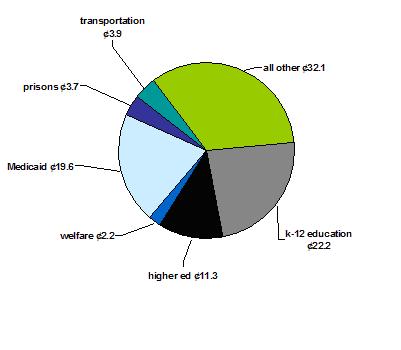
Here is how an average state tax dollar is spent. Data from National

Association of State Budget Officers, State Expenditure Report, 2001

(Summer, 2002).

And this is an average county budget from 1996-7, based on the US Census

Bureau’s survey of county officials