Author Archives: Peter Levine

charter schools and democracy

I’m enthusiastic about charter schools, but not for the standard reasons. A charter school is a public institution that operates independently, free from most of the usual bureaucratic tangles, with a direct “charter” from some higher authority such as the city or state. Charter schools are supposed to improve outcomes for the kids they enroll, by providing alternative approaches precisely tailored to their students. They are also supposed to improve the performance of public education generally, by incubating new models and by increasing parental choice (hence, competition).

Charters don’t seem to work particularly well for these purposes–no better than standard schools. (See, just for example, this RAND report, in .pdf.) It’s too early to say for sure, but charter schools certainly don’t look like a magic formula for higher test scores or graduation rates.

On the other hand, they do no harm, at least on average. And they have a huge advantage that’s distinct from student educational outcomes. As a society, we need more opportunities to propose solutions to public problems, band together voluntarily, and then work directly to implement our ideas. This is “public work”–one of the most satisfying aspects of citizenship, and a great American tradition. In general, opportunities for public work have shrunk over the last century because of increasing professionalism, standardization and bureaucracy, and a diminished role for the public sector as a whole. Social work and education used to be great fields for public work, but they are now exclusively the domains of credentialed specialists who are often unable to innovate.

This is where charter schools come in. Someone has a new idea, persuades a few friends to join her as teachers, and together they create a new institution. At any rate, that’s the story of the charters that I know personally: Cesar Chavez in Washington and the East Bay Conservation Corps in Oakland. Typically, a charter school can’t get off the ground without supportive parents, so the odds are relatively good that parents will play active roles in its governance. Flexibility, creativity, and parental participation don’t guarantee better educational results, as the RAND study shows. But they are intrinsically valuable goods–much more important, in my book, than a few extra points on the SAT.

Some ideas for charter schools are good; others are lousy. And some of the best ideas aren’t well executed. The average results for charters appear to be about the same as the mean for other public schools, but I suspect this masks a lot of variation–a wide range from best to worst. That range is a consequence of democracy. The worst charters can be shut down, but the damage they do is the price we must pay for creativity in the public sector. I think that price is well worth paying.
attitudes toward gay rights, by generation

Yesterday, Matt Yglesias wrote on his very popular blog: “Some social conservative types have speculated to me that the overwhelming pro-gay sentiment among young people can be counteracted by the natural conservatizing effects of aging.” In other words, people will “naturally” grow more hostile to gay marriage as they enter adulthood. Yglesias disputed this prediction, and he’s right. Some pretty specific data show that people tend to grow increasingly tolerant toward gays as they age–at least in the current era.

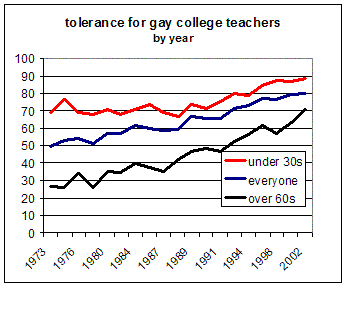
No one conducted surveys on gay marriage until recently. Our own survey found strong support for gay marriage and civil unions, but it was a snapshot of young Americans, with no adult comparison group, and it told us nothing about trends. However, the General Social Survey has consistently asked questions about other gay rights since 1973. For instance, the GSS asks: “what about a man who admits that he is a homosexual? Should such a person be allowed to teach in a college or university, or not?” This is a useful question statistically, because it divides the population into comparable-size groups that are for and against. (The GSS code name for this question, amusingly, is “colhomo.”)

As shown in the following graph (and as one would expect), tolerance for gay college teachers has increased since 1973, when the question was first asked. At any given time, the most tolerant people are the youngest:

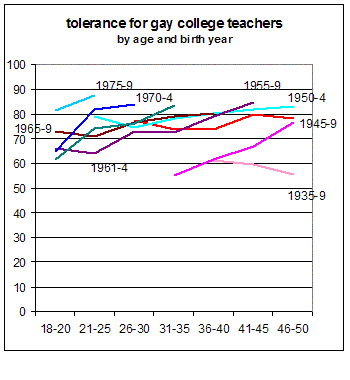
However, this first graph doesn’t tell us whether individuals become more or less tolerant over time. Perhaps each new generation starts life more tolerant than the previous ones, and thereby causes the average level of tolerance to rise, yet individuals tend to become more conservative as they age. To see whether that’s true, I looked at cohorts, and graphed their evolution over time. With the possible exception of those born in the 1930s (for whom we don’t have much data), it appears that people grow more tolerant as they age. Each of these lines represents an age cohort (i.e., part of a generation), and seven out of eight lines slope upward:

Social scientists talk about “age effects,” which hit average human beings as we move through the stages of the life-cycle. For instance, becoming more interested in politics is an age effect of early adulthood. They also talk about “cohort effects,” which are qualities that a group of people has permanently, by virtue of what happened to their society when they were young. For example, Baby Boomers were permanently marked by post-War affluence, suburbanization, and Vietnam. Finally, there are historical effects that hit everyone in a society at a given time, regardless of their age. It’s my sense that there may be a small age effect here: people become more tolerant of gays as they mature and get to know openly gay people. (This was a finding of our survey.) However, the biggest effect here is historical. Everyone is becoming more tolerant, regardless of age.

why stories are good for moral thinking

I believe in the moral value of narrative. A story, whether fictional or historical, is a coherent description of a set of events. Its coherence is not simply causal, such that the first event causes the second, which causes the third, etc. Instead, narrative coherence can take many forms, including: unity of character (one agent does a set of things sequentially); unity of community (a set of connected agents do a set of things); teleological unity (a set of events build up to a significant conclusion); or thematic unity (many things with similar meanings are described). Often more than one form of unity applies.

I would like to mention four features of narratives that make them useful for moral reasoning:

1. Narratives enable ?thick descriptions.? In Gilbert Ryle?s famous example, we may either say that someone ?contracted his eyelid? or that he ?winked conspiratorially.? The former is a thin description; the latter, a thick one. Thick descriptions often have moral significance. Contracting an eyelid is neutral, but winking conspiratorially is morally dubious. If it turns out that the contracting eyelid was a signal to commit murder, then that even thicker description marks the act as prima facie immoral.

What justifies a thick description is almost always a story. For example, a video camera would record a wink as a wink, whether it was a signal to commit murder or the result of biting a lemon. We know that it is one thing rather than the other because of what comes before and after it. But we don?t consider every prior and subsequent event, nor do we focus exclusively on actions that cause the wink or are caused by it. Rather, we ?thicken? the description by placing the event within a coherent narrative. This brings me to the second point ?

Continue reading

Leaders for Tomorrow

I’ve agreed to direct a new undergraduate program at the University of Maryland, starting next fall. It’s called Leaders for Tomorrow. Participants will have access to funds to support their own travel, summer internships, and other activities relevant to their work. Everyone in the first batch of admitted LFT students has also received a full scholarship (including room and board) from some other source.

The goals of the program are to attract some of the nation?s best undergraduates, to prepare them to compete for prestigious national scholarships such as the Rhodes and Marshall, and to enhance a campus-wide student culture of scholarship, leadership, and service. I’m particularly interested in helping talented undergraduates to bring some coherence to their various activities inside and beyond the classroom. I’m all for breadth, yet I think our students would benefit from being more strategic and purposive.

If you attend an Ivy-size college (about 6,000 undergraduates), it needs an endowment of $276 million to generate $2,300 worth of special extracurricular programs for each student. My university is much bigger than that, but it has a much smaller endowment. However, we’re earmarking something like $2,300 in cash to benefit each LFT student. I think you can make a pretty good case that Maryland (which has enormous shared assets) is a better place for these students to attend than some of the top colleges in America.

I’m imagining that most of the LFT students will work independently on extracurricular activities and courses, and we will convene regularly to discuss our separate experiences and to participate in special programs such as “field trips” and service opportunities. However, I’ll be especially excited if the LFT students do projects together. I have all kinds of ideas (creating a venue for publishing student research, organizing after-school classes in the County schools, etc. etc.); but I’m hoping that the LFT students can generate ideas of their own. They will have four years ahead of them when they arrive in September, so I’ll be patient and let them consider alternatives for a year, if necessary.

Abu Ghraib

We like to bomb from 30,000 feet,
fly back to Whiteman, MO after the run,
then drive to the mall for something to eat,
Or wire funds to the guys who buy the guns
that jab into the backs of old women
who stagger away from burning homes.
We don’t do firing squads, rape rooms, mass graves,
midnight arrests; we think we don’t know how.
A GI is a big buzz-cut guy who saves
The cowering victims of a foreign war,
or despotism, or incompetence.
We can even oust regimes from afar.
Dick and Lynne, in the VP’s residence,
once more shoulder the burden to maintain
security, order, and common sense.
They’re grandparents with degrees, guardians
of churches, agencies, and industries:
they know just how to handle ruffians.
Saddam built his own Lubyanka, grim and dank.
Isaiah asked: “How hath the oppressor ceased?”
The new commandant of Abu Ghraib’s a Yank.
And Babylon shall be as Sodom and
Gomorrah; by her shall we sit and weep.