Author Archives: Peter Levine

map work

As regular readers know, my colleagues and I have been helping high school students to conduct fieldwork and make maps of their community. They are trying to understand how features of local geography may affect behaviors that, in turn, affect health. We and the students have collected mountains of data of various kinds: questionnaires, focus group notes, notes from “window tours” of the neighborhood, GIS data collected with Palm Pilots, ratings of local food sources, and more. Most of the data is incomplete and not yet suitable for drawing conclusions. Nevertheless, we need hypotheses so that we can narrow our focus.

Here’s a map, generated from the students’ data, that suggests some ideas for our kids to pursue more rigorously. Each name is a pseudonym of a real student in our class.
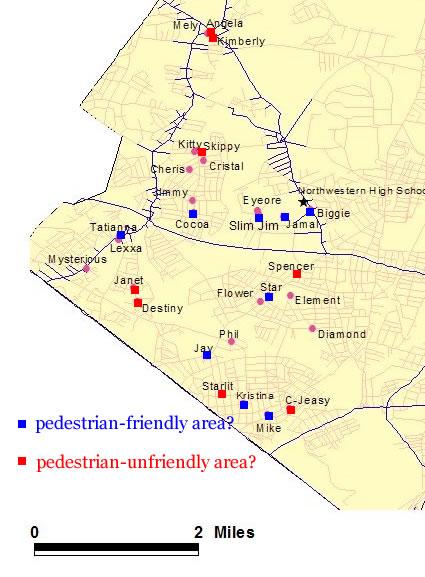
The blue squares show students who appear to live in pedestrian-friendly areas. They say that they walk for exercise, they report that their neighbors walk a lot, and they say that it’s safe to walk near their homes during the day.

The red squares mark students who answered “no” to at least two of the same questions, so they appear to live in pedestrian-unfriendly zones. The remaining dots mark students who gave mixed answers or no answers at all.

The cluster of red squares near the top of the map includes three young women of Caribbean ethnicity who live in single-family homes. Two of them say that it’s safe to walk, but none say that they or their neighbors walk. (In general, females in our sample are less likely to report that their neighborhood is safe, but more likely to walk even if they feel unsafe.) The cluster of blue squares near Northwestern includes four African American young people, all apartment-dwellers, who walk and feel that walking is safe and common. There is a positive correlation between being African American and walking, in our small sample.

The real purpose of all this work is civic education–to teach students to understand and care about their communities, by engaging them in real research. This approach to education requires that we take their research questions very seriously ourselves. Although most of the information we have collected so far is simply confusing, I remain hopeful that we and our students can generate truly innovative findings about the effects of urban planning on health.

exploiting the war dead for “politics”?

Beth Gillin wrote Saturday’s lead story in the Philadelphia Inquirer about peace activists who commemorate slain American soldiers in public ceremonies. She also discussed Ted Koppel’s decision to read the names of the American dead on “Nightline,” and Gary Trudeau’s naming some fallen soldiers in Doonesbury. I saw this article because Gillin interviewed me and quoted me twice, but I didn’t give her any interesting or profound ideas to use. (You have to register with the Inquirer to read the story, unfortunately.)

Many of today’s peace activists say that they are against the war but not against our troops. They want to distance themselves from that wing of the anti-Vietnam movement that vilified American soldiers of all ranks. They explain that they are deeply saddened by the loss of American lives; indeed, that’s one of their reasons for opposing the war. They want to grieve publicly and also to draw attention to our losses, as part of an argument against the invasion and occupation.

Koppel (whose program provoked massive controversy) denies having an anti-war motive, but he admits trying to make an editorial point:

The reading tonight of those 721 names was neither intended to provoke opposition to the war, nor was it meant as an endorsement. Some of you doubt that. You are convinced that I am opposed to the war. I?m not. But that?s beside the point. I am opposed to sustaining the illusion that war can be waged by the sacrifice of the few without burdening the rest of us in any way. I oppose the notion that to be at war is to forfeit the right to question, criticize, or debate our leaders? policies. Or, for that matter, the policies of those who would like to become our leaders. ?Nightline? will continue to do all of those things in the weeks and months to come. But not tonight. That is not what this broadcast was about.

Meanwhile, defenders of the war argue that it is wrong to commemorate our dead in these ways, at this time. They argue that it shows a lack of balance to emphasize casualties without providing context, such as lists of Saddam’s victims. They accuse Koppel and Trudeau of doing something inappropriate for their respective roles. (Koppel is supposed to break news; Trudeau is supposed to entertain; and a list of people killed in the past is neither news nor entertainment.) They worry that public grieving will weaken morale. Finally, they smell political manipulation. They see reciting the names of dead Americans as a way to play on citizens’ emotions, to attack the incumbent administration under the cover of patriotism. They claim that the deaths of military people are being exploited to attack the military itself.

I’m strongly in favor of these commemorations. Since I’m basically skeptical of the war itself, my stance wouldn’t surprise or persuade anyone on the other side of this particular issue. However, I think it’s worth considering a more general point. In modern America, we tend to see “politics” as deeply suspect. Thus any mixing of “politics” with journalism or with mourning and ceremony strikes us as inappropriate. But “politics” includes trying to persuade one’s fellow citizens about important issues–including war and peace. Thus understood, “politics” is a very noble and serious matter. There’s no pollution or manipulation involved in combining “politics” with other things. Indeed, one cannot create serious art, religion, or journalism in times of war without some admixture of “politics.”

Many people have made up their minds about the war. They intend to vote accordingly in November, and they believe that everyone else should vote the same way, or else the election will be a travesty. In this context, people are looking very critically at news organizations, schools, and religious congregrations for signs that leaders are trying to influence the vote. Regardless of our opinions about the war, however, we ought to be able to stomach emotional and powerful statements by people on the other side. Otherwise, we evidently lack the maturity to handle “politics” when the stakes are high.

“media literacy” means believing some things

I’m back from a conference on the reliability of information on the Internet. The motivation for the meeting was a concern about false information and people’s excessive credulity. There was a lot of talk about the need to educate young people not to believe everything they read online.

I’m beginning to think that credulity may not be our biggest problem. Every belief deserves to be tested. But what can you test a belief or claim against? Answer: other beliefs. In principle, science can proceed like that forever, testing each proposition and each method. But in practice, you can’t make any progress at all unless you treat much of what you know as reliable. If you doubt everything, you can say and do nothing. To borrow Otto Neurath’s metaphor, we are at sea, and we can repair our boat, but only one plank at a time. If we reject the whole thing, we sink.

I mention this because I suspect that some Americans–especially younger ones–suffer from a blanket skepticism. They doubt everything that politicians say, so they tune politics out. They doubt everything that journalists write, so they don’t use the press. And they note the prevalence of disagreement and uncertaintly in medicine, so they allow themselves to ignore all medical advice (especially the painful parts, like “eat your broccoli”). Thus I’m not as concerned about teaching young people to doubt what they read. I’m more interested in helping them to develop some sources on which they can rely.
The graph shows young Americans’ confidence in the press since 1972. (Source: General Social Survey; sample: ages 18-30). The dramatic drop in trust coincides with a steep decline in readership. Alternative news sources such as the Internet and talk radio have not come anywhere close to replacing newspapers as a source of information for young people.

a varied life

I am fortunate to enjoy a lot of variety in my professional life. Yesterday was a nice example. On my way to work, I thought about a seminar from the previous day when several senior colleagues had discussed a philosophical paper of mine. That discussion was challenging, intense, and enjoyable.

When I arrived at work, I wrote yesterday’s blog about Stanley Fish, mainly so that I could send it to a group of people (all targets of Fish’s critique) who have been discussing his article by email.

After some discussion of CIRCLE’s media strategy, I participated in two long conference calls: one for the Campaign for the Civic Mission of Schools, the other for a taskforce of the Deliberative Democracy Consortium. Each group is a coalition of organizations and individuals who have banded together to advance their field. Both coalitions have won foundation grants for their core operations, but they also depend upon voluntary contributions of labor from their members. Therefore, the discussion on both calls was largely about how we can work together more productively.

Finally, three colleagues and I picked up a batch of high school kids and took them out into their community to rate grocery stores and supermarkets for the quality of their food. I had drawn up a quick scoring rubric. Students were supposed to assign a store 1/3 of a point for each type of fresh fruit or vegetable it sells, 1 point for whole-wheat bread, 1 point for yogurt, and so on. The kids took their scoring sheets into stores and jotted down notes in the aisles. Twice in a row we were thrown out by managers who said, “You can’t do that here.” (What we were doing didn’t seem to interest them.) I felt increasingly uncomfortable about putting kids in this position–especially since they’re African-American adolescents, who don’t need extra occasions to be treated rudely by store managers. We gradually developed a method for surreptitious assessment. We’d reread our scoring sheets to remind ourselves of the questions, then enter the store, split up, and act like shoppers. It worked pretty well. (The product, for those new to this blog, will be a map to be posted on a community website.)

And now I’m on my way to Chicago for an American Libraries Association meeting on the reliability of online information. I really am grateful for this breadth of daily experience.