Author Archives: Peter Levine

the Coffee Party Convention

The U.S. Constitution is uniquely stable–or rigid–among all the advanced democracies, and we are slower to change our political processes than almost anyone else. Yet we experience occasional periods in which the mass public focuses on political processes and culture (in addition to the standard issues, like the economy and foreign policy). The amendments enacted after the Civil War, reforms passed during the Progressive Era at the local, state, and federal levels, the reinterpretation of the Constitution by Franklin D. Roosevelt and its blessing by the Supreme Court, and the post-Watergate reforms are important examples.

The 2008 election was not about political reform. To an extraordinary extent, the insurgent Democrats seemed satisfied with the rules of the game and promised “change” as a direct consequence of winning the presidential election. Candidate Obama employed a somewhat new style of campaigning within the existing rules, and he endorsed modest ethics reforms and transparency, but those were minor themes in the election.

I don’t blame him, because issues like campaign finance reform, districting, and congressional procedures were hardly “ripe.” They were not in the public’s eye, nor were they major concerns of progressive interest groups. Ideas like strengthening the civic capacities of communities and promoting public deliberations were even further down the national priority list. To raise them to the top would have cost votes, and maybe the election.

By far the most significant change since the campaign was not a reform promoted by the new administration but the Supreme Court’s Citizens United decision, which permits corporations to spend unlimited money on campaigns. It should now be obvious to progressives that the political system and culture blocks reform–in ways that are indefensible from most ideological perspectives. We deeply need political reform and innovation.

I will not predict a new wave of reform, as I did in my 2000 book, The New Progressive Era. Today, I am much more attuned to obstacles. But there is at least the potential that large numbers of people will turn their attention to processes and political culture. They might coalesce around the kinds of ideas, leaders, and topics on display at the Coffee Party Convention: Restoring American Democracy.

moderation, civility, and bipartisanship are not the same, and the differences matter

There seems to be widespread confusion about moderation, civility, and bipartisanship–not just about the words, but about real implications for politics and justice. People who want more radical policies are prone to demand more aggressive rhetoric (example: Paul Krugman); and people who want more civil discourse call for moderate policies (example: David Broder). Attitudes towards parties and partisanship are mixed together with those two questions, when they should all be separated.

Consider the question of how President Obama should have reacted to the recession when he first took office. He could have adopted more or less moderate proposals; the main difference would have been the price tag of the stimulus request, which could have been twice or half as big as it actually was. He could have used more civil or more aggressive discourse in addressing his ideological critics. And he could have constructed both his policy and his strategy for passing it with more or less regard for its impact on the two major parties.

To see that these are separate issues, consider that the president could have doubled the dollar value of the stimulus package but defended it with elaborate courtesy, or he could have halved it and shoved it in the face of conservatives in Congress. He could have tailored it to provide cover for wavering Republican legislators, or deliberately constructed it as a “wedge issue” to embarrass them.

Moderation refers to the content of the policy. It falls between timidity and recklessness. So defined, it is a virtue: close to prudence. However, whether a given policy actually is moderate and prudent is a difficult question. Some would say that the Obama stimulus package and health care reform bills were timid, not moderate. Others think they were breathtakingly radical. Everything depends on what would work best–something we cannot know for sure but can rationally debate. If you think that Keynes was wrong and governments cannot stimulate demand in recessions, then the stimulus package was profligate and immoderate. If you think that the recession demanded twice as much Keynsian stimulus, then the package was timid and weak. It was moderate only if it was the right size.

Civility refers to a style of discourse. Civil speakers refrain from personal attacks, imputations of bad motives on the part of their opponents, and highly negative language. Civil speakers presume the basic good faith of other people until clearly proven wrong, and do not give up on individuals just because they belong to groups that the speaker dislikes. Civility means trying to keep the conversation going and welcoming replies from the other side, rather than trying to exclude opponents.

As such, civility is a virtue–certainly in ordinary life. But it is not a transcendent virtue and it can trade off against other virtues, such as clarity, commitment, and moral passion. In politics, I think it generally pays off. For example, I suspect that President Obama has polled better than one would expect (given the economy) because people basically like his courteous style. But there can be a political cost if civil language obscures important differences or fails to motivate “the base.”

Partisanship means lining up with a party and making tactical and strategic choices to benefit your party over the others. It is by no means always wrong. Parties are vehicles for achieving social change. If one of the parties reflects your views much better than the others do, you should support that party. If you hold political office, it may be wise to win control of the government even if that means playing hardball. For example, Republicans may be trying to prevent the administration from successfully addressing the recession; and while that has a cost for America, it is not unprincipled, if one assumes that they would legislate for their own principles once they won Congress back. Partisan competition is good for democracy because it gives voters consequential choices.

On the other hand, professional politicians often neglect the costs–the collateral damage–of pursuing partisan strategies because their self-interest aligns with their party’s. Partisan strategies often fail because our system is engineered to require at least some votes from both parties for important legislation. And a partisan lens can obscure the truth if one starts to believe that everyone on either side of the aisle is alike and that the only pathway to reform is for your party to win more seats. I think that is simply a false interpretation of reality in our system of weak parties and entrepreneurial candidates.

For what it’s worth, I would tend to favor stronger, bolder policies. I think our actual policies are weak rather than moderate. I welcome a robust debate but I would recommend conducting that debate with basic rules of civility even if one’s opponents fail to be civil in return. Civility is popular, it makes uncivil opponents look bad, and it promotes broad public engagement. (When politics turns into a shouting match, most Americans tune it out.) I favor clear partisan differences and electoral competition, but I believe our system rewards partisan maneuvering even when the collateral damage is too high.
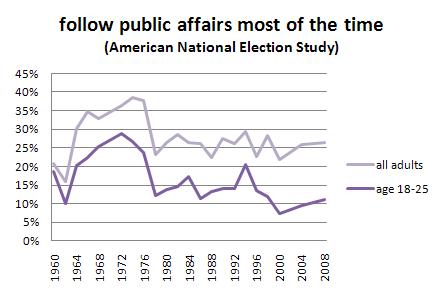
graph of the day: paying attention to public affairs

Here is the trend for the proportion of people who say they pay attention to public affairs. The lower line shows the trend separately for younger adults, ages 18-25.

I notice a few points:

  • It seems that “the Sixties” grabbed people’s attention–older people’s more than young adults’.
  • The interest of the whole population has been pretty stable since the 1970s, despite momentous changes in the news media, which morphed from three TV channels and metropolitan daily newspapers to cable, the Internet, and cell phone apps. Even as the supply shifted, demand was steady.
  • Younger people have been less engaged in recent years than in the 1970s, 1980s, and early 1990s.
  • The past decade saw an upward trend for both age groups, albeit from low baselines.
  • Young adults are not too far below their 1960-2008 average (about five points below), but the gap by age was larger from 1998 to 2008 than it was earlier.

All of this matters because people who pay attention have the most impact, and because habits of news consumption that form in early adulthood tend to stick.

new CIRCLE website

We just launched our new website at www.civicyouth.org. That’s the same address we’ve used since 2001, and it’s mostly the same content, but there’s a whole new look and organization. I see some items that need to be moved around, missing legends on graphs, etc. But please check it out: it’s the best source of research, data, evaluation tools, maps, policy analysis, and other geeky stuff related to young people’s civic engagement.

students as part of the accountability puzzle

Yesterday, I suggested alternatives to holding teachers accountable on the basis of test scores. Just a few hours later (by coincidence), I was shown an interesting initiative from the Boston Public Schools. All Boston high school students will soon begin completing “Constructive Feedback Forms” about their teachers each semester. These very carefully constructed surveys do not ask the students to rate their teachers as good, bad, nice, smart, or by any overall measure. Instead, they ask a whole series of very specific questions about teaching practices. How soon after the bell does the class get down to work? How many students participate in discussions? In what ways does the teacher provide feedback on homework?

The union and school system endorsed the policy, which is pretty modest because only the teacher receives the anonymous results. It would be interesting to consider sharing the results in some form with administrators, mentors, or other colleagues. I see the disadvantages of those ideas, but they are worthy of experiment.

Another fascinating aspect of this policy is its origin. Students on the Boston Student Advisory Council developed it–both the outline and the details–and succeeded in persuading the Boston School Committee to approve it. Those students are supported by Youth on Board (a nationally recognized nonprofit) and by the school system’s Office of High School Renewal, so they perform excellent, well-informed, and effective work as.public leaders.