Author Archives: Peter Levine

Justice Ginsburg at the National Conference on Citizenship

Justice Ruth Bader Ginsburg (following the example of justices O’Connor, Souter, Breyer, and Scalia) is speaking at the National Conference on Citizenship. It’s helpful for the Supreme Court–and the judicial branch in general–to endorse civic engagement and civic education. Judge Learned Hand was right: “Liberty lies in the hearts of men and women; when it dies there, no constitution, no law, no court can save it. While it lies there, it needs no constitution, no law, no court to save it.”

Justices O’Connor and Souter have made civic engagement a special priority in their retirements–more than speaking, they also organize and lead practical efforts–and Justice Breyer has written substantively about civic education. (Apparently, he addresses it in his new book.)

Today, Justice Ginsburg took a turn to address the topic. She used the “Impeach Earl Warren” campaign as an example of a time when people paid attention to the law and engaged, but in an ignorant way. Asked whether she was disturbed by public “ignorance” (the questioner’s term, not hers), she said she was. She cited her own work litigating for equal rights. She said that the litigants who won important court victories for civil rights were ordinary people who understood their rights and the courts.

“The courts are reactive institutions. Why was Sally Reed‘s case before the Court in 1971? Because there was a women’s movement. Why was there activity in the 50s and 60s? Because there was a burgeoning Civil Rights movement. The courts will react …, not to the weather of the day, but to the climate of the era.” I think her point was the importance of active citizenship in the process of reinterpreting and strengthening the law.

Justice Ginsburg argued that case law regarding gender is now quite fair and equitable. In that sense, an Equal Rights Amendment would not change our laws. But our Constitution, she noted, is older than other countries’ and does not contain an explicit statement about gender equality that would be found in almost all other constitutions. “My granddaughters will not find that statement,” she said, and “for that reason, I remain a partisan of the Equal Rights Amendment.”

“If I could design an affirmative action program, it would be for men. It would give men every incentive to be an equal partner in raising the next generation.”

Justice Ginsburg praised the Campaign for the Civic Mission of Schools, which is now co-chaired by Justice O’Connor, and materials supported by the Annenberg Foundation. “There is an important job to be done to persuade school administrators to request these materials and use them in their classrooms.”

at the National Conference on Citizenship

I am in DC for the National Conference on Citizenship’s annual meeting and some related events. It has been a long day and I cannot reflect adequately on all that has happened, but here are some highlights.

In partnership with the Corporation for National and Community Service and the Census, the NCoC is releasing the first annual National Civic Health Assessment. This is the lineal descendant of the Index of National Civic Health (INCH) and the the Civic Health Index, both of which I worked on with many colleagues. But the CHA is based on a national Census survey and is therefore the best data yet.

Today’s pre-conference was a series of panels and speeches: very rich and interesting. The Twitter feed (#ncoc) gives a flavor.

Splashlife was publicly launched. That’s an impressive new social network the provides incentives for volunteering, organizing, and activism. The young people who built it announced it at NCoC in a creative way. Dressed as waiters and other characters who had infiltrated the audience, they pretended to interrupt a speaker (their colleague) who was giving a PowerPoint presentation about the Millennials. It was all theater and very nicely done.?

philanthropy, the White House and promoting civic engagement

Tomorrow in DC, I’ll be on a panel with Sonal Shah from the White House Domestic Policy Council, Chris Gates from Philanthropy for Active Civic Engagement, and Steve Gunderson, President and CEO of the Council on Foundations. The topic is “An Evolving Relationship: How Philanthropy and the Executive Branch Work Together to Promote Civic Engagement.” I’m supposed to address that topic for about 10 minutes. I haven’t decided what to say but I have a few notes.

In a fine paper on the this subject, Brad Rourke cites Michael Delli Carpini’s definition of civic engagement: “Individual and collective actions designed to identify and address issues of public concern.” If that is civic engagement, how should the executive branch of the federal government and foundations promote it? I can think of several strategies:

1. They can fund opportunities for citizens to identify and address public concerns collaboratively. Professional public servants do that, and so do employees of many private companies, but somehow their roles aren’t addressed under the heading of “civic engagement.” Instead, foundations that support citizenship have often funded volunteering or non-career service jobs. Lately, the main source of financial support has shifted. Philanthropy has lost money in the stock market while the Corporation for National and Community Service–the federal program that funds volunteering opportunities–is on course to triple and has an annual budget approaching $1.5 billion.

In a way, the story is straightforward: foundations seeded various programs that are now growing because of federal dollars. But the Corporation is not allowed to spend any funds on electoral activities, even though political action meets the definition of “civic engagement.” (As does journalism and media-creation.) Instead, the Corporation has been charged with recruiting large numbers of volunteers to address several big, pre-defined social problems, such as the dropout crisis. That is a different way of thinking about “civic engagement” than we see when citizens define, discuss, and diagnose their own issues. So there is plenty of room for foundations to support participation that is more political or more deliberative, or both, than the Corporation does. Meanwhile, I would like to see the Corporation adopt civic learning objectives for all its participants.

2. They can draw national attention to issues of civic engagement. Citizenship is a contested topic: progressives, conservatives, and others have different opinions about it. But there is also some common ground, and I think our democracy would benefit from paying more attention to active citizenship–even if we continue to disagree about it.

The White House has tried to attract attention to civic engagement on several occasions. George H. W. Bush made it the theme of his inaugural address. President Clinton launched the New Citizenship Initiative in the White House Domestic Policy Council. President George W. Bush held a White House Forum on American History, Civics, and Service (which I attended and blogged about). Those are examples; more could be cited.

It’s my sense that today’s polarized political atmosphere would make presidential leadership on citizenship especially difficult. When people are willing to call AmeriCorps volunteers “Obama’s Brownshirts,” it’s difficult to have a reasonable discussion of civic engagement. And it’s a fact that two thirds of young American voters pulled the lever for Obama in 2008. That means that any concerted effort to get young people civically engaged will tend to draw the center-left, even if that’s not the intention.

The Clinton “New Citizenship” effort migrated to civil society when my then boss, Bill Galston, left the Domestic Policy Council and The Pew Charitable Trusts funded his National Commission on Civic Renewal. Although the issue of citizenship needs presidential leadership, it fits more comfortably in the nonprofit sector today and that creates an opening for foundations. The main recent example is the Knight Commission on the Information Needs of a Democracy, a bipartisan effort to address an important aspect of civic engagement.

3. They could reform government so that all Americans had better opportunities to influence and collaborate with public institutions. I think that is the most important goal, but it cuts against technocratic impulses on the left and anti-government assumptions on the right. Arnold Fege has shown that getting communities involved with schools was a major purpose of federal policy during the 1970s, but there is not much of a groundswell for that approach today. DC School Chancellor Michelle Rhee’s remark that “collaboration is overrated” is probably closer to the norm.

On his first day in office, President Obama signed an order on transparency, participation, and collaboration. He strongly endorsed the ideal of government collaborating with citizens. Since then, the transparency agenda–giving more people access to more public information–has made much more progress than participation or collaboration. Transparency is somewhat more clear cut than collaboration, and it has an active, organized coalition that is funded by foundations. Collaboration has no lobby, and philanthropy could help build one.

4. They could work to make sure that all young Americans are educated for active citizenship, a cause that will require research, policy reforms, funding, changes in teacher education, and partnerships with institutions other than schools. Civic education has been a low priority for the federal government and a major issue for only a few foundations. There is much more to be done.
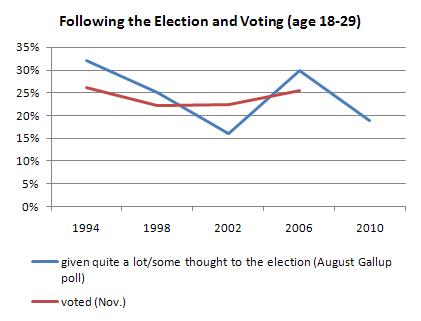
youth interest in the 2010 election

According to a Gallup poll last month, just 19 percent of Americans between the ages of 18 and 29 had paid attention to the election so far. That is a fairly low number in historical perspective, and it suggests that youth turnout may be pretty weak: around 22-23 percent of eligible voters.

My graph shows recent midterm elections. Both trends are much higher in presidential elections. For example, in August 2008, 75 percent of young people were paying attention to the election, and 51.1% ultimately voted.

The correlation between Gallup’s “paying attention” surveys and voter turnout in midterm elections is high: 0.84, for you statistics geeks. That makes paying attention a good predictor of turnout. On the other hand, no one has a crystal ball, and the future is ultimately up to us. If you want young people to vote, now would be a good time to get them interested.

British exceptionalism: how the UK is different from Europe

In Britain, the Industrial Revolution came early, lasted long, and transformed the whole society and much of the landscape. On the Continent, its effects were more limited, and that difference still matters.

In 1950, half the working population in Spain, Greece, Poland, and many other Continental countries was still employed on farms. Even in France, thirty percent worked in agriculture, and almost one quarter of West Germans worked on farms. Agriculture was not heavily mechanized. In the early fifties, there was just one car for every 314,000 Spaniards, and only one of every twelve French households had a car.* I don’t know the number of tractors, but one can tell from the rate of car ownership that many roads were unpaved, fuel was scarce, and in general the internal combustion engine was hard to find.

In Britain at that time, only one in 20 workers was employed in agriculture. Despite the Depression, the Second World War, post-War austerity and rationing, and the loss of empire, there were more than 2.2 million cars in Britain in 1950. Two centuries of industrialization had caused the population to migrate and had transformed the very land. Marx and Engels were wrong about much, but they accurately depicted the pace of change in their adopted land. They had the British bourgeoisie in view then they wrote:

    It has accomplished wonders far surpassing Egyptian pyramids, Roman aqueducts, and Gothic cathedrals. … Constant revolutionising of production, uninterrupted disturbance of all social conditions, everlasting uncertainty and agitation distinguish the bourgeois epoch from all earlier ones. All fixed, fast-frozen relations, with their train of ancient and venerable prejudices and opinions, are swept away, all new-formed ones become antiquated before they can ossify. All that is solid melts into air, all that is holy is profaned. … All old-established national industries have been destroyed or are daily being destroyed. They are dislodged by new industries, whose introduction becomes a life and death question for all civilised nations, by industries that no longer work up indigenous raw material, but raw material drawn from the remotest zones; industries whose products are consumed, not only at home, but in every quarter of the globe.

Put more soberly, the British by 1950 lived and worked in structures designed for Victorian industry in a landscape reconfigured for the rapid movement of goods and people, and they held jobs in commerce, manufacturing, or service industries. Meanwhile, across the Channel, most Europeans lived in villages devoted to subsistence agriculture, whose most important buildings dated to the Middle Ages or the baroque.

Over the next quarter century, the vast majority of those Continental agricultural workers migrated to cities. For example, one million Andalucians moved to the cities of Catalonia, and nine million Italians exchanged regions, mostly migrating northward. Many moved from old farming villages to high-rise apartment blocks: slum-like ones in the suburbs if they were poor, and comfortable ones nearer the central city or the sea if they were more fortunate. They also moved from fields to automated office jobs in one or two generations. All that movement changed the Continent, but less profoundly than the much more protracted Industrial Revolution had affected Britain. For example, outside the banlieus of big French cities, the countryside and the centers of towns are often very well preserved today, notwithstanding two world wars.

Britain’s much longer and deeper experience with industrialization by 1950 explains its slower post-war growth rate. The UK had less to gain from industrializing and had to deal with an obsolete stock of factories, machines, and organizations. These differences also explain persistent gaps in culture, expectations, and priorities on either side of the Channel.

*I derive all the statistics in this post from Tony Judt’s book Postwar, chapter 10.