(No blogging today–too much turkey to eat and too many little tots to play with.)
Author Archives: Peter Levine
progress toward an information commons
Since 2002, some colleagues and I have been working slowly to create an “information commons” for Prince George’s County, MD. A real information commons would be a voluntary association devoted to creating public goods and putting them online. These goods might include maps, oral histories, historical archives, news articles, discussion forums, research reports, calendars, and directories. If community groups preferred to maintain separate websites, they could link to features on the commons site and thus “distribute” the commons across the web. The association would also lobby locally on issues like the “digital divide” and broadband access; and would provide training and support. Information commons in various communities would form networks and share software.
So far, the tangible products of the Prince George’s Information Commons are a modest website whose best feature is an oral history, and a series of articles defending the concept of a commons.
We decided not to start by creating an association, because we were afraid that community people wouldn’t see the need for such a body or the advantages of joining. Instead, we hoped to create enough exciting and useful content on one site that it would draw traffic and interest. We would then ask participants if they wanted to “own” the site formally by creating a non-profit governing board.
Progress has been slow for two main reasons.
First, we have chosen to work with high school students, and for the most part ones who are not currently on the college track. This has been extremely rewarding work, but it’s also a relatively slow way to generate exciting content. For instance, students spent a whole summer gathering excellent audio recordings that documented immigration into the County, but we haven’t figured out how to use that material online. It sits on a CD. Likewise, the kids took a very long time collecting information for “asset maps,” and the result was a relatively small set of incomplete (and now dated) maps.
Despite the slowness of this approach, I intend to continue to invest the majority of my discretionary time in the high school, because I find it extremely satisfying to work directly with kids.
The second obstacle is financial. We have had great difficulty raising money for the core concept of an “information commons.” Instead, we have raised funds from foundations with specific interests in, for example, history or geography. As a result, we haven’t had money or time to develop the commons itself. Instead, we have lurched from one project to another.
Ideally, we would always be busy with three tasks: 1) teaching high school (or middle-school) students to create digital products for the website; 2) working with college classes, churches, and other adult groups to help them to create content; and 3) installing and managing interactive features for the website itself, such as an open blog, a “wiki,” or a map that visitors could annotate. These features would have to be carefully monitored or else they would be vulnerable to spammers and cyber-vandals.
To date, we have only had sufficient resources to do the first of these tasks, and that only on a small scale. Recently, I’ve been thinking hard about the second job: recruiting independent groups to produce their own content. Based on some recent conversations, I am optimistic that by the spring we will have three groups feeding content into the commons site: the high school class, a college class, and possibly a group of teachers.
Boyte on Lakoff
I haven’t read George Lakoff’s Don’t Think of an Elephant, although it’s been urged on me more than once. His book and Thomas Frank’s What’s the Matter with Kansas? seem to be the two most influential works on the left right now. Amazon says that people often buy them together. I shouldn’t criticize something I haven’t read, but Harry Boyte’s critique rings exactly true. (This is from the latest Civic Engagement News. I don’t think it’s on the web yet, but it will go here, with the past issues.)
Liberal “527” groups on the Democratic side took their cue from George
Lakoff, the Berkeley linguist who has become a Democratic guru for what
is called “frame theory,” or the idea that politics needs to convey
simple metaphors. To counter what he calls the Republican view of
“government as punitive father,” Lakoff argues that the core progressive
message is “government as nurturant parent” that expresses its care for
the citizenry through social service safety nets and regulation. In
Lakoff’s view “protection is a form of caring. The world is filled with
evils that can harm a child* and protection of innocent and helpless
children is a major part of a nurturant parent’s job.”
Government-as-nurturant-parent protects against “crime and drugs,
cigarettes, cars without seat belts, dangerous toys, inflammable
clothing, pollution, asbestos, lead paint, pesticides in food, diseases,
unscrupulous businessmen, and so on.” …
why the Democrats are slipping into minority status
It’s possible that
we’re a fifty/fifty nation, evenly divided between Democrats and Republicans,
and the last two elections have been so close that they only prove we’re tied.
But I don’t believe it. A powerful current is moving us rightward. It has helped
Republicans to gain control of both houses of Congress, to appoint most federal
judges, and to control seven more governors’ mansions than the Democrats do.
(State legislatures are still about evenly split, with 19 completely under the
control of each party, and the rest divided.) In the national
exit poll, 34% of voters called themselves conservatives compared to 21%
who identified as liberals. The ideology score is nothing new, but the balance
of power is startlingly different from 20 years ago. It is possible that the
rightward trend will stop of its own accord at the current point, but I wouldn’t count on it. 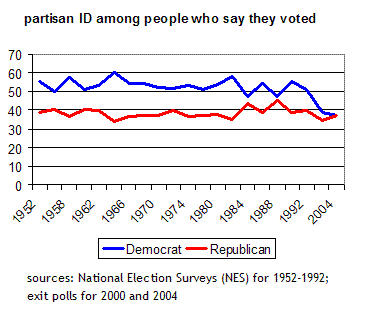
Progressive parties demand more of voters than conservative ones. To start
with, they demand more taxes. Under favorable circumstances, progressives can reserve
their tax increases for a wealthy minority, but people won’t vote to tax
anyone unless they believe that the revenue is likely to be well spent.
Progressive parties also need low-income people
to turn out, something that is relatively hard for them to do because the “costs”
of voting (becoming informed and taking time off to go to the polls) are relatively
onerous for poor citizens. Besides, poor people have little reason to trust politicians enough
to vote for them. Finally, the modern Democratic party is (rightly) committed
to a set of unpopular moral values, so it must convince people to overlook those
commitments in return for other benefits.
Historically, American progressive parties (usually Democratic, but occasionally
Republican) have won elections when they have identified the really important
issues that concern majorities of voters, and have directly addressed those
issues. People will vote to raise taxes–their own or other citizens’–if they
think the money is needed for critical purposes. For example, the nation faced
a deep depression in 1932. One of its causes appared to be malfeasance in the financial
markets. And even before the depression began, people risked becoming indigent
if they lost their jobs. Roosevelt responded with employment programs to stimulate
the economy, market reforms, and Social Security. We can argue about whether
he solved the problems that the country faced in 1932, but there was
no question that he pursued policies that directly addressed the country’s needs.
In the 1960s, there was less consensus about the need to wage a “war on poverty,”
given that most families had become relatively affluent. But there was wide
agreement that the country had to move past racial segregation. Liberal Democrats
and liberal Republicans who tackled discrimination won elections.
Today, the
traditional problems have not disappeared. De facto racial segregation is worse
than it was 25 years ago; losing your job can still be very bad news. But for
most Americans, there doesn’t seem to be a compelling reason to invent new solutions
to these old concerns, which are manageable. People support the traditional progressive
programs, but they need not vote Democratic to preserve them; Republicans
also swear oaths in defense of Social Security and Medicare. In any case, Americans
are now more concerned about a new set of problems, including the lack of decent
jobs for those with high school diplomas; persistent violent crime that we barely
control by jailing millions of our fellow citizens; reliance on foreign oil;
and the coarseness of popular culture, especially as it affects kids. While
the long-term fiscal condition of the federal government probably doesn’t worry
people as much as these other issues, the deficit does matter because it makes
it hard to propose expensive policies.
No doubt, some people are also worried about issues that Democrats cannot and should not define
as “problems,” such as immigration and increased diversity, gay weddings in
San Francisco, or the legal right to abortion. But Democrats would have a fighting
chance if they addressed a different set of important concerns. Otherwise, people will vote conservative.
gave up on this year’s Democrats when they failed to address any serious
problems at their convention. They seemed to think that Americans would vote for a Democrat
because Bush had made mistakes and Kerry was personally macho. I think a Kerry
administration would have been at best a holding-action; at worst, a last stand.
A considerable part of me is relieved that Democrats (and McCain-ite Republicans)
now have four years to come up with a plausible program.
humanistic versus technical philosophy
My two good friends from as early as kindergarten, the brothers Marcus and Jason Stanley, are guest-blogging with Brian Leiter. Lately, they have considered the very question that I have been writing about lately as I try to finish my current book-in-progress: the distinction (if there is one) between humanistic and technical philosopy.
My expertise, to the extent that I have any, is strictly limited to moral and political questions. In those fields of philosophy, there are not two distinct camps, the humanists versus the technical analysts. But there are two poles in a continuum. The same continuum defined moral philosophy in the Renaissance, when humanists (writers and teachers who practiced the studia humanitatis) challenged the highly technical Scholastics, who saw philosophy as a science. I believe that we should move closer to the humanistic pole today, reviving certain aspects of Renaissance humanism. [Warning: The rest of this post is long, because I’ve pasted a section from my book into it.]