Author Archives: Peter Levine

“community as text”

Last night and today, I’m attending a meeting organized by the Coalition for Community Schools. The Coalition has convened representatives of six movements:

  • service learning: community service combined with academic work and reflection
  • environmental education: studying environmental science and applying the knowledge to understand local ecosystems
  • place-based education: studying local communities in order to increase appreciation (as well as knowledge) of disparaged places, such as poor rural areas
  • civic education, which should include the study of local issues and structures of government
  • work-based learning, as defined in the School to Work Opportunities Act of 1990, which supports programs that place students in job settings for academic study.
  • community youth development: which treats young people as assets in community development, and trains and supports them to participate in local organizations and networks.
  • Each of these movements or philosophies of education treats the local community as a “text” for students to interpret–and, to some degree, “rewrite.” There are many examples and stories of truly exciting results. For example, students in a Texas border school district conducted oral histories of their elderly, immigrant relatives, translated the results into English, and used the resulting English/Spanish narratives as textbooks in their schools. On the other hand, using “community-as-text” is hard and often frustrating work, especially when communities do not embrace the participation of students.

    In the end, I think that using the “community as text” is one of several strategies that can bring coherence, purpose, and passion to education. It is not better than an arts focus, a global-cultures focus, a history focus, a tech focus, or various other choices. I do believe, however, that it implies its own set of principles and values, which can be particularly attractive in certain settings. For example, we are motivated to use the community as text in Prince George’s County, MD, because the students are growing up in a fascinating jurisdiction–diverse and rapidly changing–yet people of all ages tend to overlook or discount it as a community. Thus studying the county and disseminating the results is a means of (much needed) community organizing.
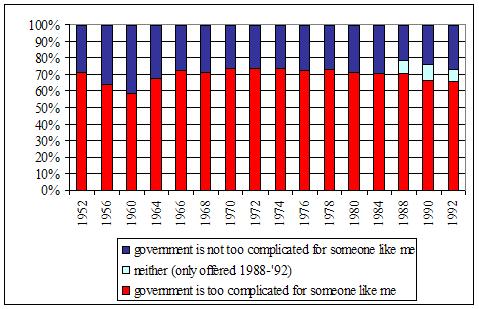
    is policy just too complicated?

    Some people think that it’s harder for citizens to participate in politics today than it was 50 years ago, because issues have simply grown more complex. The G.I. bill was relatively simple legislation, so it was easy to organize members of veterans’ groups and others to support it. But health care reform in the 21st century is enormously complex. No one really knows what should be done. Some people argue that public engagement has declined as a result.

    I think there must be something to this theory. Between 1952 and 1992, the National Election Study (NES) asked people whether they agreed with the following statement: “Sometimes politics and government seem so complicated that a person like me can’t really understand what’s going on.” Generally, people have found politics too complicated–or at least, have doubted their own capacity to understand it. However, the results do not show a lot of decline in Americans’ sense that politics is too complicated for them. The trend is pretty flat. Unfortunately, the question was dropped in 1996, and it changed a bit in 1988, when people were offered the option of refusing both choices (“too complicated” and “not too complicated”). If we assume that the people who chose “neither” would otherwise have said “too complicated,” then there was an erosion of confidence after 1984. But that’s a big assumption.

    By the way, people’s impression of complexity is not the only thing that might affect their participation. Regardless of their subjective beliefs, the actual complexity of policy issues might block their engagement. And perhaps we should be a little disappointed that people haven’t gained confidence in their understanding of politics. Before World War II, the mean level of educational attainment of the US population was elementary school; by 2000, it was two years of college. Yet we feel no more capable of understanding policy–perhaps somewhat less.

    a map of civic renewal

    Here’s a map of the civic renewal network. I made it in the following way. I visited TouchGraph’s amazing GoogleBrowser, which generates diagrams of the links among websites, as recognized by Google. I entered three URLs that to me represent important nodes in the real (not merely virtual) network for civic renewal in America:

  • The Civic Practices Network, a gateway to such fields as asset-based community development, public journalism (i.e., news that tries to support citizen participation), and civic environmentalism (efforts to protect nature collaboratively).
  • CIRCLE, where I work. We try to cover the fields of civic education and youth politics, since it’s critical to prepare the next generation of citizens.
  • Common Cause, an organization that seeks to reform government and make it more responsive to citizens.
  • TouchGraph generates a dynamic map that moves and expands as you adjust it. It’s great to watch. The map that you can view on my site is static, because I pasted it into a graphic file. Nevertheless, it neatly shows the relationships among such fields as neighborhood activism, civic engagement on college campuses, public deliberation, national service, and public journalism. It is evidence of a robust and fairly tight network of organizations that are improving the quality and power of citizens’ public work.

    This is a map of civic renewal, not the map. It has at least three major limitations: (1) I chose the three initial nodes–not arbitrarily, but guided by my personal experience; (2) Google’s database of links is imperfect and incomplete; and (3) links among websites are not always meaningful. One site can link to another without having anything to do with it; or two groups can work closely together but neglect to exchange links on their sites. (They might not even have websites.) In short, I find my own map fascinating, but my main advice is to use TouchGraph to make your own.

    funding opportunity for micro-level news online

    The New Voice project launched its website today and issued a Request for Proposals. The proposal deadline is March 17. As the website says,

    New Voices is a pioneering program to seed innovative community news ventures in the United States. Over the next two years, New Voices will help fund the start-up of 20 micro-local, news projects with $12,000 grants; support them with an educational Web site, and help foster their sustainability through $5,000 second-year, matching grants. New Voices is administered by J-Lab at the University of Maryland and supported by a grant from the John S. and James L. Knight Foundation.

    Disclosure: I’m on the project’s advisory committee and will help read applications.

    an AARP for youth?

    Should there be a large membership organization for youth that lobbies on economic issues that affect them–an American Association of Young People? I can think of three major arguments in favor. First, there are huge and perhaps unprecedented issues of generational equity. The government is borrowing and spending with wild abandon and saving the bill for younger people; and things are likely to get worse as the boomers age. The injustice (and short time horizons) reflected in current policy seem to require an organized response. Second, young people tend to be low political priorities because they don’t vote and aren’t organized to lobby. An “AAYP” would help. Third, it’s important for people to have reasonably positive political experiences when they’re in their late teens and twenties, because Karl Mannheim’s classic theory of development suggests that early experiences permanantly shape people’s civic identity, making them active or passive for the rest of their lives. If young people were more organized as a political bloc, then parties and interest groups would compete for their support, and as a result they would have more experiences of being important and sought after.

    There are also some arguments against an “AAYP.” First of all, organizing it would be heavy-lifting. Young people are comparatively hard to organize at all, since they are relatively unlikely to give money and to voluntarily support disciplined organizations. Besides, compared to their elders, they are not too interested in the kinds of programs and issues that involve generational equity–Social Security, Medicare, and the like. For example, only six percent of under-25s (and 3 percent of college students) picked medical care as the top voting issue in the 2004 elections. To the extent that young people do think about Social Security reform and other relevant issues, they certainly disagree about what should be done, which would make it hard to show a united front. In any case, young people may be relatively unconcerned about the impact of these issues on youth because they don’t see themselves as essentially young. They expect to move on and become middle aged, whereas the AARP consituency is “retired” for good.

    Some people see the AARP’s model as bad for democracy because it empowers a few experts in Washington to decide what makes good policy and then “sell” their ideas to a huge population using advertising techniques–not very empowering. It’s also a special-interest model, and a clash of special interests does not often make good policy. Then again, if the over-60s have an expert-driven, special-interest organization with 35 million dues-paying, voting, letter-writing members, then maybe youth need one too.