Author Archives: Peter Levine

Ruth Simmons

Ruth Simmons is the President of Brown University. I had a chance to hear her speak and then joined her for a dinner yesterday. In the speech, she described her path from a small, East-Texas town where she was the twelfth child of sharecroppers to the presidency of an Ivy League university. I was particularly interested in her description of Houston in the 1950s. She said that a tight network of very talented Black teachers and ministers, plus a few lawyers and doctors, led the community and collaborated closely to help young people–they raised money for college tuition, picked out students’ clothes, taught and counselled them. Because of segregation, these adults had no options other than to hold a few professional jobs within the Black community. This restriction was deeply unfair, but it meant that children who came from deep poverty had access to skilled and charismatic people in their own neighborhoods.

Dr. Simmons’ parents were suspicious of schooling and constantly told her to take her nose out of books. She suggested three reasons for this attitude: her parents worked with their hands and distrusted “idleness”; they were afraid that Ruth might question racial injustice and be killed; and they worried that she might lose touch with (and respect for) her own family. A final reason could have been a kind of “bargain with reality.” Since other opportunities had always been closed for African Americans, especially in rural East Texas, sharecroppers developed a pride in manual labor and a hostility to books to help validate their own lives. But Simmons was also exposed to community leaders for whom education was a route to freedom. Despite centuries of oppression, her teachers and other professionals prepared youth to become leaders in the hope that better opportunities would arise. I suspect that their hope was an essential precondition of the Civil Rights Movement.
the president’s budget and civic education

The Bush Administration’s budget proposal for education is available online. For those concerned about civic learning, here are two key points:

  • Funding for the Office of Safe and Drug-Free Schools is cut in half, from $672 million to $317 million. This is the office that manages character and civic education, including grants to produce curricular materials, train teachers, etc.
  • The budget makes high school reform a major priority. There will be a big fight over what that means. Some believe that the standards-and-accountability regime that’s now in place for grades 3-8 should be extended upward to grades 9-12; others think that high schools should be made smaller, more various, and more connected to communities. In principle, we could do both; but in practice, there are likely to be major tradeoffs between the two approaches. For one thing, a standards-and-accountability regime will drive schools toward standardization, which will make it more difficult for them to develop idiosyncratic curricular themes, such as public service or American history. Many in the “civic ed” world see great promise in small, themed high schools, especially ones that emphasize civic values.

    The budget is somewhat ambiguous about how to reform secondary education. On one hand, the title of the relevant subhead is “Finishing the Job: Bringing NCLB to High Schools,” and money is earmarked for mandatory “testing in grades 9?11 in language arts and math.” On the other hand, the following passage implies some flexibility:

  • This initiative provides $1.2 billion to help States implement a high school accountability framework and a wide range of effective interventions. In return for a commitment to improve academic achievement and graduation rates for secondary school students, States will receive the flexibility to choose which intervention strategies will be most effective in serving the needs of their at-risk high school students. Allowable activities would include vocational education programs, mentoring programs, and partnerships between high schools and colleges, among other approaches. A portion of the funding will be used for randomized trials and evaluations to identify the most effective intervention strategies to enable school administrators to make better choices on what educational strategies to adopt.”

    I read this as a negotiated statement. Those who simply want high-stakes testing to be expanded through the 12th grade probably have the upper hand, but they have made some room for people who see other ways to reform high schools.

    [cross-posted from the CMS Community blog]

    handbook of public deliberation

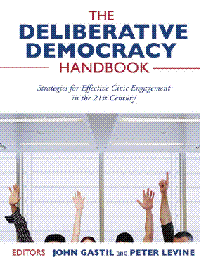
    John Gastil and I are busy organizing the production of our co-edited volume, The Handbook of Public Deliberation: Strategies for Effective Civic Engagement in the 21st Century. Jossey Bass will publish it this summer. Of the 19 chapters, 16 describe very concrete and practical approaches to public deliberation; thus the book will offer a diverse menu of choices for civic groups, governments, school systems, and others to use. (The three remaining chapters are overviews of the field.) Since almost all chapters have been written by teams, usually comprised of both scholars and practitioners, there are 44 authors in all. Coordinating everyone’s participation has been quite a job for John and me. However, we’ll reach a milestone tomorrow when we submit a fully edited and complete manuscript.

    The cover design to the right is preliminary. We’ve asked for more people, more evident diversity, and less office ceiling. (Apparently, that’s the publisher’s office, and one arm belongs to our editor.) Still, I like the informality and zest of the basic design.

    “every subject’s soul is his own”

    (Continuing Friday’s theme. …) There is no doubt, after Nuremberg, that soldiers must question the justification of their side’s conduct during a conflict–and disobey any immoral orders. But should they worry about the purposes and legitimacy of the whole war? “Adam K. Anonymousargued “no” on this blog. “In a democracy,” he wrote, “the military is a tool, subjected to our elected representative[s], who should worry about the legitimacy of the war. The military, who don’t represent the people, should not be in a position to make autonomous decisions about the legitimacy of the war.” One could add that soldiers don’t have all the information available to high elected officials, so they should simply follow orders about whether to wage war.

    On the other hand, it might seem that soldiers in a democracy bear a particularly heavy responsibility for deciding whether to participate in a war. In a dictatorship, it’s very hard to obtain information relevant to a moral assessment of your country’s foreign policy. If you want to object, you may have no practical options; you certainly can’t agitate publicly against the government. And passive resistance will probably just get you killed. All of these problems are less serious in a democracy, so perhaps the individual soldier must treat the decision to participate in a war–and thus to help kill other human beings–as a matter for personal judgment.

    I’m not sure what to think, but I’m struck by the relevance of Henry V, act IV, scene 1.

    Continue reading

    just war theory

    I’ve been thinking about just war theory, mainly because my colleagues and I discussed a good paper on that topic by Judy Lichtenberg today, but also because of Lt. Gen. James N. Mattis’ recent comments (“Actually, it’s a lot of fun to fight. You know, it’s a hell of a hoot. It’s fun to shoot some people. I’ll be right upfront with you, I like brawling. … You go into Afghanistan, you got guys who slap women around for five years because they didn’t wear a veil. …You know, guys like that ain’t got no manhood left anyway. So it’s a hell of a lot of fun to shoot them.”)

    Just war theory, with its roots in medieval Christian theology, traditionally separates jus ad bellum from jus in bello. The former deals with justifications for waging war; the latter, with acceptable behavior during a war. For instance, some would say that a just conflict is one waged in self-defense or one authorized by the Security Council to promote human rights. Meanwhile, just behavior during a war requires, for example, not deliberately harming civilians, protecting captives, and not taking hostages.

    Continue reading