Author Archives: Peter Levine

Ben Franklin’s tips for nonprofit development and fundraising

From the Autobiography:

    The Rev. Gilbert Tennant came to me with a request that I would assist him in procuring a subscription for erecting a new meeting-house. … Unwilling to make myself disagreeable to my fellow-citizens by too frequently soliciting their contributions, I absolutely refused.1 He then desired that I would furnish him with a list of the names of persons I knew by experience to be generous and public-spirited.2 I thought it would be unbecoming in me, after their kind compliance with my solicitations, to mark them out to be worried by other beggars, and therefore refused also to give such a list.3 He then desired that I would at least give him my advice. “That I will readily do,” I said I4; “and, in the first place, I advise you to apply to all those whom you know will give something; next, to those whom you are uncertain whether they will give any thing or not, and show them the list of who have given5; and lastly, do not neglect those who you are sure will give nothing, for in some of those you may be mistaken.” He laughed and thanked me, and said he would take my advice. He did so, for he asked everybody,6 and he obtained a much larger sum than he expected, with which he erected the capacious and very elegant meeting-house that stands in Arch-street.

Summary:

1Don’t fund-raise for other people.

2Try to get other people’s lists.

3Don’t share your own list.

4Give advice; it’s cheap.

5Make giving seem cool.

6Ask everyone

The result:

what our social studies teachers think

The American Enterprise Institute has released a new survey called “High Schools, Civics, and Citizenship: What Social Studies Teachers Think and Do.” I know four of the authors and respect their work in general as well as this particular survey.

Ideology is inescapable when we consider civic (a.k.a. political) education. AEI is generally seen as a conservative organization, but that does not mean that the report is biased or designed to reach conclusions convenient to conservatives. On the contrary, it rebuts the kind of sharp conservative critique represented by Chester Finn and colleagues in a 2003 Thomas B. Fordham Institute report entitled Where Did Social Studies Go Wrong?. Finn claimed that students emerged “from K-12 education and then, alas, from college with ridiculously little knowledge or understanding of their country’s history, their planet’s geography, their government’s functioning, or the economy’s essential workings.” The underlying problem, he asserted, was that social studies teachers had bad values. By the year 2001, he wrote:

    in the field of social studies itself, the lunatics had taken over the asylum. Its leaders were people who had plenty of grand degrees and impressive titles but who possessed no respect for Western civilization; who were inclined to view America’s evolution as a problem for humanity rather than mankind’s last, best hope; who pooh-poohed history’s chronological and factual skeleton as somehow privileging elites and white males over the poor and oppressed; who saw the study of geography in terms of despoiling the rain forest rather than locating London or the Mississippi River on a map; who interpreted ‘civics’ as consisting largely of political activism and ‘service learning’ rather than understanding how laws are made and why it is important to live in a society governed by laws; who feared that serious study of economics might give unfair advantage to capitalism (just as excessive attention to democracy might lead impressionable youngsters to judge it a superior way of organizing society); and who, in any case, took for granted that children were better off learning about their neighborhoods and ‘community helpers’ than amazing deeds by heroes and villains in distant times and faraway places.

This assertion was not based on any data whatsoever. In contrast, the new AEI survey finds:

    83 percent of the teachers surveyed [see] the United States as a unique country that stands for something special in the world. At the same time, 82 percent of survey respondents say students should be taught to ‘respect and appreciate their country but know its shortcomings.’ Despite all of the concerns about anti-American sentiment in schools of education, just 1 percent of teachers want students to learn ‘that the U.S. is a fundamentally

    flawed country.’ This sounds, to our ears, like a near pitch-perfect rendition of what parents, voters, and taxpayers would hope for–schools where students learn that America is exceptional even as they learn about its failures.

In the AEI survey, 60% of teachers think it is “absolutely essential” to teach students to “follow rules and be respectful of authority.” Many fewer (37%) think it’s absolutely essential to teach students “to be activists who challenge the status quo of our political system and seek to remedy injustices.” Four out of five consider it absolutely essential to know the components of the Bill of Rights and to have “good work habits such as being timely, persistent, and hardworking.” One in five think that education professors are overly critical of the US; eight percent think those professors are overly appreciative.

The AEI results are consistent with our own finding that many more young Americans recall studying “great American heroes and virtues of the political system” than “racism and other forms of injustice.” I don’t necessarily object to the balance that exists in most American classrooms, but I do think leftists critics have more empirical basis for their complaints than conservatives have. If the ideological valence in our schools is wrong, it’s not that students receive an overly cynical account of American history but rather than real injustices are ignored.

On most of the questions about values and goals, public school and private school teachers respond similarly. But their actual practices are different. For example, 86% of private school students say they expect their students to keep up with the news, compared to 44% of public school teachers. That could be in part because laws and policies that govern public schools make no place for current events. Forty-five percent of public school teachers in the survey–but only 9 percent of private school teachers–say that “social studies has been deemphasized” because of No Child Left Behind.

book talks on civic engagement

This fall, please join these four authors for discussions of their new books.

Sept 9, Noon-2 pm, Rabb Room, Lincoln Filene Hall

Henry Milner

The Internet Generation: Engaged Citizens or Political Dropouts

Tufts University Press, 2010

Henry Milner is a political scientist at the University of Montreal in Canada and Umeå University in Sweden, and co-editor of Inroads, a Canadian journal of policy and opinion

Oct. 13, 4:30-6:00 pm, Rabb Room, Lincoln Filene Hall

Shirley Sagawa

The American Way to Change: How National Service and Volunteers Are Transforming America

Jossey Bass, 2010

As special assistant to President Clinton for domestic policy, Sagawa drafted the legislation that created AmeriCorps and the Corporation for National and Community Service. After Senate confirmation as the Corporation’s first managing director, she helped lead the development of the new agency and its programs. She is co-founder of the sagawa/jospin consulting firm and Visiting Fellow at the Center for American Progress.

Oct. 15, Noon-2 pm, Crane Room, Paige Hall

Mark R. Warren

Fire in the Heart: How White Activists Embrace Racial Justice

Oxford University Press, 2010

Mark Warren is Associate Professor of Education at Harvard University. A sociologist, he is concerned with the revitalization of American democratic and community life. He is the author of several previous books, including Dry Bones Rattling: Community Building to Revitalize American Democracy.

Co-Sponsored by the Social Justice Initiative

Dec. 10, Noon-2 pm, Crane Room, Paige Hall

Richard Wolin

The Wind from the East: French Intellectuals, the Cultural Revolution, and the Legacy of the 1960s

Princeton, 2010

Richard Wolin is Distinguished Professor of History, Comparative Literature, and Political Science at the City University of New York Graduate Center. His previous books include Heidegger’s Children and The Seduction of Unreason and he writes regularly in Dissent, the Nation, and The New Republic.

Co-sponsored by the Department of Romance Languages and the Center for the Humanities at Tufts (CHaT)

the heart, the head, and who you vote for

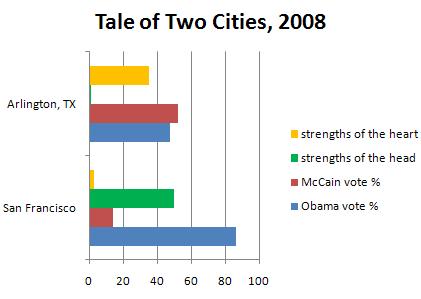
Nansook Park and Christopher Peterson ask people to rank themselves on a battery of strengths that are “intellectual and self-oriented” (such as curiosity, judgment, and appreciation of beauty) and a set of “strengths that are emotional and interpersonal” (such as love, prudence, bravery, and hope). They find substantial differences in the average scores on these scales among U.S. cities. They also find that city-level differences matter for several important outcomes.

An example is the 2008 presidential election. Cities that ranked themselves high on “strengths of the head” chose Barack Obama. Cities that prided themselves on “strengths of the heart” preferred John McCain. I illustrate that pattern with two examples, San Francisco and Arlington, TX. I give San Francisco a score of 50 for strengths of the head because it was top ranked in that category among the nation’s 50 largest cities. I give it a 3 for strengths of the heart because, in that category, it surpassed only Seattle and our own warm and friendly city of Boston. Arlington was virtually the mirror image. (Vote counts from here.)

Some caveats would be appropriate. These are self-reported scores, so they may measure the perceived value of the various strengths, rather than their real prevalence in each city. The sample is not random, although the authors argue that it is representative. The relationship between the two virtues and voting outcomes might not be causal; it could be explained by some third factor. (It is not, however, the case that a particular virtue–such as faith–is mainly responsible for the results; the authors check for that.)

Caveats aside, these results seem plausible. America has hard-driving, competitive, creative, and cerebral cities that like Democrats, and warm, friendly, emotional, and devout cities that prefer Republicans. People move to San Francisco, Seattle, and Boston if they think they can succeed in research, consulting, or the arts, and they surround themselves with neighbors who would gag before voting Republican. People move to El Paso, Mesa, and Fresno because they want friendly neighbors and church picnics. They don’t necessarily vote Republican (cities in general tilt leftward), but they are far more conservative than their peers in the cerebral cities.

The Republican Party is supposed to be committed to competition and individualism; the Democrats, to solidarity and care. Yet the very cities that are most competitive and individualistic are most enthusiastic about Democrats. Maybe a caring government seems more valuable in San Francisco and Boston than in Arlington, TX.