Author Archives: Peter Levine

why Dante is “good to think with”

The Cambridge philosopher Miles Burnyeat says that Plato is ?good to think with? (pdf, p. 20) I believe the same of Dante, which is why I chose to write a book about current moral issues by interpreting sections of the Divine Comedy. Like Plato?s dialogues, the Comedy is a concrete story in which abstract ideas appear as statements by embodied characters in specific historical circumstances, who attempt (to various degrees) to live by what they say. In both works, the question of irony arises. Plato is not Socrates, and Dante-the-poet is not Dante-the-pilgrim. It isn’t clear what the author thinks of his main character’s views.

It is not obvious why we should use old literary works to think about current moral issues, especially if the authors of those texts refused to say straightforwardly what they believed. However, the humanities are premised on the idea that we should ?think with? novels, dialogues, and other narratives.

Continue reading

reading and civics

It’s hard to modify the current regime for elementary education in America, which revolves around annual high-stakes tests in a few subjects. However, without changing the fundamental structure now in place, we could infuse civic ideas and values in reading education. In general, there is a remarkable lack of nonfiction in early reading texts. According to studies summarized in this article, nonfiction represented just 12 percent of the texts included in five major ?basal? reading series for first grade. “Furry-animal stories” dominate. A survey of 83 primary school teachers found that just 6 percent of the material discussed or used in their classrooms was factual.

However, students perform better on existing reading assessments if they have had practice reading in a variety of genres, including history, news, and science as well as fiction. Thus schools should incorporate more social studies into k-8 education as a strategy for complying with existing “No Child Left Behind” reading requirements. As a very important by-product of reading about George Washington, Rosa Parks, or Nelson Mandela, civic knowledge and skills should also increase.

who’s more powerful, Bill Gates or Kim Jong-il?

This is a silly question, except that it can prompt some serious thinking about the nature of power, the state versus the market, and monopoly.

Let’s say that “power” is the capacity to do things you want to do. Clearly, the Microsoft Chairman and “chief software architect” and the Chairman of North Korea’s National Defense Commission (also known as the country’s dictator) can each do things that the other cannot. Bill Gates can shape the daily experience of, I suppose, billions of human beings. He can influence the flow of global ideas and capital and the creation of new forms of culture. He can employ thousands, and fire any employees he chooses. He cannot, however, order people killed, turn Seoul into a “sea of fire,” or sell nuclear bombs to al-Qaeda that might incinerate Manhattan. Nor can he order people to listen to his six operas, or have a conspicuously weird sex life. Kim Jong-il can do all of the latter things, but he cannot travel freely or have a frank conversation with anyone–or make the North Korean economy prosper while maintaining a totalitarian state.

As Hellmut Lotz (a Maryland graduate student) notes, a dictator cannot retire. Once he loses control of the military and police, he cannot guarantee his own security. He is inevitably a threat to the successor regime, which may decide to destroy him–regardless of any deal he may have struck before exiting power. Augusto Pinochet is just the latest example of an ex-dictator who has paid a serious price for relinquishing control. In contrast, Bill Gates can step down at any time and retain any amount of wealth and influence he likes.

In a perfectly competitive market, Gates’ “power” would be very limited. He would have to produce software that people wanted to buy. He would be constantly maximizing his products’ popularity, at peril of losing his position on top of a publicly-traded corporation. Any discretion that Gates does enjoy results from Microsoft’s quasi-monopoly position. But his monopoly is insecure.

For his part, Kim Jong-il relies on all those guys with guns and bombs in the North Korean security apparatus. If they decide collectively to withdraw support, he’s dead. Fortunately for him, soldiers in a totalitarian regime cannot safely communicate–unlike investors and consumers in a free market.

Bill Gates was part of the “personal computer revolution,” which has certainly changed billions of people’s lives. However, it is not easy to estimate his personal contribution to that revolution. On one theory, he was the very clever (and lucky) guy who capitalized on an inevitable technological development by getting there first. This is not to minimize his intelligence, but it does suggest that he wasn’t very powerful. On the other hand, the discretionary decisions that Gates made early in Microsoft’s history have had enormous and perhaps irreversible affects on the precise way that software works today.

It’s easy to see that Microsoft has been on the side of history over the last 30 years, whereas North Korea is doomed. But that doesn’t by itself show that Bill Gates is more powerful than Kim Jong-il. We don’t say that a dinghy being swept to shore by a strong tide has more power than one battling to stay at sea.

the aesthetics of suburbs

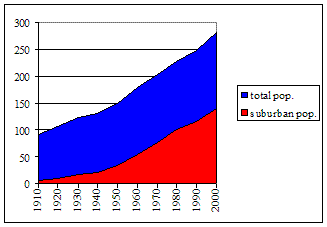
This post was prompted by a family weekend in some beautiful parts of northern Virginia?which necessitated a lot of travel through ugly northern Virginia suburbs. I’ve always been a city person, prone to disparage suburban life on political, ethical, environmental, and aesthetic grounds. However, I recognize some important counter-arguments. Suburbs are becoming increasingly diverse and integrated. As they have grown, they have developed sophisticated cultural institutions. Suburban landscapes may be ugly, but our cities aren?t all gleaming Manhattans, either. For every Telegraph Hill or Michigan Avenue, there are hundreds of square blocks of slums and ?brownfields? in our urban centers. Contrary to what I would have guessed, suburbanites (according to Robert Putnam) are slightly more involved in voluntary associations than urbanites are. In short, prejudice against suburbanites could be simple snobbery, closely related to the condescension that certain self-styled ?intellectuals? have traditionally felt toward the bourgeoisie. After all, 150 million Americans have voted with their feet by moving to, or remaining in, the suburbs. Since they know their own circumstances best, their choice demands respect.

But the fear of being charged with snobbery should not prevent us from grappling with aesthetic problems. The beauty (or ugliness) of our environment is important. And I maintain that suburbs are ugly, especially if one considers their relative affluence. A retail strip in Bethesda, MD may be more attractive than many blighted streets in the Southeast quadrant of Washington, DC. But residents of Bethesda occupy homes with a median market value of $396,000 (in 2000). Their median household income was above $99,000 that year. Compared to urbanites of the same wealth, they live in ugly surroundings. Strip malls are uglier than shopping streets. Suburban office parks are uglier than contiguous office buildings. Clusters of wires are uglier than buried ones. On-ramps are uglier than urban intersections. Ranch houses tend to be uglier than row houses. I think huge lawns are uglier than front yards. Big revolving signs for fast food restaurants are certainly uglier than shop fronts.

It?s important to recognize that the suburban landscape is very recent. More than 100 million people had to be housed in new communities in the space of 50 years. Maybe these encampments will look better once we have settled in. Maybe we?ll figure out ways to improve the look of the familiar combination of a wide road, grassy strip, parking lot, and cement-block store. Higher density may improve aesthetics, simply because all that wasted?cleared but vacant?land in the suburbs is ugly.

But we?ll have to overcome another kind of problem, too: a dynamic that discourages investment in suburban public spaces. In cities, private owners have motives to invest in the public appearance of their property: a shop-window, a fa?ade, or a lobby can be an efficient advertisement. Banks, hotels, and department stores are often major civic ornaments, constructed at private expense; but even traditional tenement houses had handsome cornices. The worst buildings in cities are often public ones: for example, housing ?projects? constructed by cheap authorities for the poorest residents.

In contrast, there is profound underinvestment in the outward appearance of suburban buildings. Even a fancy office park will often show basically blank walls to the outside. It is designed for the people in the offices. Visitors come by car and don?t need to be drawn in or impressed by the fa?ade. There are expensive suburban restaurants with ?designer? interiors that sit in completely undistinguished parking lots. The new arts center in Bethesda has received positive reviews for its glamorous architecture; but you can?t see the building from the nearby main road that carries probably 2,000 vehicles/hour at its peak. For all those ?passers-by,? the architecture means nothing.

I suspect that this underinvestment is partly a function of low density. It usually doesn?t pay in a suburb to use architecture and landscaping as advertisements?especially when people zoom past in cars. Another cause of the problem may be rapid growth. If everything around your building looks ugly and temporary, then it doesn?t pay to try to improve the landscape by investing in the small piece of it that you own. Third, suburbs compete madly for new construction, and they can?t regulate aesthetics without simply losing development to the next jurisdiction. Finally, it may be individualism that explains both the migration to the ?crabgrass frontier? and the failure, once there, to invest in public spaces.

service instead of politics? blame Clinton

When trying to explain trends in civic participation, we shouldn’t overlook major political events and how they influence ideological groups.

When I was in college, in the late 1980s, I played a very small role in national discussions about how to increase opportunities for service. These discussions helped lay the groundwork for the Points of Light Foundation and then the Corporation for National and Community Service. Most of the young people in those discussions were left-liberals. For us, service seemed useful because it might sensitize people to problems like poverty and racism and lead to political action. However, service would be harmful, we thought, if it became an end in itself or a palliative. These were the explicit conclusions of a Wingspread retreat on service that I attended in 1988.

Thirteen years later, in 2001, Campus Compact brought a new group of college students to Wingspread to discuss civic engagement. These students said:

For the most part, we are frustrated with conventional politics, viewing it as inaccessible. [However,] while we are disillusioned with conventional politics (and therefore most forms of political activity), we are deeply involved in civic issues through non-traditional forms of engagement. We are neither apathetic nor disengaged. In fact, what many perceive as disengagement may actually be a conscious choice; for example, a few of us ? actively avoided voting, not wanting to participate in what some of us view as a deeply flawed electoral process. ? While we still hope to be able to participate in our political system effectively through traditional means, service is a viable and preferable (if not superior) alternative at this time.

I suspect that there was one major reason for the change in attitudes toward service among left-liberal youth: the Clinton Administration. In 1988, most young proponents of civic engagement, having grown up under Reagan, believed that a Democratic electoral victory was much more important than any form of direct service. In 2001, having experienced a Democratic presidency, idealistic young liberals were highly skeptical of government and politics as paths to social change. Note that a similar pattern of mobilization and disillusionment could easily affect conservative youth under different political circumstances.

The title of this post is basically facetious, since I think that the Clinton Administration was at least partly successful. But a Democratic president had much less impact than left-liberal college students would have hoped, ca. 1988. And disappointment can be very demobolizing.