This site is really under attack today. In addition to the scores of spurious “trackback pings” than I’ve been receiving every day, an organization has now posted more than 200 comments that are really advertisements for its product. Their software puts no more than one comment on each of my posts, so that I must open up more than 200 separate records and painstakingly remove each ad. Their spam software uses a different, fake IP address each time so that I can’t block it from posting. Instead of writing something substantive, I’ve been trying to clean up the site and have also inquired about changing my software. I hope to be back in business tomorrow, but I may have to delay blogging until I can solve this problem. (Someone who can spam me 200 times in six hours can spam me 2,000 times and do me in.) Isn’t interactivity great?
Author Archives: Peter Levine
the computer as a metaphor for the brain
Last Friday, some colleagues and I discussed a very strong paper by Joe Oppenheimer et al. that bridged rational choice theory and cognitive psychology. The authors of the paper (and the texts they quoted) said that memories are “stored,” “linked,” “tagged,” “called up,” and “retrieved” by the brain. These metaphors have come originally from various domains of human activity. (I suppose that shopkeepers store things, dogs retrieve things, and archaeologists tag things–to name just a few uses). However, the proximate source for all these words, obviously, is computer programming. Without thinking twice about it, we use the computer as an analogy for the human brain. This analogy can be illuminating, but we must be careful to remember that it is not literal. Brains are like today’s computers in some respects, but not in many others. It struck me that in John Locke’s day, the main metaphor for the brain was painting: i.e., representation of sense-data on flat surfaces. Painting was a very advanced technology in 1700–better than it is today. But it was an imperfect metaphor for cognition, and so is computing in our era.
tolerance & generational change
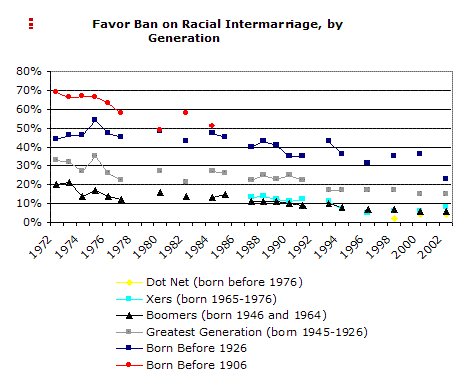 Yesterday, CIRCLE released a detailed report (pdf) on the evolution of young people’s attitudes toward racial minorities, immigrants, and gays. The report finds substantial increases in tolerance, although not much increase in actual interactions among racial groups. My favorite graph is the one on the right. It’s a perfect illustration of Karl Mannheim’s theory of generations, which holds that our political values are permanently shaped by our experiences as young adults. Why have Americans become increasingly favorable toward interracial marriage since the 1960s? Not because many individuals have changed their minds over their lifetimes, but because each generation has come of age in a more tolerant era and remained at a consistent level of support. The underlying theory is that we are forced to make up our minds about major questions when we first encounter them. Thereafter, changing one’s opinion takes a lot of effort, so we rarely do so. Those who first considered the issue of interracial marriage in 1930 are permanently different from those who first heard of it in 1980. (Incidentally, this pattern is good news, because it suggests that tolerance will rise inexorably as today’s young people predominate in the population.)
civic education: the case for smaller schools
The nation’s governors met this weekend to discuss high school reform. They identified real problems, including a high-school completion rate of only about 70% and a set of curricula and standards that obviously aren’t working. But their conversation apparently focused on preparing students for work and college–not citizenship. They called for regular standardized testing rather than reform of schools themselves. I was hoping for more emphasis on school size, which is a signature issue of the Bill and Melinda Gates Foundation. Bill Gates himself addressed the governors and said:
The three R?s [rigor, relevance, and relationships] are almost always easier to promote in smaller high schools. The smaller size gives teachers and staff the chance to create an environment where students achieve at a higher level and rarely fall through the cracks. Students in smaller schools are more motivated, have higher attendance rates, feel safer, and graduate and attend college in higher numbers.
He was right, but the governors mainly focused their attention on standards and accountability.
 The average size of American primary and secondary schools increased four-fold between 1940 and 1965, from 100 to more than 400 (see this pdf, p. 26). Toward the end of that period (1959), James Conant identified small high schools as the single biggest problem in American education. He argued that they were economically inefficient, unprofessional, and unable to provide a wide range of equipment and specialized teachers. In addition to these arguments, other factors probably contributed to massive school consolidation in that era, including a tendency to close down historically black schools under court desegregation orders (not to mention the desire to field better football teams).
The result was the creation of very large schools, especially high schools, in which students were seen as consumers who should be permitted to choose among a wide variety of offerings (curricular and extracurricular) provided by specialists. Students were presumed to have diverse interests and abilities. Thus it was right that some should choose student government and AP courses while others preferred “shop” and basketball.
If we hope to create effective, committed, and responsible citizens, huge schools have several marked disadvantages. Relatively few students–mostly ones who are already on a successful track–can possibly participate in the extracurricular activities, such as school government and scholastic journalism, that seem most likely to teach civic skills. Students in large schools tend to self-select into cliques and can avoid interacting with those different from themselves. Parents and other adults in the community have little impact on these large, bureaucratic institutions; so schools are rarely models of community problem-solving or active citizenship, nor can they create paths to participation in the broader world. We know that students who feel that they can have an impact on the governance of their own schools tend to be efficacious and interested in public affairs; but it is impossible for anyone to influence the overall atmosphere and structure of a huge school that is organized around private choice.
Finally, young people become victims of their own choices. You can pick up civic skills (as well as other ones) if you attend a school with a wide range of offerings and equipment and you elect to take the honors classes and work on the school newspaper. But those assets are of no use unless you have the confidence, motivation, networks ties, and knowledge to use them. In a huge high school, there is little chance that any adult will try to steer a student who is on a mediocre track onto a more challenging one. Twenty years later, the student who chose easy courses and avoided clubs may still be paying a price, economically as well as socially and politically.
“trackback spam” (an ethical dilemma)
Blogs originally formed a “commons,” even according to a narrow and technical definition of that term. They were always privately owned, of course. I’m the only person who can post here, because I pay the $9.95 monthly fee. However, the whole array of blogs, the “blogosphere,” originally had an un-owned feel. That was because you could visit any site you liked, and any blogger could link to anyone else. The blogs with the most incoming links were the easiest to find through search engines. Therefore, prominence was difficult to buy; it resulted from others’ “gifts” of links. Most blogs also permitted visitors to post their own ideas in the “comments” field, thus opening up space for free discussion. Finally, the clever “trackbacks” feature notified bloggers when their posts were discussed on other blogs. For example, when another site links to mine, it often sends a “trackback ping” to let me know; that site is then automatically listed here (under “links to this specific post”) so that you can see who has written something in response to me.
In short, the network of interlinked blogs belonged to no one, it was unaffected by money, and it was open to newcomers. In all these respects, it was a commons.
All commons are fragile. One form of the “tragedy of the commons” is pollution.