Author Archives: Peter Levine

the youth “lifeworld”

Before we try to engage young people in politics and civic life, it’s important to understand their day-to-day concerns, habits, and background assumptions–what Lew Friedland calls their “lifeworld.” As a start, consider the following data from the Reboot survey that I mentioned yesterday (pdf; go to p. 19). Americans between the ages of 18 and 25 said that they were “very worried” about the following issues:

getting a sexually transmitted disease 35%
your grades at school 26%
finding a job when you get out of school 23%
maintaining good relationships with your friends 19%
getting along with your parents 18%
your relationship with God 18%
deciding who to vote for 15%
making sure you are contributing to your community 11%
finding a spouse 7%
finding a girlfriend or boyfriend 4%

I was not surprised to find voting and contributing to the community pretty far down the list. (By the way, people probably overstated their concern for these matters because they know that they should care about them.) I was somewhat surprised to see the risk of STDs at the very top of the survey, and finding a girlfriend or boyfriend at the very bottom. I think my age cohort would have reversed that ordering, even though we came of age after AIDS.

using campaign money for relatives

As most American readers know by now, the New York Times reported last week that House Majority Leader Tom DeLay has paid $500,000 of his campaign money to his wife and daughter since 2001. DeLay responded angrily to the Times report, noting that other Members of Congress (including two prominent Democrats) have also put relatives on their campaign payrolls. He accused the Times of personally attacking him for ideological reasons.

Indeed, the DeLay case is symptomatic of a broader, bipartisan problem (although that does not excuse the Majority Leader, whose half-a-million-dollar payment dwarfed the other nepotistic arrangements cited in the press). Congress has closed most opportunities to give things of value to elected officials, on the ground that donors might use gifts to buy influence. Under the Buckley v Valeo Supreme Court decision, we don’t have a constitutional right to give money to politicians. However, under Buckley, we do have a right to give money to political campaigns. Electioneering is understood as a form of communication, as “speech.” Thus paying for elections is covered by the First Amendment. Congress may limit the size of campaign donations, but may not ban them altogether.

The underlying theory of Buckley implies that candidates may use donations to campaign, but not for their personal enrichment. However, most incumbent Members of the House are safe in most elections. Therefore, they are not forced by competition to spend their money efficiently on electioneering. It is hard to know how the average incumbent spends his or her money, since spending reports are not combined into one dataset that can be analyzed easily. But when reporters from the LA Times aggregated all the expenditure reports in 1992, they found that House candidates spent only 27 percent of their funds on broadcast advertising, and another quarter on other forms of campaigning (such as direct mail and canvassing). They used most of their money for activities that benefited them without advancing their campaigns: lavish travel budgets, nice offices, meals, payrolls. Thus large campaign donations made politicians’ lives more comfortable; they did not purchase “speech.”

Mr. DeLay’s contracts with his wife and daughter fit that pattern. They were campaign expenditures, thus protected as free speech under Buckley, yet their sheer size suggests that personal enrichment was a motive. The legal question becomes whether the payments so far exceeded market value that they did not represent “campaigning” at all.

Along with many other people, I feel that the Court erred in Buckley by equating “speech” with money. I would have no constitutional objection if all campaign contributions were banned. However, I don’t think that reducing–or even prohibiting–private contributions would fix the system, because wealthy interests would simply pay for their own advertising, canvassing, and other forms of campaigning. Banning independent expression is impossible if we have free speech. For instance, my blog might conceivably help or hurt a candidate, and then it would represent an “independent campaign expenditure.” But regulating my blog would violate my First Amendment rights. Thus, in my view, the only real solution is to provide free forms of communication (such as advertising time, televised debates, and mailings) that become important parts of campaigns. These free opportunities would be equally distributed to challengers and incumbents; they would be untainted by private interests; and they would be genuine “speech” rather than lifestyle-enhancements for politicians.
exemplary civic projects

Within the last week, I’ve heard about two excellent projects. They each deserve a full post, but they also go so nicely together that I’ll mention both here:

Citizen Joe is a website that provides substantive, ideologically balanced introductions to policy debates. It offers “weekly updates on the major bills being voted on in Congress,” “guides to key policy issues with facts and a balanced pro & con,” and “facts on over fifty policy areas with recommended links for readers who want to find out more.” There is also a short, basic guide to civic engagement. I looked carefully at the subject areas that I’m supposed to know something about, such as education policy, and I found the guides accurate, balanced, and up-to-date. However, what’s really impressive about this site is its origin. A band of volunteers have created it through their own free labor. At a time when the policy debate is fractured and shrill and the mass media typically neglect to explain basic matters of substance, it’s great to see a few citizens work together to educate themselves and the public.

Orange Band is a student-organized project that has reached about 6,000 people so far. Organizers distribute “4×18 inch strips of orange fabric” to fellow students. Those who accept a strip write the name of an issue on it, thereby signalling their willingness to discuss that issue with people they meet. Many students wear the strips on a single campus, creating an impression of a community that is open to discussion. Orange Band also organizes educational forums on issues, with “with speakers, panelists, and video showings.”

Democrats on government waste

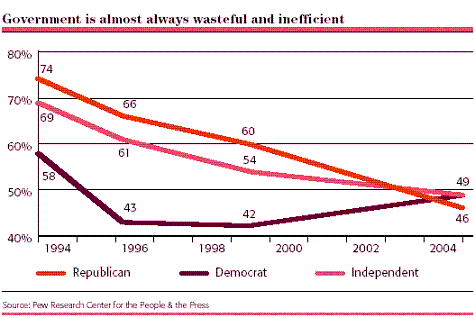
This is a fascinating chart from the Pew Research Center’s “Trends” report.

Once upon a time, a Democrat was someone who believed that most existing government programs were worthwhile. A Republican was someone who thought that most government programs were a waste of money. There is now no difference between the parties on this question, although Democrats are slightly more likely to view federal programs as wasteful.

I suspect that Republican voters became more positive about government after the Clinton-era welfare reform, which ended the traditional federal subsidy to poor women with children. Perhaps they became even more positive once their party ran the government, and the most conspicuous federal programs became the “war on terror” and the invasion of Iraq (plus Social Security and Medicare)–all of which they support.

Conversely, Democratic voters don’t like the administration’s foreign policy adventures or the people in charge of them, and that may be part of the reason that they see government as wasteful. But here’s an additional hypothesis that would help explain the current weakness of the left. Many Democrats have come to see existing government programs–including welfare, education, health, and housing initiatives–as wasteful. This suspicion has a profound effect on politics; it means that a Democratic candidate cannot whole-heartedly or passionately advocate a different position from the Republicans’. Even his or her core constituency doesn’t believe that government programs really get good results. The best that Democrats can do is what Kerry did in ’04: talk vaguely about the need for health care reform, knowing pretty well than any particular legislation is dead on arrival. All that’s left is the ethical commitment to universal health insurance without any confidence that it can be achieved.

I see two main responses: (1) Democrats and liberals are simply demoralized, led into pessimism and cyncism by years of anti-state propaganda. They need to snap out of it–not just the leadership, but also the voters. Or (2) existing federal programs have a record of wastefulness and damage that has become too hard to ignore. We just can’t overlook farm subisidies, huge prisons, urban neighborhoods bulldozed by HUD, and even large school systems like the one my kid is in, with high per-pupil spending but insufficient money trickling down to classrooms. Furthermore, no one has shown us how federal money might solve problems like rust-belt unemployment, high crime and incarceration, or global poverty.

If (2) is true, the Democrats aren’t going anywhere until they develop bold and persuasive plans for reforming government.