Author Archives: Peter Levine

deliberative democracy in the Wikipedia

Most readers of a blog will know what the Wikipedia is. For those who don’t, it’s an extraordinary encyclopedia whose entries are written by anyone who wants to participate. There are no editors–just peer editing by the millions of people who visit. The quality is quite high and it’s a model of a certain kind of deliberation.

Until this weekend, the Wikipedia’s entry on “deliberative democracy” contained this paragraph:

It is usually associated with left-wing politics and often recognizes a conflict of interest between the citizen participating, those affected or victimized by the process being undertaken, and the group-entity that organizes the decision. Thus it usually involves an extensive outreach effort to include marginalized, isolated, ignored groups in decisions, and to extensively document dissent, grounds for dissent, and future predictions of consequences of actions. It focuses as much on the process as the results. In this form it is a complete theory of civics.

The Green Party of the United States refers to its particular proposals for grassroots democracy and electoral reform by this name.

I disagree with this slant on deliberation and consider it potentially damaging. In fact, I’ve heard of a situation in Oklahoma in which some people were trying to organize a deliberative event and encountered opposition from residents who had Googled “deliberative democracy” and found the paragraphs quoted above about left-wingers and Greens. Therefore, I added the following to the Wiki entry:

On the other hand, many practitioners of deliberative democracy attempt to be as neutral and open-ended as possible, inviting (or even randomly selecting) people who represent a wide range of views and providing them with balanced materials to guide their discussions. Examples include National Issues Forums, Study Circles, Deliberative Polls, and the 21st-Century Town meetings convened by AmericaSPEAKS, among others. In these cases, deliberative democracy is not connected to left-wing politics but is intended to create a conversation among people of different philosophies and beliefs.

This was my first foray into the Wikipedia, and I decided to be respectful of the existing text. If you think the page should be written differently, click over there and edit away.
walking backwards

Ever since I was about eight years old, my routine has always included frequent walks. Even now, my daily commute involves about 50 minutes of walking as well as a Metro ride. The time that I spend alone on the sidewalks of Washington and Maryland seems continuous with the walks that I started as early as 1975. Personal identity is nothing but a story we tell ourselves; we select a few instances from the countless events of our past and make them definitive of an “I” that is, in reality, less distinctive, consistent, and separate from its context than we like to believe. As I tell myself a story about my self, I can find no deeper continuity than the series of walks I have taken since childhood and the meandering thoughts that have accompanied them.

As I grew up, my family mainly alternated between Syracuse, NY and London. I think I first walked alone frequently in Syracuse, going to school (often with friends but sometimes on my own) or strolling in the neighborhood. And what did I think about as I walked on those steep sidewalks cracked by old roots, past hippy group houses or the Arts-and-Crafts bungalows of faculty families–or between high heaps of dog-stained Syracuse snow? Mostly fantasies of adventure, I think. I also puzzled through questions of history and politics, addressing that silent inner student whom I suspect we all use as our primary audience.

Continue reading

Justice O’Connor

At last week’s Steering Committee meeting of the Campaign for the Civic Mission of Schools, we were honored by a visit from Justice Sandra Day O’Connor. I don’t want to quote the Justice verbatim, because I’m not sure if what she said was meant to be on the record. However, she spoke eloquently about the importance of civic education and youth civic engagement.

Several members of the Steering Committee argued for an experiential approach to civics. They said that we should help young people to play significant roles in their communities right now, and not wait until they become adults. The Justice seemed very supportive and even recalled her own experience in high school. She said that she was afraid and alienated there until she became part of extracurricular organizations.

She stayed with us for more than 90 minutes and asked probing questions. She was much gentler than she might be in oral argument at the Supreme Court, but much tougher and more acute than one would expect from a mere courtesy visit. She wanted to know what was working and what chance we had of succeeding with our advocacy campaign if we employed various strategies. I think she’s completely serious about this topic and ready to add her very powerful voice to the movement for youth civic engagement.

a new map of civic renewal

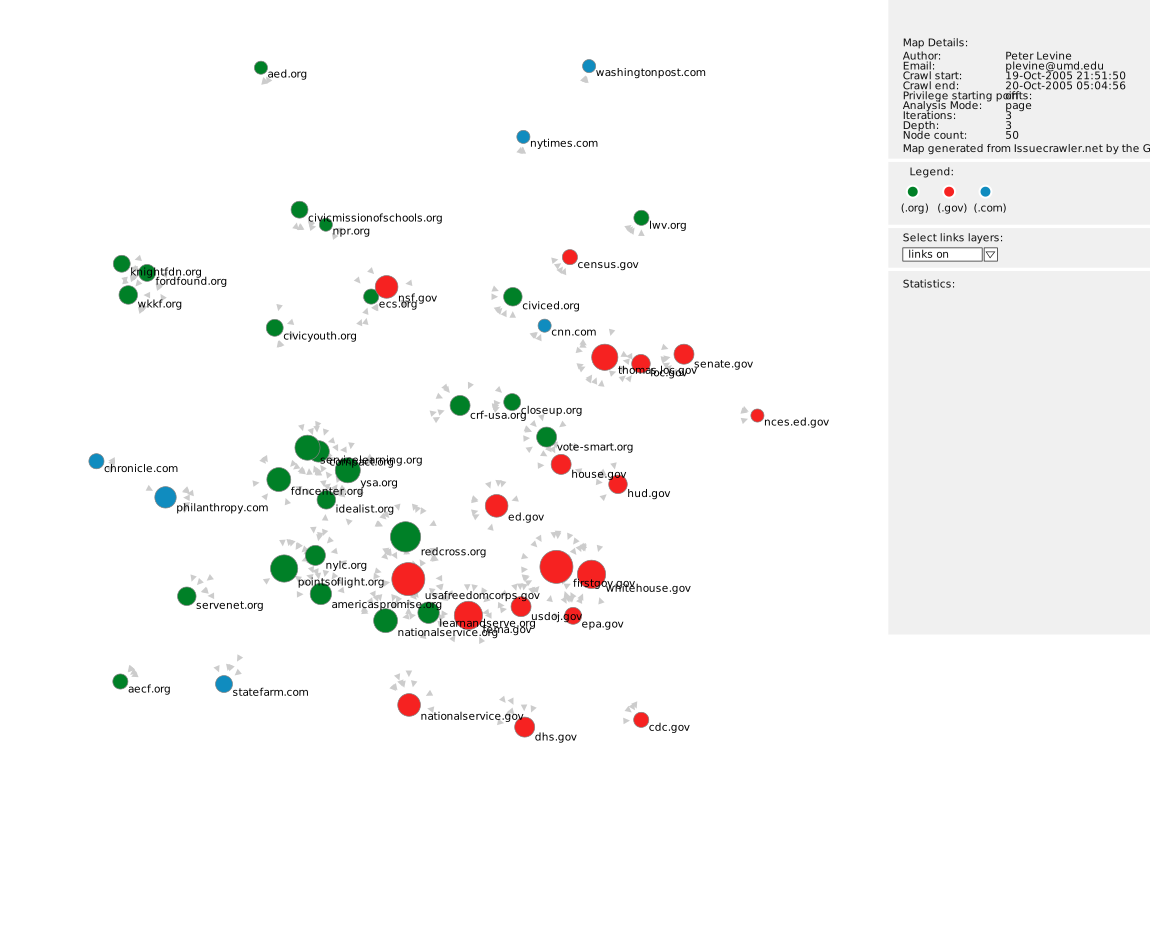
Several times before, I have made “maps” of the civic renewal movement, using software to diagram the links among websites in the civic field. (See this effort and then this one.) Web links are not reliable evidence of collaboration. However, people create links because they consider another site interesting or important, and that means something. Network-mapping software starts with a short list of sites that you provide as examples of a field or movement. The software analyzes web links among those sites and clusters them together depending on how closely they are interlinked. It also finds other sites that have many links to the ones you started with, and adds them to the map. By examining the final product, you can draw some inferences about what organizations belong in a field, which ones are central or peripheral, and where gaps exist.

I previously used TouchGraph’s GoogleBrowser, which is cool and easy. This week, however, I tried again with IssueCrawler from the Govcom.org Foundation in Amsterdam. IssueCrawler is more sophisticated and flexible. After “crawling” hundreds of linked sites, it generated a cluster map of civic renewal and a circle map of civic renewal. The cluster map is best for showing which organizations are central. The circle map shows the density of links within the network: a very dense community would look like a ball of thread. (Note: You may need to install a browser plug-in to view these .svg files: you can get it here.)

Overall, the cluster map shows a set of youth engagement and volunteering organizations that are linked, on one side, to foundations (which fund them) and on the other to government agencies (because they link to official information and interact with the state). A few commercial news sites also appear.

Alas, I forgot to save a list of my initial nodes. However, I’m sure that I started with sites that represented deliberative democracy, community economic development, civic education, and voluntary service. Among the good sites that disappeared from the analysis were the Civic Practices Network and the Pew Partnership for Civic Change. This doesn’t show that these sites are unimportant; only that they don’t connect to the world of civic education and community service that the computer decided was central.

I’m not terribly impressed by the product of this particular IssueCrawler search, although it may show that the civic renewal field is less unified than I had previously thought. If the maps mean anything, they indicate that the world of youth civic education and service is unconnected to deliberative democracy and community development–and that would be bad news if true. In any case, the software is useful and powerful, and I want to learn to use it better.

network organizations

Today and yesterday, I’m participating in steering committee meetings ofthe Deliberative Democracy Consortium. Tomorrow, I’ll be chairing the steering committee of the Campaign for the Civic Mission of Schools. I also participate in three or four other organizations that have similar forms. They all have small paid staffs that are funded by grants from foundations. Individuals and ex officio representatives of nonprofit groups serve on their steering committees and do quite a lot of the work, on a voluntary basis.

I love this kind of organization and donate, I suppose, thousands of hours per year to them in the aggregate. They have great potential. They also face some characteristic challenges, including:

  • competition for limited funds between the staff of each network organization and its various members
  • unclear lines of authority, since the staff are accountable to the funders, but they are also expected to be “steered” by their steering committees
  • unequal and sometimes sporadic contributions of voluntary effort from steering committee members
  • a tradeoff between trying to create a “big tent” and pursuing a focused agenda
  • A combination of these challenges has made the National Alliance for Civic Education, which I helped to found, basically moribund. The groups I’m meeting with this week are in pretty good shape, as are Imagining America and the umbrella organizations in service-learning. All these organizations need to learn how to use new technologies to get more people involved in doing their work; and they all need to expand their revenue sources so as to diminish competition for funds. But it may be that the challenges that these groups face are perennial, and that’s why civil society is constantly “churning”–generating new networks while others fall apart.